

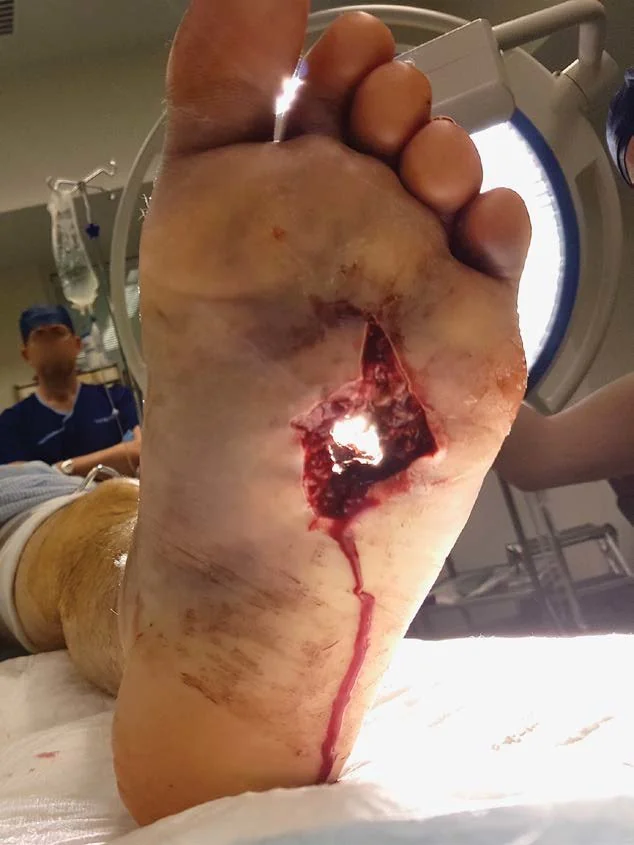
A 69-year-old man presented with a through-and-through left foot gunshot wound (Fig. 1). The patient was kangaroo hunting when he accidentally shot himself with a 0.222 caliber rifle and hollow point bullet. The patient drove himself home before presenting to the emergency department. A 1cm entry wound on the dorsum of the foot was noted, with a 5cm exit wound on the plantar aspect. There was gross contamination, poor perfusion of the fourth and fifth toes, and reduced plantar sensation. His medical history included atrial fibrillation, treated with dabigatran, digoxin, and verapamil. His baseline gait was mildly abnormal, secondary to a right femur fracture over 40 years ago.
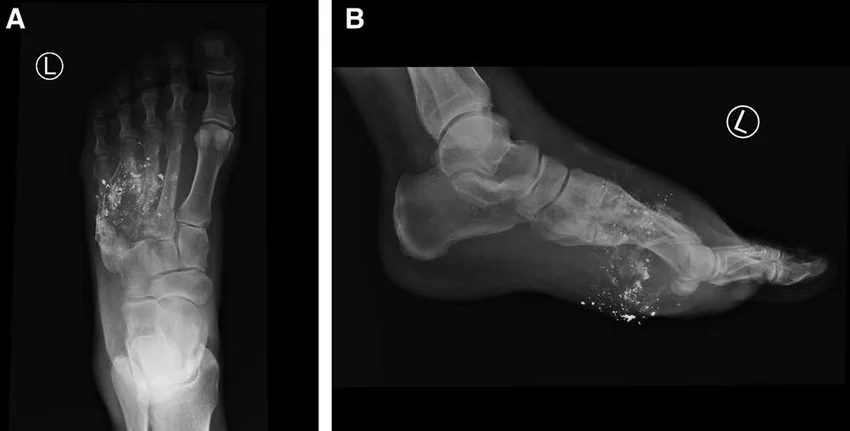
X-ray and computed tomography revealed comminuted fractures of the third, fourth, and fifth metatarsals, with bone loss and multiple foreign bodies (Fig. 2a, 2b). Immediate excisional debridement was performed, with a second look 48 hours later. Negative-pressure wound therapy was applied after the first and second debridement.
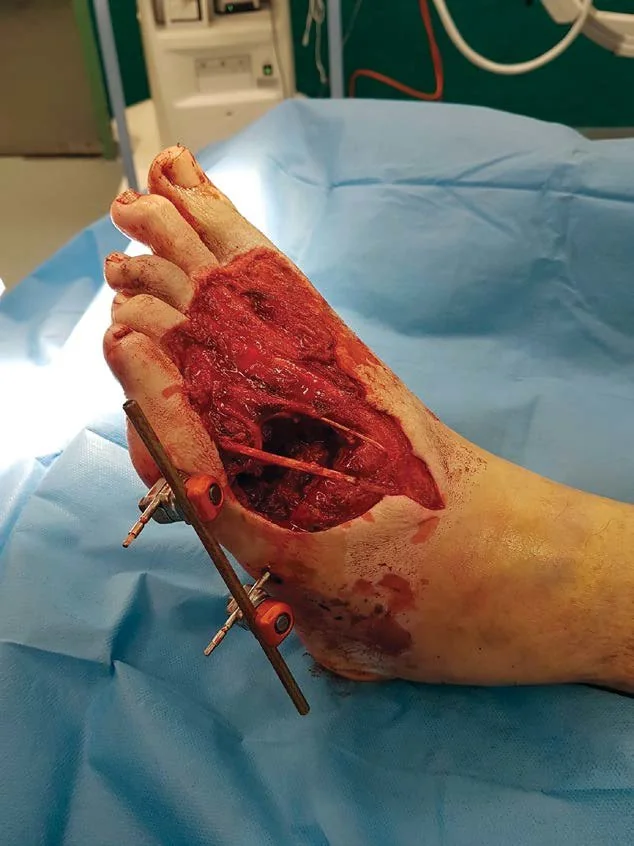
Five days later, a retrograde 1.6mm Kirschner wire was used for fixation of the second metatarsal fracture, pre-serving the medial plantar arch (Fig. 3). Due to extensive bone loss, an external fixator (Hoffman II-Compact; Stryker, Michigan, USA) was utilized for the fifth metatarsal fracture, preserving the lateral plantar arch, with plans for a secondary vascularized bone graft once adequate soft tissue coverage was achieved. An ipsilateral free gracilis muscle flap was harvested and tunneled through the wound. A split-thickness skin graft was applied to the dorsal and plantar areas of muscle. End-to-end microanastomosis was performed to the anterior tibial artery and vena comitans.
The patient's postoperative course was uncomplicated. The flap remained well-perfused, and there was 100% take of the dorsal and plantar split-thickness grafts. The external fixator was removed after 10 weeks.
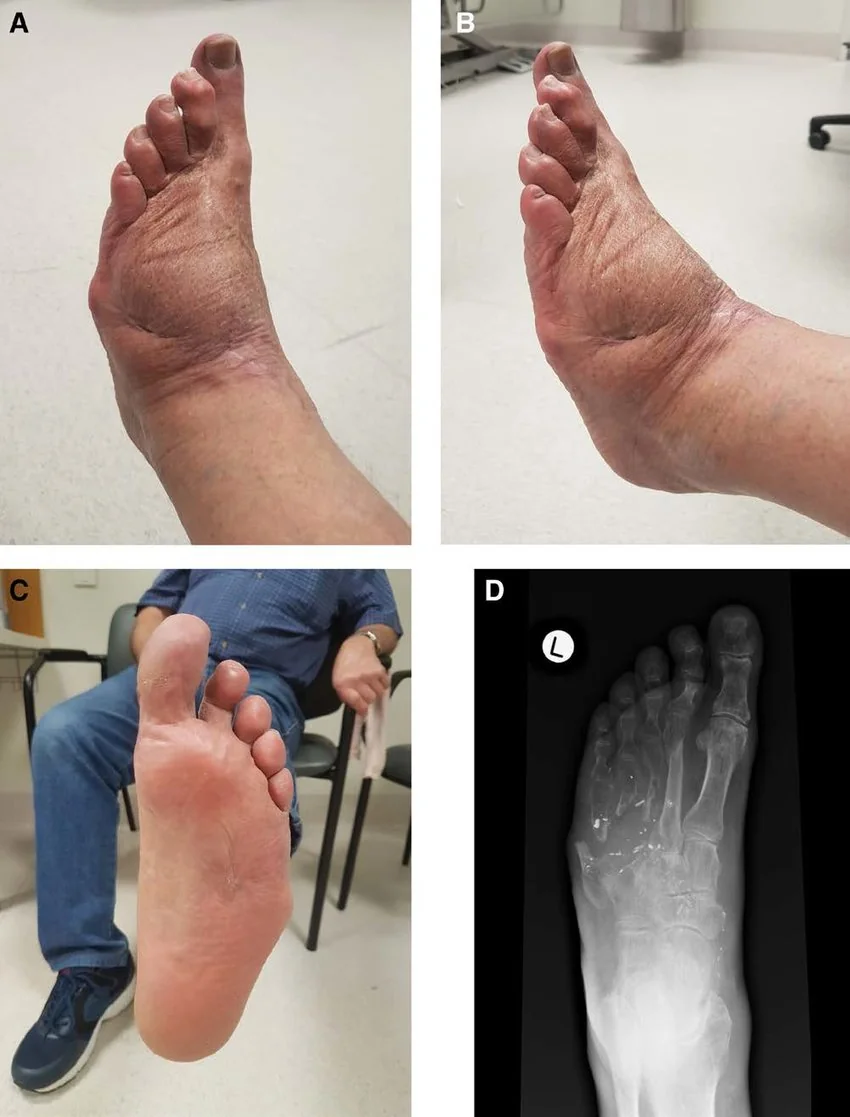
Although initially planned, secondary bone grafting was eventually not required. The gracilis flap, presumably through secondary muscle fibrosis, provided adequate skeletal support. Partial weight-bearing was commenced at 11 weeks, and by 4 months, the patient had returned to his baseline gait. The flap continued to shrink, achieving excellent contour (Fig. 4a, 4b, 4c). X-ray at 7 months revealed osteopenia of the third, fourth, and fifth metatarsals and no new bone formation Fig. 4d. His has since returned to activities of daily living and is able to fit into normal footwear (See Video, [online], in which, nine months postoperatively, the patient was able to return to use of regular footwear, as well as normal ambulation and baseline gait).
DISCUSSION
The foot serves as a dynamic platform on which posture is maintained. Although advances in microsurgery have allowed for foot reconstruction utilizing free tissue transfer, a through-and-through gunshot wound remains a challenge for the reconstructive surgeon. The severity of injury is influenced by the target distance, firearm, and 3 PRS Global Open • 2019 type of ammunition.5
This injury, involving a 0.222 caliber rifle with a hollow point bullet, created a high-velocity, blast-type injury with significant bone and soft tissue destruction. Free flap selection is based on several factors, including wound surface area, type and volume of tissue deficiency, donor site morbidity, vascular pedicle length, and anticipated cosmetic outcomes.6 The rectus abdominis and latissimus dorsi muscles, with their long and prominent pedicle vessels, are common sources of free tissue transfer for lower limb salvage7; however, debulking is often required to allow for footwear and efficient ambulation.4
Furthermore, these donor sites are commonly associated with delayed healing, seroma, suboptimal scarring, and reduced function.6 It can be challenging to simultaneously optimize soft tissue coverage along with foot contour and weight-bearing,3,8 and the use of the free gracilis muscle appears to circumvent this.
The gracilis muscle, with its long, slender shape, makes an excellent choice for soft tissue reconstruction of small- to medium-size areas,9 especially where flap tunneling is required. Furthermore, it can be harvested with minimal donor site morbidity,3 allowing early ambulation. A through-and-through gunshot wound to the foot can have devastating effects for the patient. Below-knee amputation is often a preferable option to achieve quicker wound healing, ambulation, and return to work.2 Rigid skeletal support is thought to be essential prior to full weight-bearing, and bone grafting is often utilized. This case suggests that the gracilis free flap can fill the typically deep but narrow wound, offering skeletal support, thus eliminating the need for secondary bone grafting.3 4
This case suggests that a free gracilis muscle transfer serves as a valuable reconstructive option, especially for throughand-through gunshot wounds to the foot. The free gracilis flap may also eliminate the need for secondary bone grafting, while providing a satisfactory reconstructive outcome, with restoration of contour, skeletal support, and function. Brittany Georgia Kay Department of Plastic & Reconstructive Surgery Royal Hobart Hospital 48 Liverpool St Hobart, Tasmania, 7000, Australia E-mail: [email protected]