A short article exploring how mixing different mechanics can create unique gameplay experiences.
Storytelling in a game is incredibly important to me both as a player and game designer. I'm afraid if a game isn't 'telling a story' of some description, then I'm a lot less interested. Apologies to 'abstract' game fans, but they are really not for me.
So, let's define 'storytelling' in a game as 'an immersive experience that has, like a story, a start, middle and end, includes character progression and growth, along with important decisions made by the player that can affect the outcome'.
A lot of 'storytelling' can be implicit if playing a game based on a famous TV show, film or book - such as 'Star Wars' 'Lord of the Rings' or 'Doctor Who'. The fact that you're using familiar images and tropes such as the Force, Sauron, the Daleks or the TARDIS, give a player an immediate 'hook' for the game, as you join Luke Skywalker, Frodo Baggins or the Doctor in their incredible adventures.
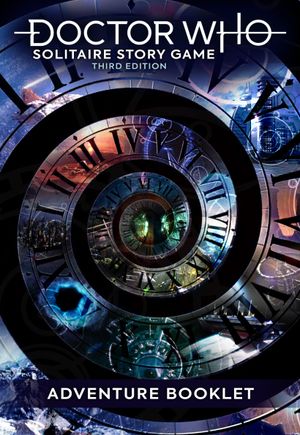
Now I love these IPs and have created a lot of games that illustrate my love for them, along with a storytelling narrative. My biggest project was (and still is - I haven't finished with it yet) DWSSG or 'Doctor Who Solitaire Storytelling Game. I mean, it even has the word 'storytelling in the title!
So how can game mechanics can support narrative and storytelling.
And my answer, simply, is STRUCTURE.
My game project for 2025 was Star Trek: Adventures in the Final Frontier' or STAFF. In it, a solo player chooses an Affiliation from the Star Trek universe, such as the Federation, Klingons and Romulans. Of course, these Affiliations are completely different in their outlook and aims which should be reflected in gameplay mechanics.
To win the game, a player must complete Missions. But the Missions of diplomacy and exploration for the Federation should be different from that of the covert subterfuge of the Romulans. So, the first narrative mechanic is to have the Affiliations complete different Missions.
Each Mission should have different dilemmas or challenges to overcome. But these should not be just randomly assigned, but carefully chosen so that they reflect the theme of the Mission. Convincing an alien diplomat is great in Diplomacy Missions. Sabotaging the warp core of a commandeered ship is great in Covert Missions. But not so much the other way around. So the second narrative mechanic is to structure the Challenges faced by the player to match the theme of the Mission.
A Mission will gain you points and a player needs 120 points to win. But isn't a 'point salad' victory a bit dull? Let's add another narrative mechanic that links to the Affiliation, called 'Objective Tokens'. There are 6 types of Token available - Exploration, Military, Diplomatic, Research, Profit and Covert. A player must choose 5 Tokens to obtain during the game (by completing tasks on Objective cards). BUT, let's make the choice narrower depending on the Affiliation you're playing. A Klingon player must have at least 3 Military Tokens to win because of their battle-orientated culture. The Federation must have 1 Exploration, 1 Diplomatic and 1 Research and can choose 2 more. The Ferengi Affiliation needs 3 Profit, and so on.
In DWSSG, I've employed the same kind of narrative mechanics too. There are a great number of 'adventure types' and places for the Doctor to explore and certain enemies fit in better in some than in others. For example, Doctor Who on television loves a sleepy English village to explore. In DWSSG, the type of Enemy you can encounter at such an adventure is skewed to 'Gothic' types such as the Weeping Angels. This mechanic gives better narrative structure.
In DWSSG too, I've split all adventures into 3 phases which mirror a typical episode - Discover (who the Enemy is), Dilemma (find out their goal), and Defeat (overcome the Enemy). This mechanic means that an adventure in DWSSG mirrors a ‘Doctor Who’ episode pretty well and increases the storytelling of the game 100%.
Any opinions on the topic that's so close to my gaming heart are most welcome and I look forward to hearing any views...