

In December of last year, Steen and colleagues published a review on saturated fat in relation to cholesterol, cardiovascular disease, and mortality.
They concluded the following:
For persons at low cardiovascular risk, reducing or modifying saturated fat intake has little or no benefit over a period of 5 years. Among persons at high cardiovascular risk, low- to moderate-certainty evidence was found for important reductions in mortality and major cardiovascular events, particularly for MI, with respect to replacing saturated fat with polyunsaturated fat.
So, for those at low cardiovascular risk, reducing saturated fat intake had "little or no benefit." But, for those at high cardiovascular risk, reducing saturated fat appeared to be an effective and worthwhile intervention.
However, the certainty of evidence was rated as "low" for most endpoints in their main (non-subgroup) analyses.
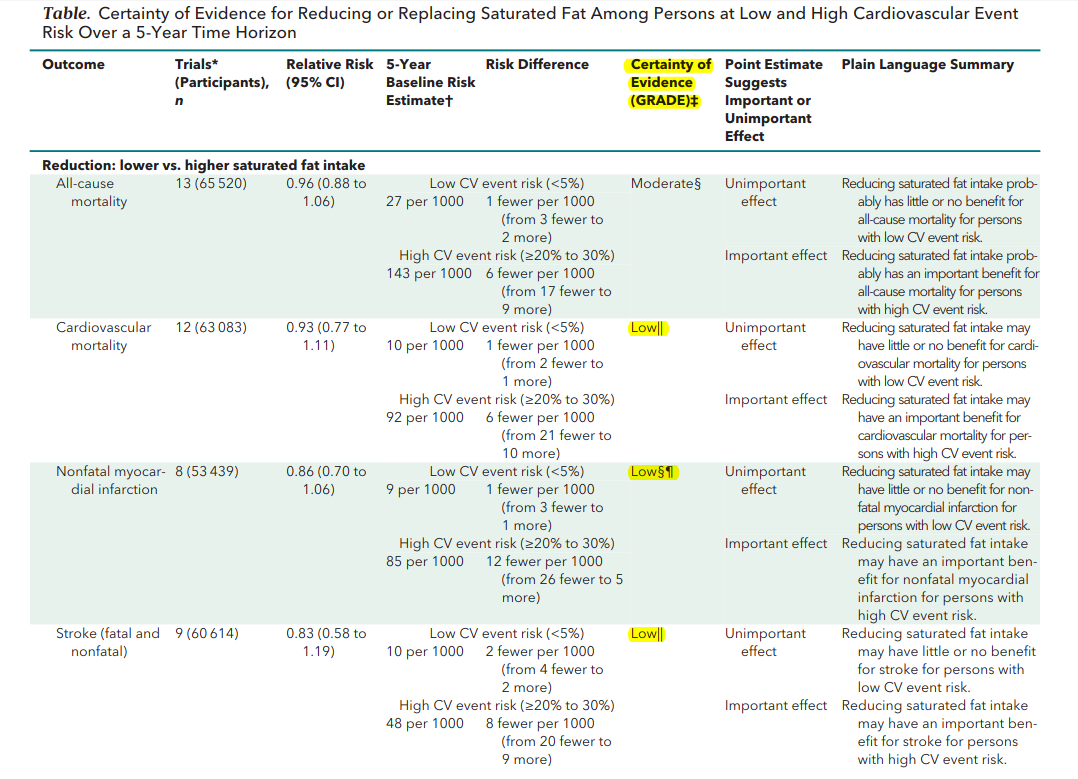 A low certainty of evidence means that the true effect may be "substantially different from the estimate of the effect."
As a result, for those three endpoints (CVD mortality, nonfatal MI, and stroke), the authors concluded that reducing saturated fat "may" have little or no benefit (for persons at low cardiovascular risk) and "may" (or may not) have an important benefit (for persons at high cardiovascular risk).
In other words, there was much uncertainty and therefore no credible evidence that reducing saturated fat would prevent cardiovascular disease.
On the other hand, they did appear to find an "important" benefit for reducing saturated fat on the endpoint of all-cause mortality (for persons at high cardiovascular risk).
But this is a curious finding, considering that all other published meta-analyses (many of them!) concluded that there was no evidence for reducing saturated fat on all-cause mortality.
So, the question becomes: How did they find this apparent "important" benefit when all other meta-analyses did not?
A New (Flawed) Interpretation of Results
Take a look at the result for all-cause mortality (Supplement Figure 2):
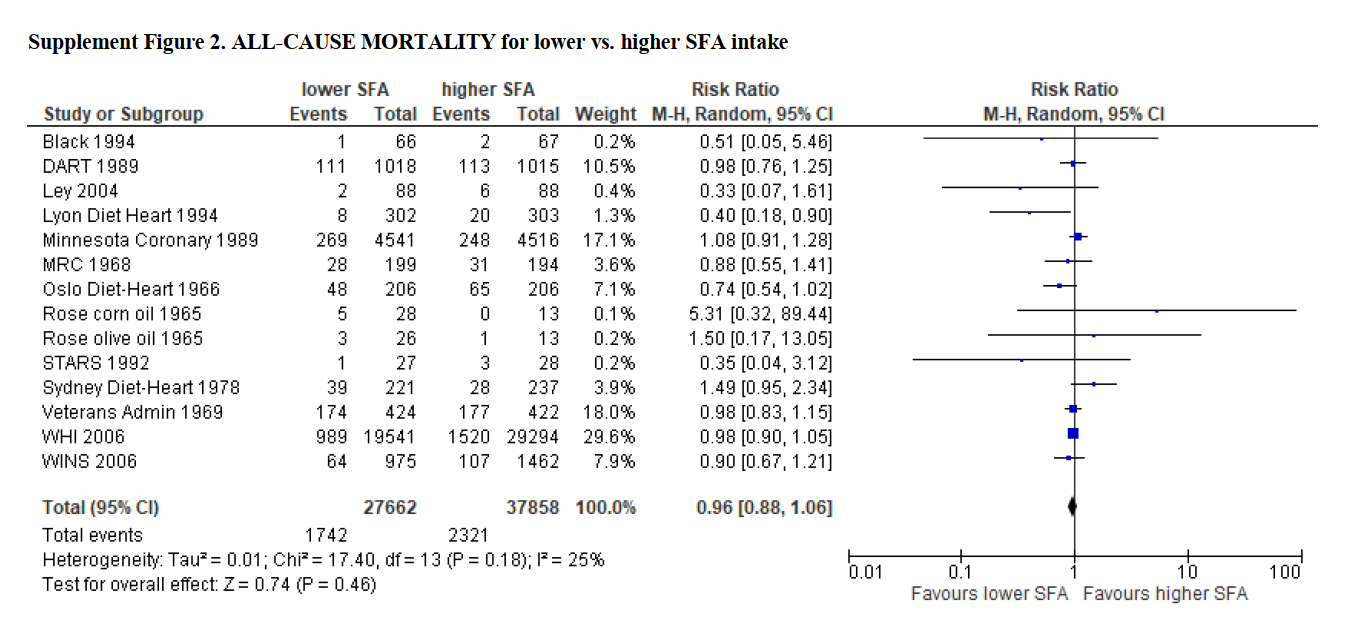 A standard interpretation of this data would simply conclude that there is no evidence for reducing saturated fat. The average estimate of 0.96 (a 4% relative risk reduction) is very much compatible with chance or random error [P = 0.46].
But instead of this standard interpretation, Steen et al. employed a concept called a minimally important difference (MID), which is the smallest change in the outcome that informed patients perceive as important. For mortality, the authors used an MID threshold of "5 fewer cases per 1000 followed over 5 years."
To calculate the absolute risk reductions, they took the 0.96 [0.88, 1.06] pooled result for all-cause mortality (because the relative effects did not seem to differ based on CVD risk), applied it to 5-year estimated baseline risks (from a completely different dataset), and compared the results to the MID.
From these calculations, they determined that, for high-risk persons (high cardiovascular risk), reducing saturated fat would result in 6 fewer deaths per 1000 participants followed over 5 years. And, because this result crossed their MID threshold (5 fewer cases per 1000), they concluded that reducing saturated fat probably has an important benefit.
Inappropriate Use of Causal Language
If we take the all-cause mortality result at face value, it is important to stress that it only applies to individuals with a high 5-year cardiovascular (CV) event risk (≥20% to 30%). It does not apply to those with an intermediate to high CV event risk (≥10% to <20%), intermediate CV event risk (≥5% to <10%), or low CV event risk (<5%). So, we cannot generalize the result to everyone.
But the real question is: Should we interpret the results in this way?
In the first image above, we can see the following "plain language summary" for all-cause mortality:
Reducing saturated fat intake probably has an important benefit for all-cause mortality for persons with high CV event risk.
This is causal language. They are essentially saying that reducing saturated fat probably "makes a difference" to all-cause mortality for persons with a high CV event risk.
But the problem is, the concept used to interpret the result — the MID — is not a causal concept! The MID is a highly subjective measure (a value judgment) that has nothing to do with establishing causation, as they seem to admit:
Users of our results will need to decide if these MIDs represent important thresholds for typical patients to inform clinical practice guidelines versus individual patients.
What the authors are encouraging here is a focus on point estimates (instead of P values) in relation to some threshold that users subjectively deem important.
This is a critical flaw, because it downplays the threat of random error. In randomized trials, deviations from the null are fully expected based on chance alone. In fact, the P value above means that results more extreme than 0.96 would frequently occur even if saturated fat had no effect whatsoever on the outcome.
Thus, the result cannot be used to claim that reducing saturated fat "probably has an important benefit." (Note: This also means that the specific GRADE rules they applied for "imprecision," which were not prespecified, are nonsense.)
Even without the word significance, researchers could not present a large (nonsignificant) p value as indicating a genuine effect. It would be nonsensical to say that even though more extreme results would frequently occur by random variability alone that their data are evidence of a genuine effect. [Mayo, 2021]
I am not claiming, of course, that we should make conclusions based on a P value alone. But the P value does offer a first line of defense against being fooled by randomness. So, it is one important consideration.
Another important consideration would be trial selection.
Questionable Trial Selection
If you inspect Supplement Figure 2 above, you will notice that Steen et al. included the Lyon Diet-Heart Study (LDHS), the Oslo Diet-Heart Study, and the STARS trial. These three trials involved a lot more than saturated fat reductions, including increases in marine fatty acids (EPA/DHA).
For the LDHS, Steen et al. claimed that PUFA was the "primary macronutrient replacement for SFA." But if you examine the nutrient changes in the LDHS, you will find that total PUFA intake actually decreased, which is contrary to true replacement trials where saturated fat decreases and PUFA intake increases.
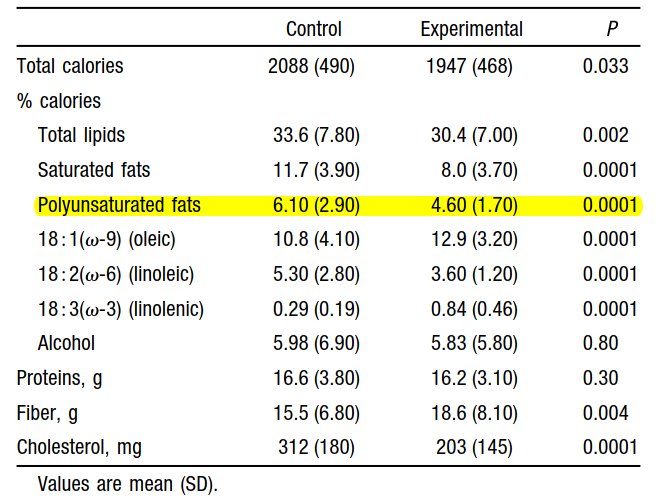
The only PUFAs that increased were omega-3 fatty acids (including blood levels of EPA). But this constitutes only a tiny percentage of total energy, which is quite irrelevant when talking about nutrient "replacements" (i.e., we can increase EPA/DHA intakes with little change in saturated fat. And, if you are insufficient in EPA/DHA, increasing their intake is likely to have a benefit regardless of what nutrient it replaces).
The major changes in Oslo and STARS have also been documented in multiple papers (even by Steen et al. themselves). The Oslo intervention group received a very large dose (≈5 grams per day) of EPA+DHA, and the STARS intervention doubled EPA+DHA (among many other dietary changes).
If we separate these trials from those with no documented increase in marine fatty acids (MFAs), we will find a mortality benefit. But, the benefit would be restricted to trials that involved increases in MFAs, suggesting that MFAs may be responsible.
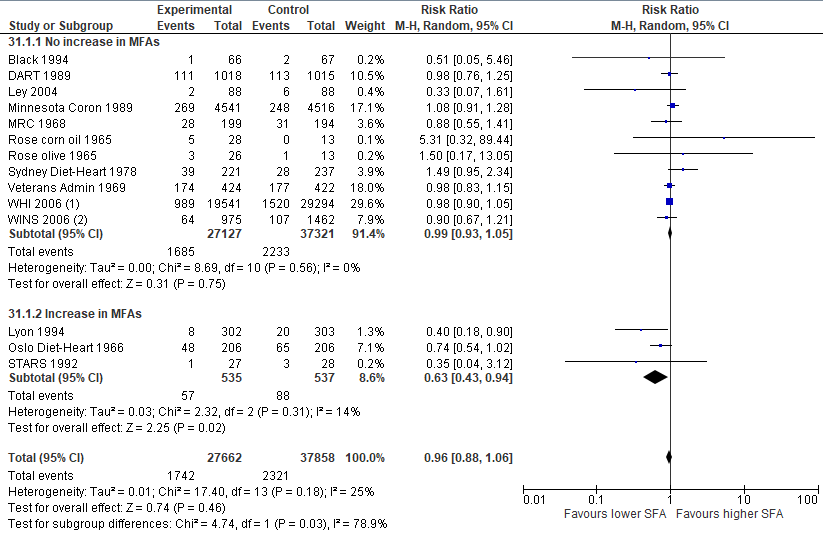 (Image: Subgroup analysis using Steen's data)
Apparently, Steen et al. are unaware that the debate is about omega-6 linoleic acid and whether its substitution for saturated fat is beneficial (given the cholesterol-lowering effects of linoleic acid). Therefore, a meta-analysis of trials that failed to isolate this change would only muddy the waters.
Moreover, Steen's analysis for all-cause mortality, even using their dubious interpretation, is extremely fragile. If we remove, say, the LDHS study alone (which should not be there in the first place), the "6 fewer deaths per 1000 participants" becomes "3 fewer deaths per 1000 participants," which fails to cross their MID threshold.
A NonFatal MI Benefit?
In addition to all-cause mortality for high-risk persons, Steen et al. also highlighted a subgroup finding (an effect modification) where an apparent benefit was seen on nonfatal MI for replacing saturated fat with PUFA:
Replacing saturated fat with PUFA probably has an important benefit for nonfatal myocardial infarction for persons with high CV event risk.
Again, note the causal language.
The ICEMAN manual, however, which is used to assess the credibility of subgroup findings, explicitly notes:
The assessment is about an association not a causal relationship: Effect modification refers to an association, not necessarily a causal relationship. . . . A causal interpretation becomes more likely if the ICEMAN rating is high credibility, but may nevertheless remain unlikely.
It follows that Steen's subgroup finding — rated as "moderate" credibility — does not justify their causal language.
But that aside, there are two other major issues to note.
In their paper, Steen et al. wrote:
Outcomes of interest, which were determined a priori, were all-cause mortality, cardiovascular mortality, nonfatal MI, stroke (fatal or nonfatal), total cholesterol, and LDL-C. [bold emphasis added]
But in a reply to Steen's review, Dr. Satoru Yamada astutely observed that nonfatal MI was not a prespecified endpoint:
It should also be noted that non fatal myocardial infarction was not one of the ten outcomes specified in advance in the PROSPERO registration (CRD42023387377). Although cardiovascular disease was included as a composite outcome, non fatal myocardial infarction constitutes only one component of that composite. The extent to which this outcome should be emphasized must adhere to the pre specified protocol.
Indeed, there is no mention of nonfatal MI as a specific endpoint in the official protocol.
Also, Steen et al. identified eleven studies that replaced saturated fat primarily with PUFA. Of these, eight were designed to evaluate cardiovascular events. Yet, their analysis on nonfatal MI included six studies, which means that two relevant trials, both unfavorable to the idea that replacing saturated fat with PUFA is beneficial, had missing data (the Minnesota Coronary Experiment and the Sydney Diet-Heart Study).
So, even if we are generous and ignore other major flaws in their analysis (flawed risk of bias assessments, questionable ICEMAN judgments, failure to separate omega-6 and omega-3, etc.), it remains true that nonfatal MIs should have never been included.
Meta-regressions
Steen et al. stated:
We used meta-regression to examine whether achieved between-group differences in SFA intake (as a percentage of control SFA intake and as absolute %E difference) and serum total and LDL-C (mmol/L) were associated with effects on all-cause mortality, cardiovascular mortality, nonfatal MI, and stroke (fatal or nonfatal).
To this end, they conducted 16 different meta-regressions (found in the supplement). But, in the main paper, they wrote:
In meta-regression, greater LDL-C reduction was significantly associated with greater benefit for nonfatal MI (P = 0.01), although this was based on only 3 trials. In addition, greater SFA reduction at follow-up (intervention vs. control) showed a borderline association with greater benefit for stroke (P = 0.05)
In other words, they conducted 16 meta-regressions and highlighted the only 2 that achieved statistical significance or nearly achieved it.
And it gets even more absurd when you realize that in these two analyses, there were fewer than ten studies available for meta-regression. (As Cochrane's handbook notes, meta-regression should generally not be considered when there are fewer than ten studies in a meta-analysis.)
Of the meta-regressions with ten or more studies (four of them), total cholesterol had no relationship with all-cause and cardiovascular mortality (P = 0.73 and 0.87), and achieved between-group differences in saturated fat intake (% of control or %E) had no relationship with all-cause mortality (P = 0.79 and 0.64).
None of these four analyses were mentioned in the main paper.
Also, the statement that "greater LDL-C reduction was significantly associated with greater benefit for nonfatal MI" does not make sense based on the three trials included in the meta-regression.
The three trials were Lyon, Moy, and WHI. But, based on the supplementary data, Lyon found a large decrease in risk despite a slight increase in LDL, Moy found an increase in risk despite a decrease in LDL, and WHI found a slight increase in risk despite a slight decrease in LDL.
 (Image: Estimates from Steen et al.)
Thus, the within-trial associations do not match their meta-regression claim. The data actually suggests the opposite!
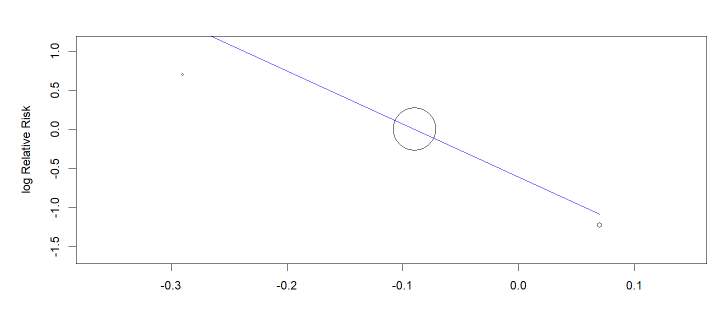 (Image: I ran a simple meta-regression and found a similar regression coefficient and P value as Steen. But, contrary to Steen, the data showed that greater LDL reduction was associated with LESS benefit)
And this error is not inconsequential.
In March of 2026, Alice Lichtenstein, who spent much of her career demonizing saturated fat and influencing dietary guidelines, parroted Steen's review, stating:
As noted by the authors of the systematic review [Steen et al.], a reduction in low-density lipoprotein cholesterol concentrations likely contributed to the lower event rates. [Lichtenstein, 2026]
The review showed no such thing.
(Note: I emailed one of the senior methodologists about this issue, Bradley Johnston, but I have yet to get a reply.)
Conclusions
The idea that we should eat less saturated fat has been debunked many times, most recently in my new book.
But unfortunately, many useless papers on the topic are still being published, and the Steen paper is no exception.
In the discussion section, Steen et al. wrote:
Trials were conducted at a time when the benefits and harms of omega-3 fatty acids and trans fatty acids, respectively, were emerging, resulting in many early trials having lacked assessment of their intakes and blood levels; thus, it is virtually impossible to assess whether observed effects from some interventions were due to SFA alone or resulted from concomitant changes in other nutrient intakes. This trial base is unlikely to resolve extant debates about the relative benefits of SFA reduction, the importance of PUFA replacement in driving observed benefits, and the ideal composition (total and specific omega-3 vs. omega-6) of PUFAs, and for these reasons contribute to the evidence being low to moderate certainty for potentially beneficial effects of reducing or modifying SFA intake. [bold emphasis added]
Put differently, this paper does nothing to resolve debates on saturated fat or any other nutrient. If anything, it makes things worse, because it perpetuates past errors and encourages a flawed interpretation of the data based on a noncausal concept (the MID).