

In 2017, I remember reading the following passage from Ference et al.:
At what is now considered physiologically relevant levels of LDL cholesterol [LDL-C; 0.5-1.0 mmol/L (20–40 mg/dL), typical of newborns and a wide range of mammalian species], the probability of LDL particle retention and the risk of developing atherosclerosis is low.
Recently, other influential figures in the lipid field (here and here) also claimed that "the ideal LDL-C level is likely what a newborn is born with."
These are baffling statements.
On what basis is an LDL-C level of 20 to 40 mg/dL "physiologically relevant" (meaning physiologically normal or ideal)?
Where is the Empirical Data?
We may imagine that physiological relevance is established by empirical studies on healthy (human) adults without clinically significant diseases.
But no.
Instead, these authors justify their position by selectively citing the low LDL levels of newborns (a brief transitional state) and other nonhuman mammals.
However, if the physiologically relevant LDL range is 20 to 40 mg/dL, we must come to the absurd conclusion that all healthy populations have "abnormal" LDL values.
These would include populations that appear virtually free from CVD (e.g., nonindustrialized populations), those that have low CVD rates with high longevity (e.g., traditional Crete among many others), and even centenarians.
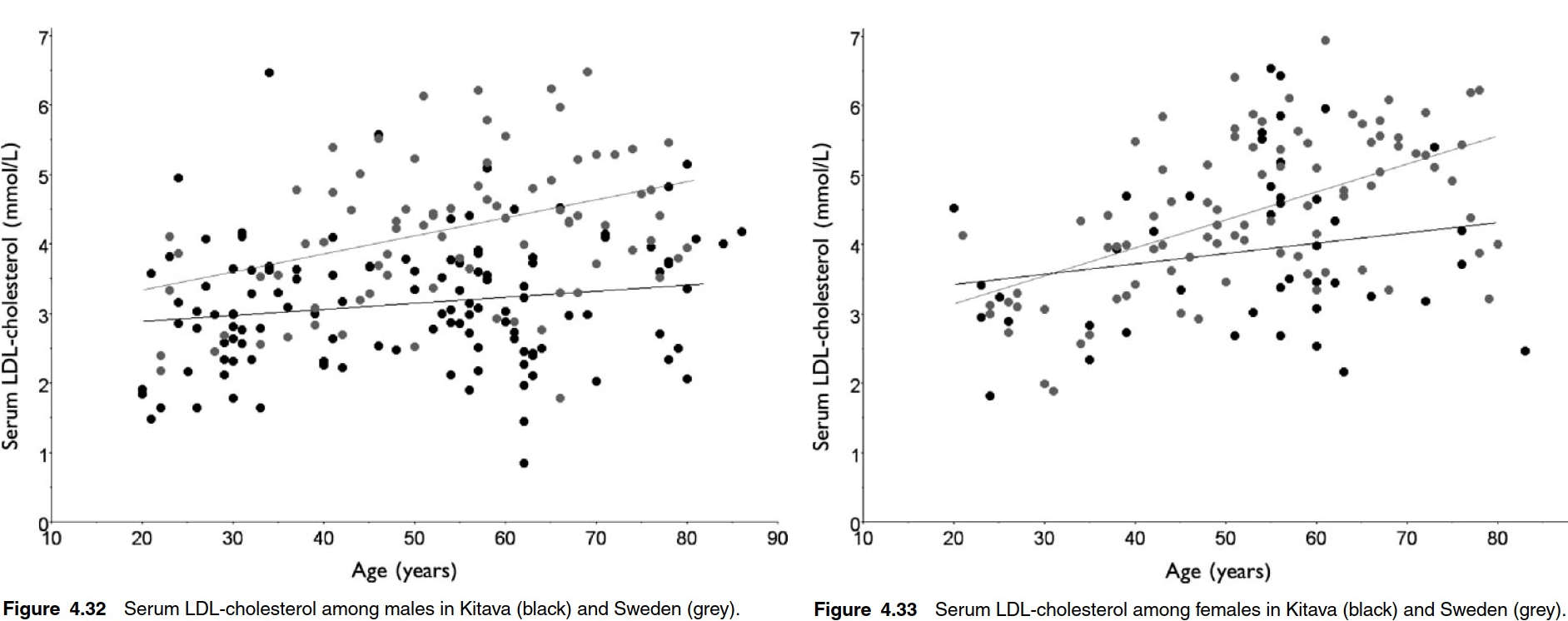 (Image: Taken from Lindeberg's Food and Western Disease. The black dots show a wide range of LDL levels in Kitava, a population apparently free from CVD on their traditional diet. Only one individual had an LDL level below 40 mg/dL. There is no narrow range of "ideal" LDL levels)
In other words, if you claim that the physiologically relevant LDL range is 20 to 40 mg/dL, the phrase "physiologically relevant" becomes meaningless.
No Benefit, Possible Harm
There is no credible evidence that we should lower our LDL levels below 70 mg/dL, let alone 40 mg/dL (van Bruggen and Diamond, 2025). Even analyses of corrupted clinical trials do not show robust associations between achieved LDL levels (including below 55 mg/dL) and improved mortality or CVD outcomes (Ennezat et al., 2023).
If anything, stroke risk might increase with lower achieved LDL levels (Ennezat et al., 2023), and total mortality and cardiac mortality were nonsignificantly higher in the only major trial (randomized comparison) that achieved LDL levels below 40 mg/dL (Erviti et al., 2022).
Similarly, in observational cohorts, LDL levels around 40 mg/dL or less are associated with increased mortality and stroke.
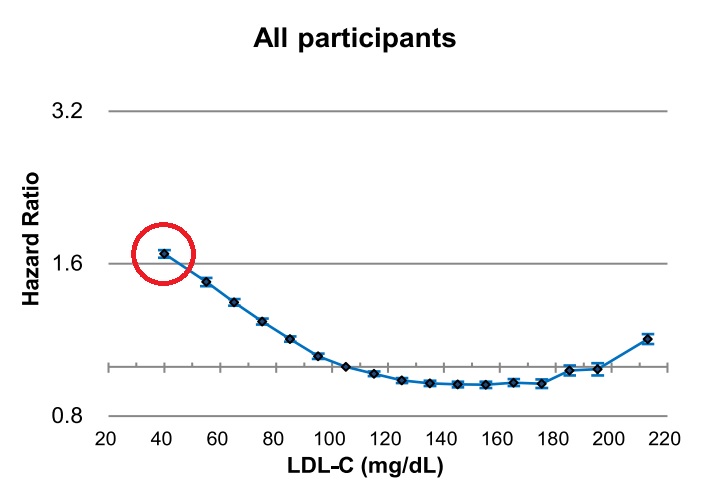 (Image: The so-called "ideal" LDL level is associated with increased death)
I am not, of course, claiming that these findings are causal: Neither observational studies nor randomized trials have isolated the effects of LDL.
But, the burden of proof lies on those using the "20 to 40 mg/dL" argument to show robust evidence that all-cause morbidity and mortality are lowest at those levels (as should happen for something called "ideal"). To date, no such evidence has been provided.
The Neonate and Mammalian Arguments
These are nonsensical arguments. As I already stated in reply to O'Keefe and colleagues, who used the neonate argument:
Since when are neonates, defined as a child under 28 days of age, the standard for what is healthy in adult humans?
I highly doubt O'Keefe and colleagues would argue that the heart rate, body weight, blood pressure, diet, and activity level of a neonate is physiologically normal for a healthy adult, so why cholesterol?
Also, why specifically neonates? Why not, say, three- to six-month-old breastfed infants with higher LDL levels (> 70 mg/dL)? Surely, breastfed infants must be in a physiologically normal state too (38):
As breastfeeding is the natural method of feeding an infant and breastmilk is superior to formula/bovine milk with respect to the specific nutritional needs for the optimal growth and development of infants, the plasma lipid pattern of the breastfed infants must be considered physiological during infancy.
Truth is: Neonates and infants need "massive amounts of cholesterol" for growth and development (39), which partly explains their lower cholesterol levels (from increased uptake).
Thus, the cholesterol level of a neonate simply reflects physiological development and should not be taken as a template for what adult values should be.
A blood pressure of 70/50 may be normal for a healthy neonate, for example, but such low levels could cause undesirable symptoms and possible death in adults.
Furthermore, it is common knowledge that variables change as we develop from a neonate. Blood pressure rises, heart and respiratory rates fall, white blood cell count decreases, plasminogen and antithrombin levels rise, and so on.
Perhaps O'Keefe and colleagues would do better by remembering that little adage in pediatrics: Children are not little adults.
With regard to mammalian species, a similar question could be asked: Why should mammals (generally short-lived) such as rabbits and rodents be a template for what is physiologically normal or ideal in humans? And if we are using this argument, why not cite closer relatives like chimpanzees, whose LDL levels are well above 40 mg/dL? (See here, here, and here.)
I am also unsure why the mammalian argument would be relevant given that the actual clinical complications so common in industrialized humans, such as atherosclerotic thrombosis, are rare in animals regardless of LDL levels (Finlayson & Symons, 1964; Stehbens, 1986; Widmaier et al., 1996; Arinell et al., 2012).
Even in genetically manipulated models with very high cholesterol levels, it is difficult to show the severe atherosclerotic features that are common in humans (e.g., occlusive thrombosis) . . . Despite hypercholesterolemia, high LP(a) levels and having the high-risk APOE4 allele, no deaths by myocardial infarction have been cataloged in the autopsy records of chimpanzees at major US primate centers. [Varki et al., 2008]
Conclusions
Ference and colleagues (2017) seem to be the first group to explicitly (and falsely) claim that an LDL level of 20 to 40 mg/dL is "physiologically relevant."
Furthermore, if we read the full quote at the beginning of this article, we will see that they promote the response-to-retention hypothesis of atherosclerosis, which they later argued for in a second paper published in 2020.
However, as discussed in The LDL Scam: A Critique of the European Atherosclerosis Society “Consensus” Paper, a careful reading of the second paper shows that (1) the retention hypothesis does not hold up to scrutiny, and (2) there is no credible evidence that normal (native) LDLs cause atherosclerosis.