
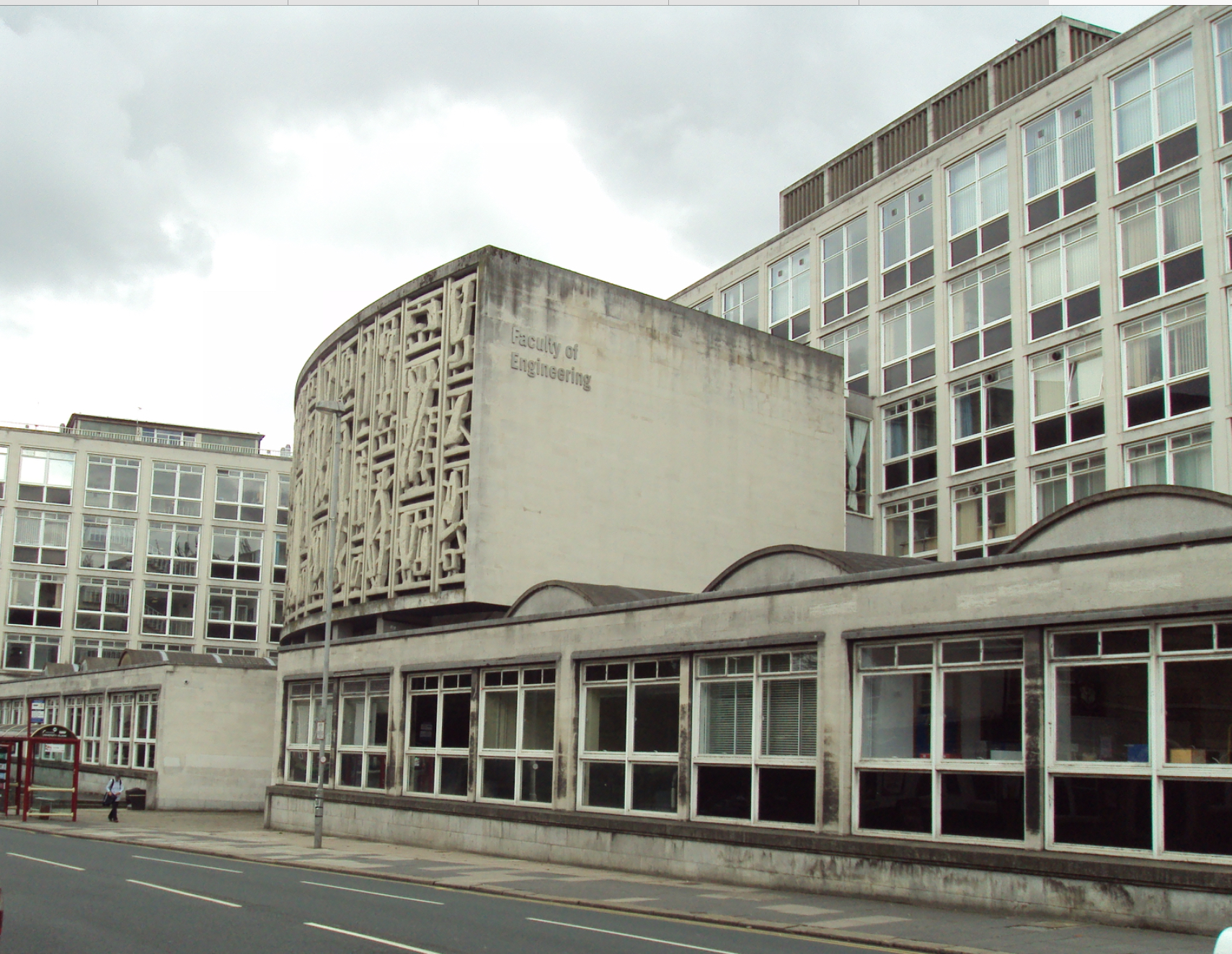
 University of Leeds, Faculty of Engineering, Woodhouse Lane, Leeds. (Photo by Rept0n1x at the Creative Commons Attribution-Share Alike)
I come from a family of engineers. Both my parents are civil engineers and my brother has 4 degrees in electronic engineering. So when I finished high school with no idea what I wanted to do, I chose the family profession.
It was a very bad idea. I tried engineering in three faculties on three continents, with no success. At Leeds University, I enrolled in their architectural engineering program and managed to finish one year out of the three needed for a BEng.
I was miserable throughout that year but, in hindsight, it was the most consequential year of my life. It had nothing to do with my studies and everything to do with experiencing life through the most random encounters.
I remember going out for my birthday with the girls from my engineering course. They were mostly Greeks and Cypriots and so they took me to a Greek restaurant.
We had the most amazing meal. Dolmas, gorgeous chunks of lamb, and roast potatoes. The food was divine and the portions were HUGE.
At some point the owner came over to our table because she’d heard the girls speaking Greek. She was this middle-aged Greek lady who felt like a cross between a British army officer and a Greek theia. She started asking everyone what part of Greece they came from. Then she looked at me.
“You must be from Thessaloniki.”
I said, “I’m not even Greek.”
“No!” She said it like I didn’t know what I was talking about. “You look like a Thessalonian.”
I was tempted to explain my family tree to her to prove that she was wrong but, for some reason, I was happy to be misidentified so I stayed quiet.
Then she noticed my plate and saw that I hadn’t finished my food.
She gave me the same steely look she’d given me when she declared me a Thessalonian:
“You have to finish your plate.”
I told her I couldn’t. It was a LOT of food.
She wouldn’t take “no” for an answer and I remember thinking: But I’ll be paying for it anyway, so how is it a problem?
She must’ve read my mind because the next thing she said was:
“It’s good food. You must eat it!”
In our culture, elders telling you to finish your plate was hardly unusual. I’d heard every variation of it, including my father reminding me about the children starving in Africa every time I left food on my plate.
Normally, being harassed to eat when I was already full would have made me resentful. But there was something different about the way she said it that didn’t make me feel bullied or condescended to.
The food was good.
That was the entire argument.
I remember looking at this woman and thinking:
I want to be her.
I know what you’re thinking: how do you go from being misidentified to being bullied into finishing your food to wanting to be her?
Yes, this was a very strange thought for me to have, but for entirely different reasons.
I was studying engineering because that was what a proper profession looked like in the Arab world. It was the best career path if you couldn’t be a doctor. My mother was the first female engineer in her country. I didn’t feel like another option existed. Whether I actually enjoyed engineering seemed almost irrelevant.
And yet this woman running a restaurant made me feel like her career choice was superior, and this is from someone who grew up in a culture where food was revered, but making it for a living was seen merely as an honest way to earn money. It didn’t bring any prestige or status, especially for a woman. Women cooked, of course, but the restaurant owners I knew were men. And yet here she was, out front, commanding the room and acting like she wouldn’t want to be anywhere else!
This lady had more pride in what she was doing than I could imagine ever having as an engineer.
She wasn’t behaving like a typical businesswoman either. I’d paid for the food. Technically, it was no longer her problem. She didn’t see it that way at all.
I realize now that what fascinated me the most about her was that she was a cross between a businesswoman, a mother and a food maker.
I spent the next few months mostly trying to survive university because I was miserable. But I had this escapist fantasy of having a little taverna somewhere by the side of the road, cooking for people and running it the same way that Greek lady ran her restaurant.
That was 1993.
Thirty-three years later:
I don’t have a taverna. Knowing now what I know about the food business, I’m not even sure I could pull one off. What I have is something much more modest and yet it feels like my dream came true.
In the eight years of running Dervish Kitchen, I can’t tell you how many times I’ve caught myself sounding like that Greek lady. When I’m giving out samples and saying, It’s good food. It needs a good home. When I’m haranguing guests at my parties to keep eating even though I know perfectly well they’re on the verge of a food coma (OK, this is also typical Syrian hospitality).
But most of all, she imprinted on me her disdain for food being thrown away. It genuinely breaks my heart to see good food go to waste.
Ask me to describe her and I couldn’t tell you a single thing. Her face is a blur. I don’t even remember the name of her restaurant but somehow she became my idol and my muse.
It’s good food.
I hear myself say it and I chuckle. That must be my Greek blood talking. 😂