

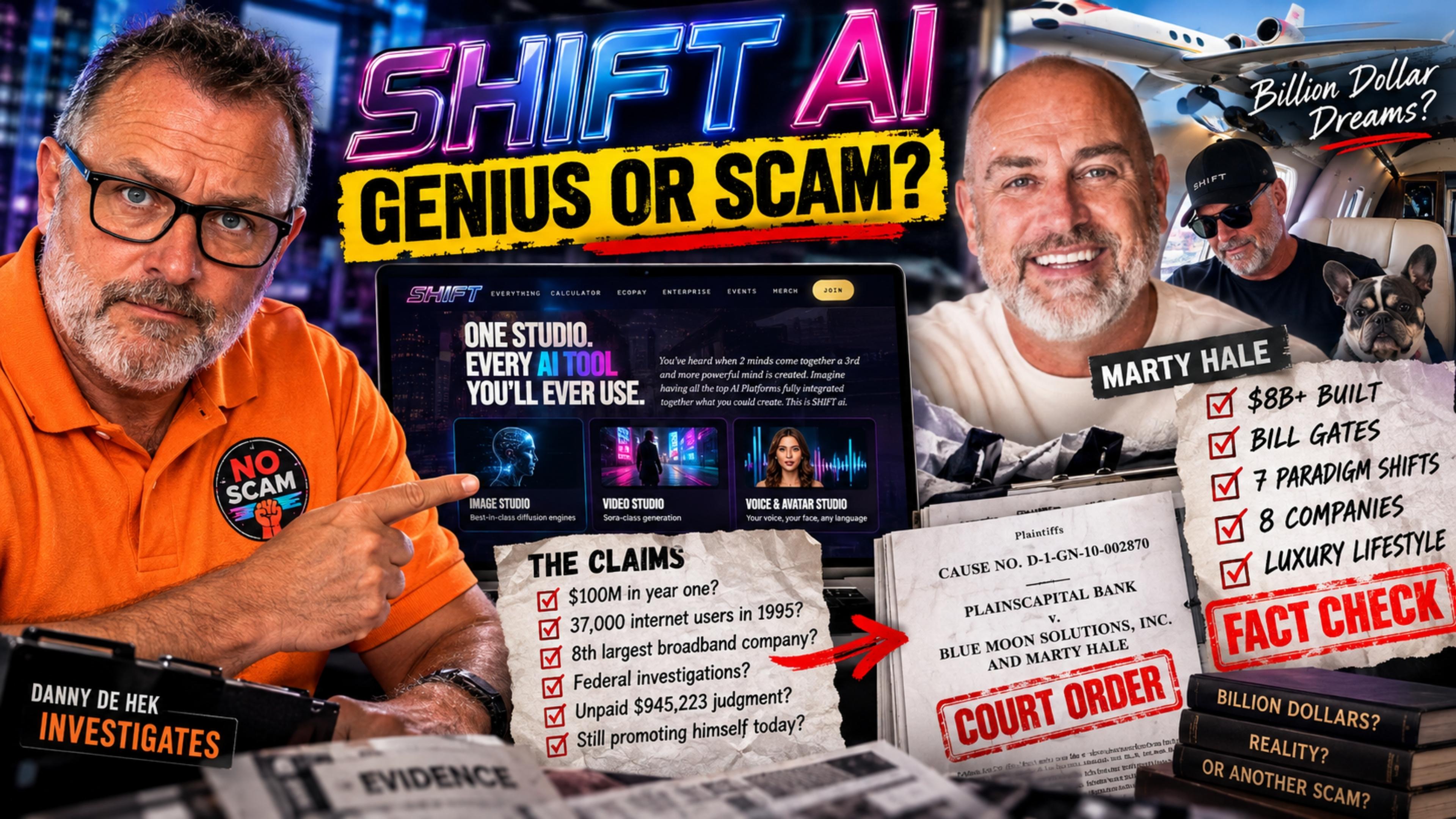
“The measure of intelligence is the ability to change.” — commonly attributed to Albert Einstein
If that quote is right, then SHIFT AI may have created one of the strangest contradictions I have encountered in the current AI gold rush.
According to Marty Hale, the man behind SHIFT AI, his company has effectively brought the intelligence of more than 20 major AI platforms together. He describes a system where a user’s request can draw upon platforms including ChatGPT, Gemini, Claude, HeyGen and others, with SHIFT’s own “AI brain” supposedly using that collective intelligence to produce something better.
Marty even invokes the old idea that when two minds come together a more powerful mind is created, before asking what could happen if 20 AI minds were brought together instead.
It sounds spectacular.
It also immediately made me wonder what they had actually built.
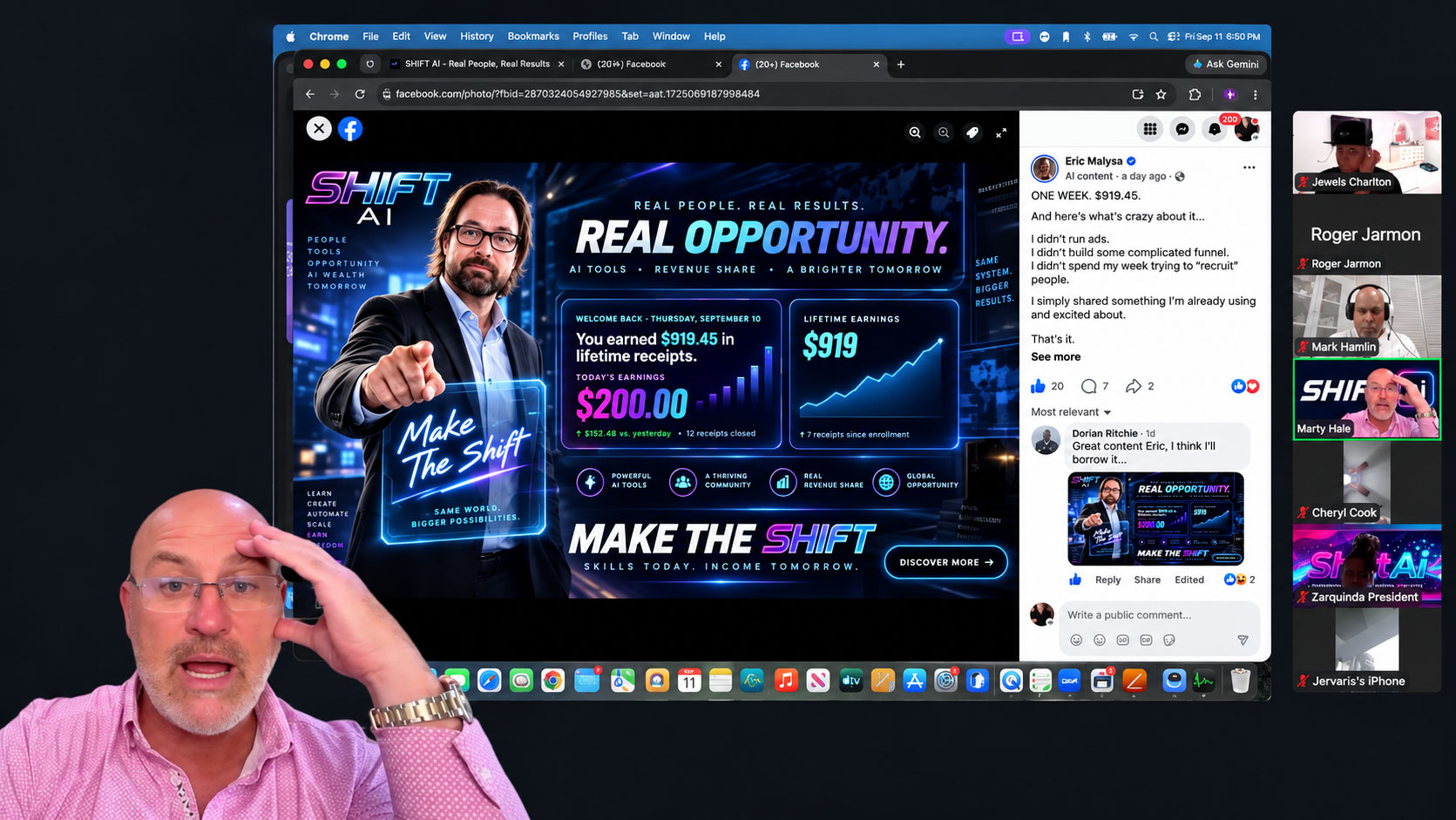 The world’s leading AI companies are spending extraordinary amounts developing models, data centres, specialised chips and infrastructure while their technology continues to change at breathtaking speed. Yet here was a company Marty openly described as roughly two months old and not even officially launched, apparently claiming it had found a way to harness all of these competing systems and create a superior intelligence sitting above them. In the presentation, Marty went even further, claiming SHIFT had its own AI, that the technology and “brain” were patented, and that getting AI patented was extraordinarily difficult.
Maybe SHIFT AI has developed something remarkable. If so, those claims should withstand scrutiny.
But the technology wasn’t actually what first brought SHIFT AI to my attention. The trail started with Pierre Maxim, a promoter I had recently contacted over his promotion of SuperOne. Shortly afterwards, Pierre began promoting SHIFT AI, telling subscribers he had “banked $800” in his first 24 hours. Within three days, his newsletter was advertising a total of $1,727.13, although $327.13 was described as projected ClubPay and the remaining $1,400 was scheduled to settle later.
I sent Pierre a detailed right of reply. I wanted to know what independent due diligence he had conducted, where the money funding SHIFT’s passive-income pools came from, why he was insisting this wasn’t network marketing, and what evidence supported the earnings and legitimacy representations he was making.
Pierre didn’t answer those questions. Instead, he sent me a private recording featuring Marty Hale and told me: “This founders interview call would explain everything.”
So I watched it.
It didn’t explain everything. It opened an entirely new investigation.
Behind all the talk about revolutionary artificial intelligence was an elaborate financial ecosystem involving Founder packages, AI credits, club levels, referrals, cash pools and participants being rewarded according to various measures of the value they supposedly brought to the system. Marty described people buying thousands of dollars of credits and not even using them. He explained how participants could purchase additional credits to move themselves up a leaderboard before a weekly cutoff and claimed that 48% of SHIFT AI’s weekly revenue was arriving during the final ten minutes before that cutoff.
And all of this was happening during pre-launch.
That is where my interest moved away from the shiny AI demonstration and towards a much simpler question.
What exactly is SHIFT AI selling — artificial intelligence, or the dream of making money from everybody else buying AI credits?
Meet Marty Hale And His Extraordinary Résumé
When Pierre Maxim pointed me towards the private Founder presentation, I expected to hear an explanation of SHIFT AI. Instead, Marty Hale spent the opening minutes establishing why everyone in the room should trust Marty Hale.
His story starts with network marketing. Marty says he joined Excel Communications at 21, became an Executive Director and developed relationships with some of the biggest names associated with the company. He then describes becoming a master distributor with The People’s Network (TPN) before moving into the early Internet industry. None of this background is incidental. Marty uses it to establish a pattern that becomes central to his SHIFT AI pitch: identify an essential service, buy it cheaply at wholesale, package it differently, and distribute it to the masses.
Then the résumé becomes extraordinary.
Marty says that at 26 he joined three other young men and launched an Internet company called US Internet in Minneapolis, with Marty becoming CEO. He describes starting from a spare bedroom, becoming the first Microsoft-based Internet company, landing major customers and eventually operating from an entire college campus filled with servers and networking equipment. According to Marty, the company generated “a little over 100 million” in its first year, remains in business approximately 30 years later and went on to generate billions of dollars in annual revenue.
 But the claim that really got my attention was the investor.
Marty told the group that Bill Gates was the company’s only investor. He says being able to tell major telecommunications carriers that Gates had invested opened doors and allowed US Internet to negotiate wholesale access from companies including AT&T, MCI and Southwestern Bell. He then claims the company secured household-name customers including Yahoo, Pillsbury, Polo, Disney and Ford Motor Company, while also white-labelling Internet services for numerous network-marketing companies.
The story doesn’t stop with telecommunications. Marty says he later applied essentially the same wholesale model to deregulated electricity. During the presentation he refers to Just Energy, Crius Energy and Viridian, describes businesses doing hundreds of millions of dollars annually, and talks about serving millions of customers. The underlying message is difficult to miss: I’ve done this before, on an enormous scale, and now I’m doing it with artificial intelligence.
That matters because SHIFT AI is asking people to trust a company with almost no operating history. Marty’s track record becomes part of the sales proposition. When a founder tells prospective participants about $100-million first years, billion-dollar companies, tens of millions of customers and Bill Gates backing one of his ventures, those aren’t colourful anecdotes. They help establish credibility for what comes next.
And what comes next is an even bigger proposition.
Marty says he took the same wholesale concept that supposedly worked with Internet access and electricity and applied it to the world’s leading artificial-intelligence providers. His pitch is essentially that his history and connections helped him obtain extraordinarily favourable access to AI services, which SHIFT can then package together while returning a substantial portion of its revenue to members.
Some of Marty’s historical claims may ultimately prove completely accurate. Others require considerably more documentation before I am prepared to repeat them as established fact.
So I started checking.
A Business That Hasn’t Really Started Yet
The more I listened to Marty Hale, the more important one detail became: SHIFT AI had barely started.
Marty described the company as approximately two months old and repeatedly explained that it had not officially launched. During the presentation he showed figures indicating just 115 active club members and 45 active customers. That is an extraordinarily small sample from which to demonstrate the long-term economics of any new business, particularly one promising to distribute a substantial percentage of its gross revenue back through an elaborate rewards system.
Yet the presentation quickly moved from what SHIFT AI was actually doing with a few hundred people to what participants might experience when the numbers became much larger.
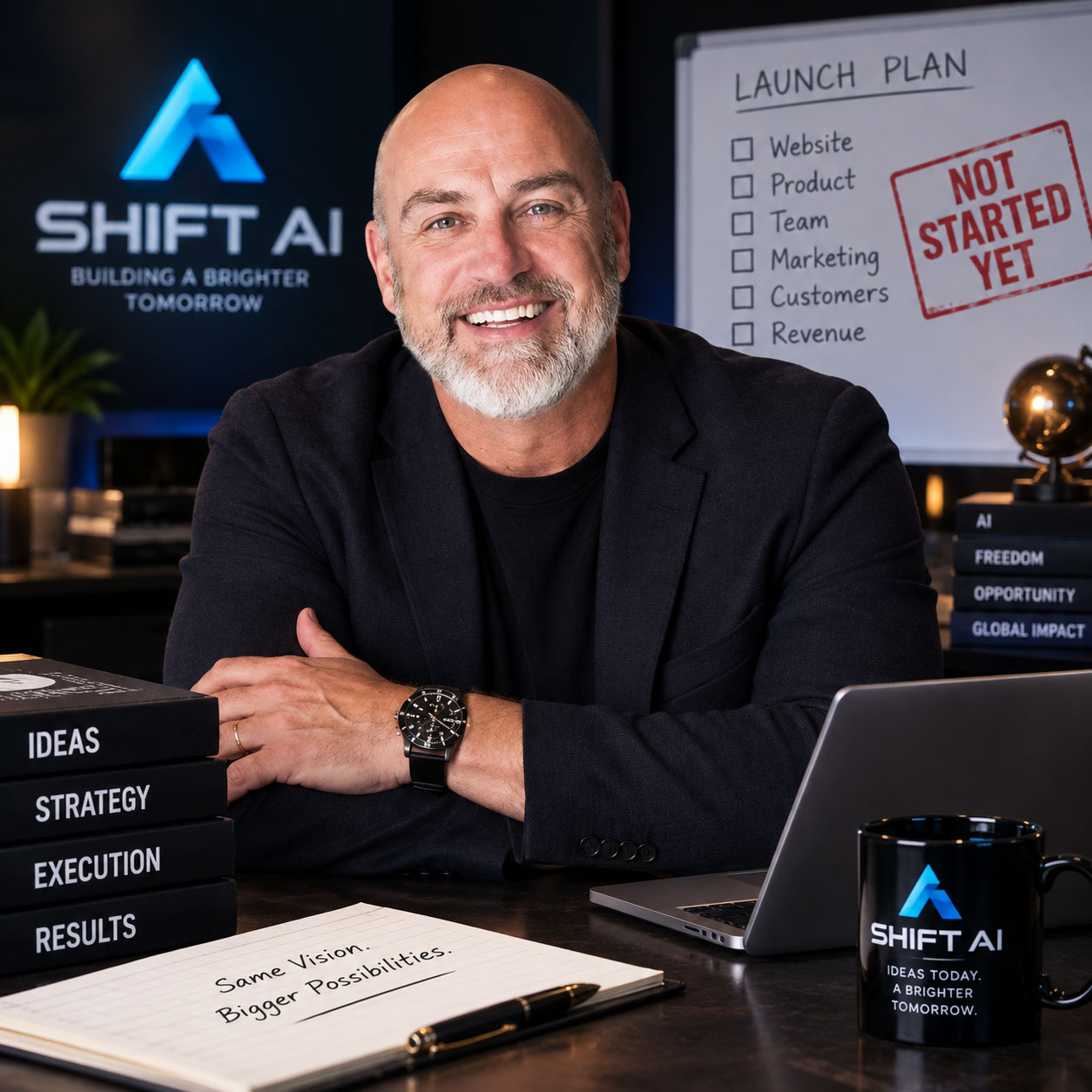
Marty modelled the system at 1,000, 10,000 and 100,000 members, showing how dramatically the amounts distributed through the various pools could increase as the ecosystem grew. At one point he said he believed SHIFT could probably reach 10,000 people within 90 days. Elsewhere he described people already making thousands or even tens of thousands of dollars while the company was still in this tiny pre-launch phase.
That distinction between actual results and projected growth is critical.
A new business can make almost any spreadsheet look spectacular if you keep multiplying the number of future participants. Going from 115 club members to 100,000 would mean increasing the membership base roughly 870 times. Going to one million would require growth of roughly 8,700 times. The projected distributions become enormous because the hypothetical ecosystem feeding them becomes enormous.
But those future participants don’t exist yet.
Neither does the mature retail economy needed to demonstrate whether people genuinely want to purchase and consume SHIFT’s AI credits at scale when there isn’t a Founder position, leaderboard, passive-income pool or compensation opportunity attached to the transaction.
That is why I think the term pre-launch deserves more attention than it normally receives in these opportunities. I have watched countless online money-making ventures use pre-launch as a period where almost anything seems possible. There is no lengthy operating history to examine, no years of audited results to compare and often very little ordinary customer behaviour to study. Instead, early participants are being shown what could happen if thousands of people arrive after them.
SHIFT AI was doing something else at the same time: creating scarcity.
The presentations promoted a limited Founder group, with 250 Founder positions in the United States, while early participants were offered enhanced credit allocations and other benefits. Marty explained that a $1,000 Founder purchase received 200,000 credits, whereas after the Founder window the same $1,000 would receive 100,000. In his words, that effectively gave Founders “double value in Credit Pay Hold.”
So before SHIFT AI had even properly launched, prospective participants were being presented with three powerful ideas at once: get in early, secure more credits while they are available, and imagine what those credits could produce when the ecosystem becomes much larger.
For me, that is where the investigation needed to slow down.
Before worrying about what happens when SHIFT AI has 100,000 members, I wanted to understand what the first few hundred people were actually buying — and why owning more of it could apparently result in them receiving more money.
So What Exactly Are People Buying?
Strip away the talk about Bitcoin, revenue sharing and future earnings, and SHIFT AI does have a product. Customers purchase AI credits that can be consumed across a collection of artificial-intelligence tools for generating text, images, video, voice, avatars, music and other content. Marty describes SHIFT as an intelligent layer sitting above numerous AI providers, selecting or combining different systems depending on what the user is trying to create.
That part isn’t particularly difficult to understand. Plenty of businesses aggregate third-party technology behind a single interface. The interesting part begins when those AI credits stop behaving merely like consumable credits.
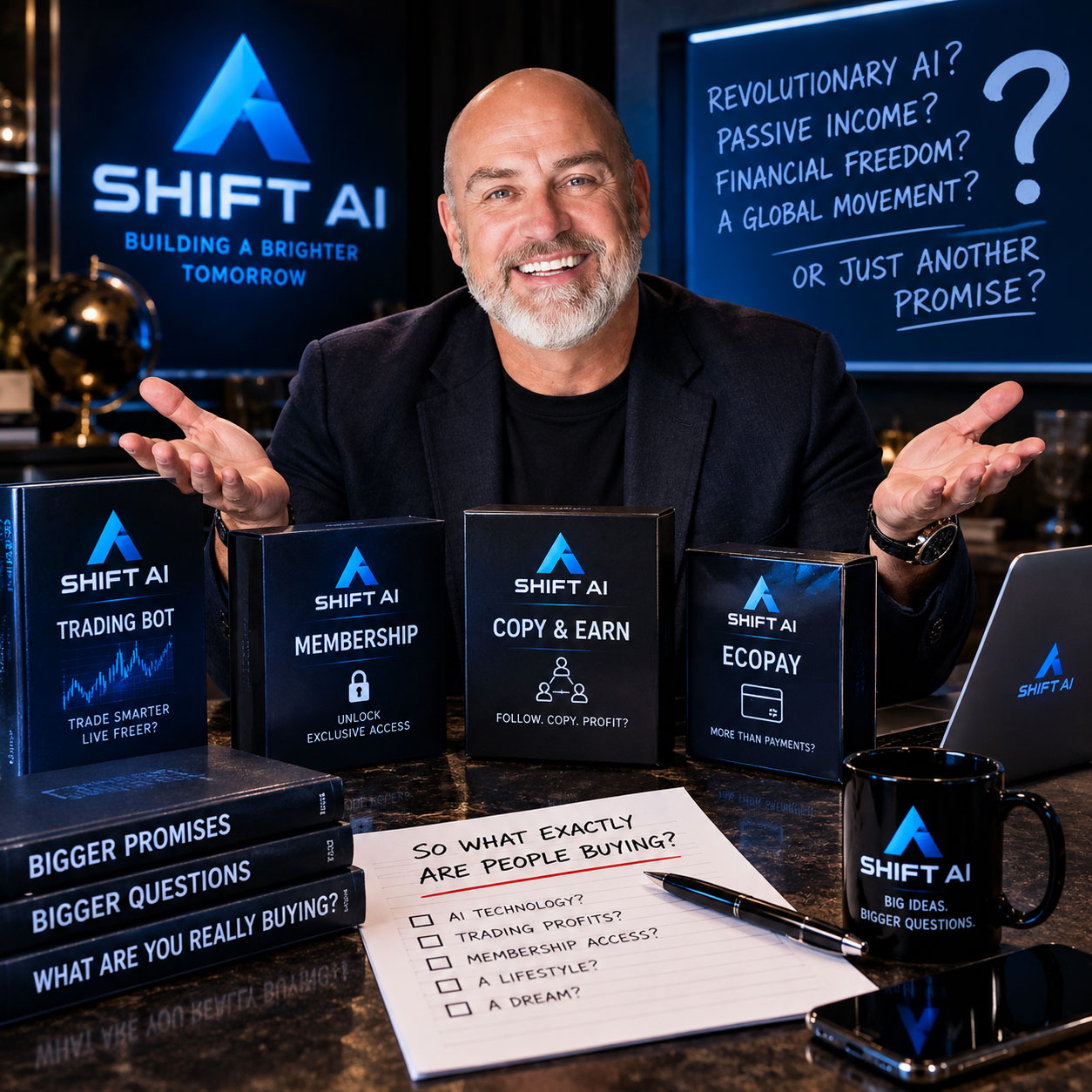 Marty explains that participants can join different club levels and that their position can be determined by the number of credits they personally purchase together with credits purchased by people they directly connect to SHIFT. His description is wonderfully simple: “you can either buy your way or build your way.”
The numbers become substantial very quickly.
Marty gives examples where purchasing approximately $3,000 in credits can qualify somebody for Bronze, around $13,000 can reach Silver, and $113,000 can reach Gold. Alternatively, those levels can be achieved through qualifying credit purchases made by people personally connected to the participant. In one example, Marty describes somebody introducing a business that purchases $113,000 worth of credits, resulting in both parties reaching Gold and the person who made the introduction potentially receiving a sizeable direct payment.
This is where SHIFT’s repeated insistence that it isn’t network marketing becomes interesting.
There may not be the traditional endless genealogy of uplines and downlines that people associate with an MLM compensation plan, and SHIFT uses its own terminology to describe the relationships. But Marty openly explains that your own purchases and the purchases of people you personally introduce can affect your club status and earning position. He also describes Connect Pay as the one part of the system that is similar to network marketing or affiliate marketing.
The Founder offer adds another layer. A US Founder was expected to purchase $1,000 worth of credits, receiving 200,000 credits during the limited Founder period rather than the 100,000 Marty said would normally be supplied for the same amount afterwards. Those extra credits weren’t presented merely as extra AI usage. Marty specifically explained that having twice as many credits provided “double value in Credit Pay Hold.”
That distinction matters.
If I buy prepaid credits for an ordinary software platform, I expect their value to come from using the software. I don’t normally buy more unused credits because possessing a larger pile could improve my position in a weekly cash distribution. I certainly don’t expect other people’s future credit purchases to contribute towards money being distributed back to me.
But that is precisely where SHIFT AI becomes much more complicated than an AI subscription.
The credits appear to serve two purposes at the same time. They buy access to AI services, but the quantity purchased and held can also influence how much money a participant receives from the ecosystem.
To understand why people were apparently buying thousands of dollars’ worth of them, I needed to understand EcoPay — the machine Marty says distributes up to half of SHIFT AI’s gross revenue back to the community.
The Money Machine Marty Describes
This is where SHIFT AI stops looking like a straightforward AI subscription and starts requiring some careful explanation.
The system is called EcoPay, and Marty describes five ways money can flow back to participants: Club Pay, Connect Pay, Content Pay, Credit Pay and Compete Pay. Different presentations use slightly different percentages and terminology, but the headline claim Marty repeatedly makes is that SHIFT is prepared to distribute up to 50% of its gross revenue through this ecosystem.
The important words there are gross revenue.
 Marty isn’t describing a conventional profit-sharing arrangement where a company pays its expenses, determines what profit remains and distributes a portion of that profit. He repeatedly describes money being allocated from the revenue coming into SHIFT as people purchase and consume AI credits. During the presentation he says that as people spend or buy credits, EcoPay examines the activity, club levels and other qualifying factors before determining how the money is distributed.
Each pay stream is designed to reward a different behaviour. Connect Pay rewards somebody for bringing another customer into the ecosystem. Marty openly describes this as the part most similar to affiliate or network marketing. Content Pay rewards people whose content results in credit purchases. Compete Pay introduces competitions and performance-based rewards. Club Pay uses a participant’s credits, connections and club level when calculating their weighting.
Then there is Credit Pay, which is where my attention really started to focus.
Marty divides this into behaviour involving the use and holding of credits. In the presentation, he describes Credit Pay Hold as a system where participants possessing larger quantities of credits can receive larger distributions when new credits are purchased. He explains that EcoPay effectively ranks the holders: the person holding the most receives the largest share, followed by the next person, and so on.
This creates an obvious incentive that goes well beyond buying AI credits because somebody needs to generate a video or write an email.
Owning more credits can potentially mean receiving more money.
Marty even explains that participants can watch the leaderboard, see where they are positioned and calculate how many additional credits they might need to purchase to move ahead of somebody else before the weekly cutoff. Money received from previous distributions can then be used to purchase still more credits.
At the same time, new people entering the ecosystem are purchasing credits, existing participants are purchasing additional credits, businesses can make much larger credit purchases, and some of that incoming gross revenue is being distributed through EcoPay.
That doesn’t automatically tell us whether the model is sustainable. It does, however, tell us what question matters most.
If SHIFT AI eventually develops a huge population of ordinary retail customers who simply purchase and consume AI services because the product is competitive, those customers could provide genuine external demand. But during this tiny pre-launch phase, Marty was simultaneously showing participants how buying, holding and accumulating more credits could improve their position for cash distributions.
And that creates a very different motivation for purchasing them.
The next part of Marty’s presentation made that motivation impossible to ignore, because he didn’t just describe people holding unused credits.
He started showing the audience how much money they were supposedly making from doing it.
Buy Credits, Hold Credits, Get Paid
If I had misunderstood Credit Pay Hold, Marty Hale soon removed any doubt.
He described participants purchasing substantial quantities of credits without necessarily consuming them at all. One example involved a man buying around $5,000 worth of credits every week who, according to Marty, wasn’t using a single credit. Marty said the participant treated the credits “like stock.” He also described people taking money they received from SHIFT and using it to buy additional credits, increasing their holdings before the next weekly calculation.
That is a very different behaviour from somebody prepaying for software they intend to use.
 Marty explained that the leaderboard allows participants to see their position and work out what it might take to move above somebody else. His example was remarkably direct: “you might buy $1,000 of more credits and make $3,000 more cash.” The credits don’t disappear simply because they have been counted for Credit Pay Hold. They remain available for future AI consumption while continuing to form part of the participant’s accumulated holdings.
Then Marty revealed something that I think is one of the most important pieces of information in the entire presentation.
According to him, 48% of SHIFT AI’s weekly revenue comes in during the final ten minutes on Tuesday night.
Think about what that means.
If nearly half of an entire week’s revenue really arrives during the final ten minutes before a weekly rewards calculation, I want to know what is driving those purchases. Are thousands of customers suddenly discovering they desperately need AI generations at exactly the same moment? Or are participants watching the leaderboard, buying additional credits and trying to improve their position before EcoPay calculates the week’s distributions?
Marty’s own explanation points strongly towards the latter behaviour. He describes people “jockeying” for position, watching who is above them and purchasing additional credits accordingly. And then he asks who gets paid on all those purchases.
His answer is effectively: the community does.
The presentation gives examples of the kind of money participants were supposedly already receiving. Marty talks about people making thousands and even tens of thousands of dollars while SHIFT AI is still in pre-launch. He describes one participant receiving money simply from holding credits and repeatedly emphasises that recruiting isn’t necessary to participate in some of these pools.
This is where the distinction between product demand and financial motivation becomes critical.
There is nothing inherently unusual about selling prepaid credits for an AI service. There is also nothing inherently unusual about giving customers loyalty rewards. What deserves scrutiny is a system where participants can apparently purchase credits, leave them unused, receive cash distributions influenced by the size of those holdings, use those distributions to purchase still more credits, and compete with other holders immediately before a weekly cutoff.
The obvious question isn’t whether the credits technically have utility. They apparently do.
The question is why people are buying them.
If somebody purchases $5,000 worth of AI credits every week without using them, the existence of an AI product doesn’t by itself explain that behaviour. If almost half the company’s weekly revenue really arrives during the final ten minutes before the payout cutoff, ordinary consumption doesn’t readily explain that either.
Marty provides another explanation himself.
He repeatedly compares what these people are doing to investing, stocks and Wall Street.
And that is where SHIFT AI’s attempt to distance itself from the investment world becomes considerably harder to follow.
“It’s Like A Stock” — Except Marty Says It Isn’t
One of the strangest things about Marty’s presentation is that I don’t have to compare SHIFT AI to an investment. Marty Hale repeatedly does that himself.
At different points he tells the audience that SHIFT is “not SEC regulated” and “not a stock, although it works like a stock.” When describing somebody buying credits without using them, he says the participant treats them “like stock.” He talks about the leaderboard in terms of Wall Street, describes people purchasing thousands of dollars of credits and doing nothing with them as “like an investment for them,” and explains how participants can buy additional credits immediately before the weekly cutoff in an attempt to increase what they receive.
Then comes Bitcoin.
Marty uses the extraordinary growth of Bitcoin as a way of getting the audience to think about what might happen if SHIFT AI grows from a tiny pre-launch community into something much larger. In another presentation, he tells the audience that somebody who bought Bitcoin early didn’t need to recruit anybody, create anything or sell anything — “all you got to do is buy” — before returning to SHIFT’s own projected numbers and asking the audience what the opportunity was beginning to look like.
The implication isn’t particularly subtle.
At the same time, Marty is adamant that SHIFT AI isn’t a stock and isn’t network marketing. He describes it instead as something closer to a customer loyalty programme, comparing the concept to companies such as Costco and airline reward programmes. His argument appears to be that customers buy and use a legitimate product, while SHIFT chooses to return an unusually large proportion of its revenue to the people participating in its ecosystem.
But ordinary loyalty programmes don’t normally encourage customers to watch a leaderboard and purchase another $1,000 of unused loyalty points because doing so might result in receiving $3,000 more cash.
That contradiction became even more interesting when somebody participating in Marty’s own meeting raised the obvious question. The person asked whether credits needed to be consumed regularly “to show that it’s not just a Ponzi scheme.”
Marty said no.
He explained the distinction between Credit Pay Hold and Credit Pay Use and then discussed what he remembered his legal advisers telling him about how much compensation could supposedly be allocated through the holding side of the programme without creating a securities problem. Marty claimed that, as long as less than 50% of commissions were being paid through Credit Pay Hold, they would not fall under SEC regulation. He then said SHIFT was allocating considerably less than that.
I want to be careful here because Marty’s interpretation of the law is Marty’s interpretation of the law. A statement made during a private Founder presentation is not a regulatory ruling, and I have seen no evidence establishing that there is some universal percentage test where a business suddenly escapes securities regulation simply because less than half of its compensation comes from one particular pay stream.
Then Marty said something even more remarkable:
“If we were doing everything on Credit Pay Hold, it’d be a Ponzi scheme.”
That statement deserves to be understood in context. Marty was arguing that SHIFT isn’t a Ponzi scheme because Credit Pay Hold represents only one component of a broader ecosystem involving genuine AI products, credit usage, content creation, connections and other activities. He wasn’t confessing that SHIFT itself was a Ponzi scheme.
But his answer reveals something important about the issue he knows needs explaining.
SHIFT AI isn’t simply asking customers to buy AI services. Marty is describing a system where people can buy credits, hold them unused, receive cash influenced by those holdings, reinvest their distributions into additional credits and potentially receive more as future participants purchase credits.
Whether Marty calls that a loyalty programme, an ecosystem, Credit Pay Hold or something completely new doesn’t answer the fundamental question.
Where does the money ultimately come from, and what happens if people stop buying more credits?
The Claims I Could Actually Check
By this point, I had heard enough projections. Marty Hale had given me something much more useful than another income chart: a long list of specific claims that should leave a paper trail.
One of the easiest places to start was Marty’s story about US Internet. In his presentation, he says that at 26 he joined three other young men, they made him CEO, and together they launched US Internet in Minneapolis. He describes the business starting from a spare bedroom, generating “a little over 100 million” in its first year, eventually producing billions of dollars in annual revenue, and having Bill Gates as its only investor.
So I started looking for independent evidence of that history.
What I found immediately created more questions. Historical accounts of US Internet identify Travis Carter, Kurt Lange, Joe Caldwell and Bill Milota among the people associated with founding the Minneapolis company. Marty Hale’s name was not appearing in the company history I was finding. That doesn’t prove Marty never worked with US Internet or had some other involvement, but it certainly doesn’t independently substantiate the extraordinary version presented to prospective SHIFT participants: founder, CEO, $100 million first year and Bill Gates as the sole investor.
The same problem appears when Marty discusses his energy career. In the presentation he describes senior roles involving Just Energy, Viridian and Crius Energy, at points talking about being CEO, president and an owner of businesses generating hundreds of millions of dollars. Yet Marty’s own published professional biography has described his involvement differently, including roles such as CMO and International Director with Momentis/Just Energy and Chief Ambassador with Crius Energy. Those may still have been significant positions, but they are not automatically the same thing as being CEO or an owner.
Then there are the patents.
Marty doesn’t cautiously tell the audience that SHIFT has filed intellectual-property applications. He says: “I have a patent… it’s all patented. The comp plan… is patented. The technology is patented. The brain itself is patented.” Yet another SHIFT presentation describes the technology as “patent pending.”
Those are not interchangeable terms.
If SHIFT has granted patents covering its AI brain, technology and compensation system, there should be something concrete to identify: patent numbers, inventors, owners, filing dates and the inventions actually protected. Until SHIFT provides those records or I can independently verify them, I am not prepared to convert Marty’s statement that “it’s all patented” into an established fact.
The claimed relationships with major AI companies deserve the same treatment. Marty says SHIFT has contracts with some of the world’s largest AI providers, describes obtaining extraordinarily favourable wholesale pricing and, in another presentation, goes considerably further by saying: “Our contracts with those companies are exclusive.”
That’s an enormous claim for a company that hasn’t officially launched.
If SHIFT genuinely has exclusive commercial arrangements involving companies behind ChatGPT, Claude, Gemini, ElevenLabs, HeyGen and other major AI platforms, there should be a straightforward way of substantiating at least the existence and nature of those relationships. Until that happens, there is an important difference between accessing another company’s technology commercially and possessing an exclusive partnership with that company.
Then there is the Founder scarcity.
One presentation advertised 250 US Founder positions and said the Founder window would close on 4 July 2026. Yet Founder positions were still being promoted during September, and Pierre Maxim subsequently continued using the limited-Founder narrative when marketing SHIFT AI to his subscribers.
A deadline that keeps moving isn’t much of a deadline.
None of this proves SHIFT AI will collapse, nor does it establish that every story Marty tells about his career is false. What it does establish is that some of the most impressive claims being used to build credibility require considerably more evidence than a Zoom presentation provides.
Bill Gates as the sole investor. A $100-million first year. Billion-dollar companies. CEO and ownership positions. Patented AI technology. Exclusive agreements with the world’s leading AI companies. A strictly limited Founder opportunity.
These aren’t insignificant details.
They are part of the reason people are being asked to believe Marty Hale when he tells them what SHIFT AI could become.
And when extraordinary claims are being used to establish trust in a brand-new money-making opportunity, I don’t think asking for evidence is unreasonable.
I think it’s due diligence.
Yes. I think we should update “The Part Of Marty Hale’s Résumé He Didn’t Mention”, because Marty’s current website gives us a much cleaner bridge into Blue Moon.
And I agree about the 37,000 Internet users claim. At this stage, phrase it as a question rather than declaring it false. Something like: “Were there really only 37,000 people on the Internet in 1995, as Marty now claims?” Then if we independently verify the historical figures later, we can answer it.
The Blue Moon material is different: Marty himself currently claims Founder & CEO, so we can state that directly and contrast his present-day portrayal with the documented history.
Here’s the updated section:
The Part Of Marty Hale’s Résumé He Didn’t Mention
The more I tried to verify Marty Hale’s extraordinary business résumé, the more his history began taking me somewhere I hadn’t expected.
And then I found MartyHale.ai, his current personal AI-training website. Interestingly, the domain redirects to a Shopify-hosted website, but it was the content rather than the platform hosting it that caught my attention.
Marty is now putting some of the extraordinary claims I heard during the SHIFT AI presentations in writing.
The website advertises “$8B+ BUILT,” “7 PARADIGM SHIFTS” and “40+ YEARS AT THE EDGE.” It describes Marty as an “AI brand authority and paradigm-shift operator who has built eight billion-dollar companies across a 40-year career.” His claimed track record includes Excel Communications, US Internet / Net Lifestyles, Blue Moon, The Trump Network, Momentis by Just Energy, Viridian / Crius Energy and Folium Biosciences.
There are plenty of claims on that page I would like to investigate further.
Was Marty really Co-Founder and CEO of US Internet / Net Lifestyles, producing more than $100 million in its first year? Were Disney, Ford, Pillsbury, Yahoo and Polo.com really clients in the circumstances described? And were there really only 37,000 people on the Internet in 1995, as Marty’s website currently claims?
Those questions can wait for another day, because one company on Marty’s list immediately connected with something much more substantial I had already discovered.
Blue Moon.
Marty’s current website doesn’t distance him from Blue Moon Solutions. Quite the opposite. He proudly presents Blue Moon as one of the seven great “paradigm shifts” of his career, identifies himself as “FOUNDER & CEO · 2003”, and claims:
“I founded Blue Moon and we built it into the 8th largest broadband wireless company in America.”
That makes what happened to Blue Moon particularly relevant.
Federal records show that Blue Moon Solutions and Marty Hale were suspended by the USDA Rural Utilities Service from participation in federal government programs in November 2005. The subsequent USDA administrative decision records that the agency relied upon alleged irregularities and failures involving Blue Moon’s compliance with federal grant agreements. Blue Moon and Hale disputed the agency’s conclusions and argued that the problems involved accounting and bookkeeping errors rather than fraud or wilful wrongdoing.
Then the story became considerably more serious.
In December 2008, Texas television station KCBD reported that Blue Moon Solutions pleaded guilty in federal court to theft of government money following allegations concerning more than $400,000 in grant funds. The same report states that Marty Hale, identified as Blue Moon’s CEO, agreed to plead guilty to a misdemeanor involving $800 in government money and received five years’ probation.
There was litigation as well. Federal court records show Marty Hale and Blue Moon Solutions as defendants in separate contract disputes filed in 2007 and 2008. Another Texas proceeding brought by Wells Fargo in 2011 alleged that Blue Moon and Hale had failed to comply with the terms of a $48,300 business line of credit, which court filings said Hale had personally guaranteed. The existence of litigation doesn’t establish that every allegation made by a plaintiff was proven, but it forms another documented part of the business history that doesn’t appear in Marty’s current presentation of Blue Moon as one of his great entrepreneurial successes.
But it was another court document that really caught my attention.
I discovered that martyhale.com, a domain I had associated with Marty for years, was no longer displaying the type of entrepreneurial material I remembered. Instead, it was displaying legal documents concerning Plains Capital Bank v. Blue Moon Solutions, Inc. and Marty Hale, Cause No. D-1-GN-10-002870, in Travis County, Texas.
One of those documents is an Order Requiring Turnover and Appointing Receiver, signed on 27 November 2024.
According to the certified court document being displayed on martyhale.com, the court had previously entered a final judgment of $304,606.45, plus interest and costs, against Blue Moon Solutions and Marty Hale collectively. The document states that by 26 August 2024, the balance had grown to $945,223.98, with interest continuing to accrue at $112.16 per day.
Then comes a particularly important sentence:
“The judgment remains unpaid.”
The court document says the application for post-judgment turnover was granted and a receiver appointed. It states that the defendants’ non-exempt property became part of the receivership estate and required the turnover of non-exempt property and associated records. The receiver was also granted extensive powers to locate assets and financial information.
I don’t yet know why these documents are being displayed on martyhale.com, and I am not going to speculate about who currently controls the domain or who placed them there.
What interests me is the timing.
This order was signed in November 2024.
Less than two years later, Marty’s current website is presenting Blue Moon as evidence of his extraordinary entrepreneurial track record while he introduces prospective SHIFT AI participants to another supposedly revolutionary business model involving AI credits, revenue distributions and the opportunity to get positioned early.
None of Marty’s past litigation automatically tells us what will happen to SHIFT AI. Nor does an unpaid civil judgment involving Marty and Blue Moon establish that SHIFT itself is doing anything unlawful.
But this history is relevant for a very simple reason.
Marty Hale made his business record relevant when he used that record to establish why people should trust him.
If prospective participants are going to hear about Bill Gates, $100-million first years, billion-dollar companies and millions of customers — while Marty’s own current website promotes Blue Moon as one of the great successes behind his claimed $8-billion track record — then I think they are entitled to know about the other documented chapters of that business history as well.
Those chapters don’t appear in the résumé Marty is currently selling.
Pierre Maxim Had Some Questions To Answer
This investigation began with Pierre Maxim, so eventually I had to come back to him.
Pierre wasn’t simply telling his audience that he had discovered an interesting new AI platform. His newsletter promoted SHIFT AI with the subject line “Bank $800 in my first 24 hours”, followed days later by another announcing $1,727 in 72 hours. He described four Founder sign-ups, two progressing to Bronze, showed his position on the global leaderboard and encouraged subscribers to secure a Founder position before the supposed cap filled.
What particularly concerned me was the confidence behind the promotion.
In his video, Pierre repeatedly described SHIFT AI as “not network marketing” and told viewers they could potentially earn passive income without recruiting. He talked about people potentially making $1,000 a week or even $1,000 a day and reassured viewers about the possibility of the company disappearing or “rug pulling.” He also pointed to payments being made through Stripe Connect as evidence that this was a legitimate business opportunity.
Those are strong representations to make about a company that, by Marty’s own account, hadn’t even officially launched.
So I gave Pierre a right of reply. I asked what independent due diligence he had conducted on SHIFT AI and Marty Hale, what proportion of the company’s revenue came from ordinary retail customers rather than Founders and opportunity participants, where the money distributed through Credit Pay and Club Pay originated, and what evidence supported the earnings representations he was making.
I also asked the obvious question created by his own presentation: if somebody buys a Founder package, introduces others who purchase Founder packages, receives a direct commission and can increase their earning position through those connections, what exactly does Pierre mean when he says this isn’t network marketing?
There was another reason I expected a meaningful answer.
Only days earlier, Pierre and I had been corresponding about his promotion of SuperOne. After I raised concerns about that operation, the SuperOne video we had discussed disappeared from his YouTube channel. I therefore specifically asked whether that experience had changed the level of due diligence he performs before introducing another income opportunity to his subscribers.
Pierre didn’t answer the questions.
Instead, he sent me the private Founder recording and wrote: “This founders interview call would explain everything.”
In fairness to Pierre, I did exactly what he suggested. I listened to Marty Hale explain SHIFT AI in his own words. I reviewed another presentation. I followed the compensation mechanics, the credit purchases, the Founder offer, the leaderboard and the projected payouts.
The recording certainly helped my investigation.
It just didn’t provide the reassurance Pierre may have expected.
Instead, I heard Marty describe people buying thousands of dollars in credits without using them, participants buying additional credits to improve their position before a weekly cutoff, distributions influenced by credit holdings, enormous hypothetical payouts as membership grows, and a system Marty himself repeatedly compared with stocks, investing, Wall Street and Bitcoin.
Pierre was given another opportunity to answer the questions directly rather than simply referring me back to SHIFT AI’s founder.
For me, this is what promoter accountability looks like. You don’t get to outsource your due diligence to the person selling you the opportunity.
If you’re going to tell an audience that something is legitimate, isn’t network marketing, won’t disappear and could potentially generate substantial passive income, then you should be able to explain what you independently checked before putting your reputation behind those claims.
That question remains particularly important because SHIFT AI hasn’t had years to prove itself.
It hasn’t even properly launched.
What SHIFT AI Still Has To Prove
The temptation with an opportunity like SHIFT AI is to make a prediction. I don’t need to.
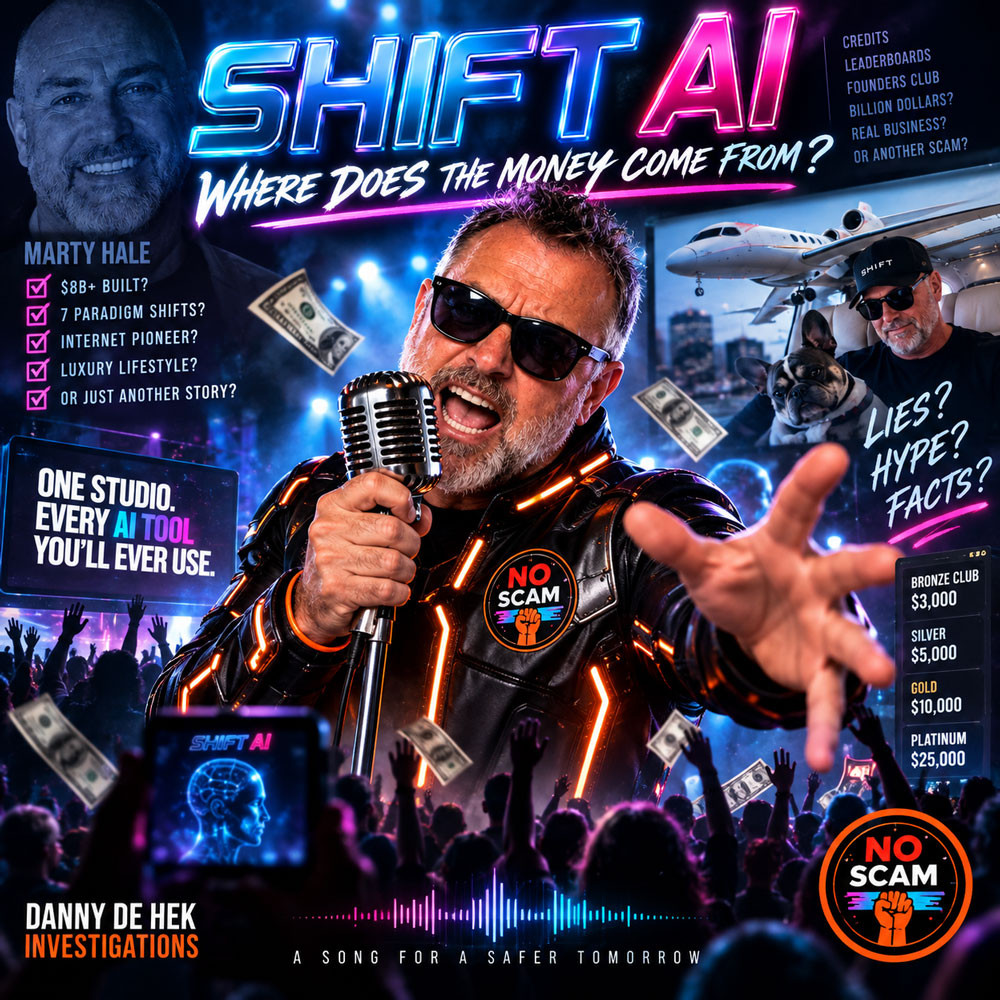 SHIFT AI is still in pre-launch. It hasn’t operated long enough for anyone to point to years of financial performance, sustained retail demand or a mature customer base and say, “There you go — the model works.” Marty Hale was presenting hypothetical earnings at 1,000, 10,000 and 100,000 participants while showing an ecosystem that, at the time, contained only 115 active club members and 45 active customers.
That means the burden isn’t on me to prove what SHIFT AI might become.
The people making the extraordinary claims need to prove them.
If SHIFT has genuinely developed proprietary technology capable of intelligently harnessing more than 20 leading AI systems, show us what has actually been built. If the AI brain, technology and compensation system are patented, provide the patents. If SHIFT has exclusive contracts with major AI companies, identify the agreements that can be independently confirmed. If 250 Founder positions really represent a fixed scarcity limit, explain why Founder recruitment continued months after an earlier presentation said the window would close.
Most importantly, show us the economics.
I want to know how much revenue comes from ordinary customers purchasing AI services because they genuinely want to use AI, compared with people purchasing credits because those credits affect club status, leaderboard positions and cash distributions. I want to know what happens to EcoPay when growth slows. I want to know whether a customer who has absolutely no interest in earning money would still choose SHIFT’s product, at SHIFT’s prices, over the rapidly evolving AI products already available elsewhere.
Because underneath all the terminology, that is the question I keep coming back to.
Marty describes people buying credits and leaving them unused. He describes participants reinvesting distributions into more credits. He explains how people can watch a leaderboard and purchase additional credits before the weekly cutoff. He claims 48% of weekly revenue arrives during the final ten minutes on Tuesday night, while participants are jockeying for position. And when somebody in his own presentation raised the question of a Ponzi scheme, Marty himself acknowledged that if everything were being paid through Credit Pay Hold, “it’d be a Ponzi scheme.”
That doesn’t establish that SHIFT AI is a Ponzi scheme, and I’m not going to pretend that it does.
But after investigating hundreds of online investment schemes, MLM opportunities and supposedly revolutionary platforms, I have learned to pay very close attention when the financial incentive to buy a product starts becoming more exciting than the product itself.
SHIFT AI says artificial intelligence is the product.
Right now, the presentations I have reviewed spend an extraordinary amount of time showing people what might happen to their money if everybody keeps buying more AI credits.
SHIFT AI now has an opportunity to prove that there is a sustainable business underneath those projections.
Until then, I won’t be watching the leaderboard.
I’ll be watching where the money comes from.
Disclaimer: How This Investigation Was Conducted
This investigation relies entirely on OSINT — Open Source Intelligence — meaning every claim made here is based on publicly available records, archived web pages, corporate filings, domain data, social media activity, and open blockchain transactions. No private data, hacking, or unlawful access methods were used. OSINT is a powerful and ethical tool for exposing scams without violating privacy laws or overstepping legal boundaries.
About the Author
I’m DANNY DE HEK, a New Zealand–based YouTuber, investigative journalist, and OSINT researcher. I name and shame individuals promoting or marketing fraudulent schemes through my YOUTUBE CHANNEL. Every video I produce exposes the people behind scams, Ponzi schemes, and MLM frauds — holding them accountable in public.
My PODCAST is an extension of that work. It’s distributed across 18 major platforms — including Apple Podcasts, Spotify, Amazon Music, YouTube, and iHeartRadio — so when scammers try to hide, my content follows them everywhere. If you prefer listening to my investigations instead of watching, you’ll find them on every major podcast service.
You can BOOK ME for private consultations or SPEAKING ENGAGEMENTS, where I share first-hand experience from years of exposing large-scale fraud and helping victims recover.
“Stop losing your future to financial parasites. Subscribe. Expose. Protect.”
My work exposing crypto fraud has been featured in:
Coffeezilla 2026): Featured in the investigation exposing the alleged $328M Goliath Ventures Ponzi scheme
Bloomberg Documentary (2025): A 20-minute exposé on Ponzi schemes and crypto card fraud
News.com.au (2025): Profiled as one of the leading scam-busters in Australasia
OpIndia (2025): Cited for uncovering Pakistani software houses linked to drug trafficking, visa scams, and global financial fraud
The Press / Stuff.co.nz (2023): Successfully defeated $3.85M gag lawsuit; court ruled it was a vexatious attempt to silence whistleblowing
The Guardian Australia (2023): National warning on crypto MLMs affecting Aussie families
ABC News Australia (2023): Investigation into Blockchain Global and its collapse
The New York Times (2022): A full two-page feature on dismantling HyperVerse and its global network
Radio New Zealand (2022): “The Kiwi YouTuber Taking Down Crypto Scammers From His Christchurch Home”
Otago Daily Times (2022): A profile on my investigative work and the impact of crypto fraud in New Zealand