

A long time ago, I started imagining a scoring system that could evaluate commander pairings in a more complete and objective way.
Why?
Because most rankings in Rise of Kingdoms tend to fall into one of two categories:
Subjective rankings, based on a content creator’s or player’s personal experience and preferences.
Theoretical rankings, based on mathematics and simulations that often struggle to account for the chaotic reality of open-field combat.
At the same time, with the emergence of report management platforms, the community gained access to an unprecedented amount of real battle data. Yet most discussions still revolve around a single metric: Trade Ratio.
Trade Ratio is important. But a march is much more than just its trade ratio.
A pairing can deal tremendous damage while having average trades, because slightly wounded troops also matter. It can provide exceptional support to allies and impact the performance of other marches. Skill cycle speed is important. Sustainability is often a concern as well.
That is the philosophy behind DRASTC (read Drastic) .
What is DRASTC?
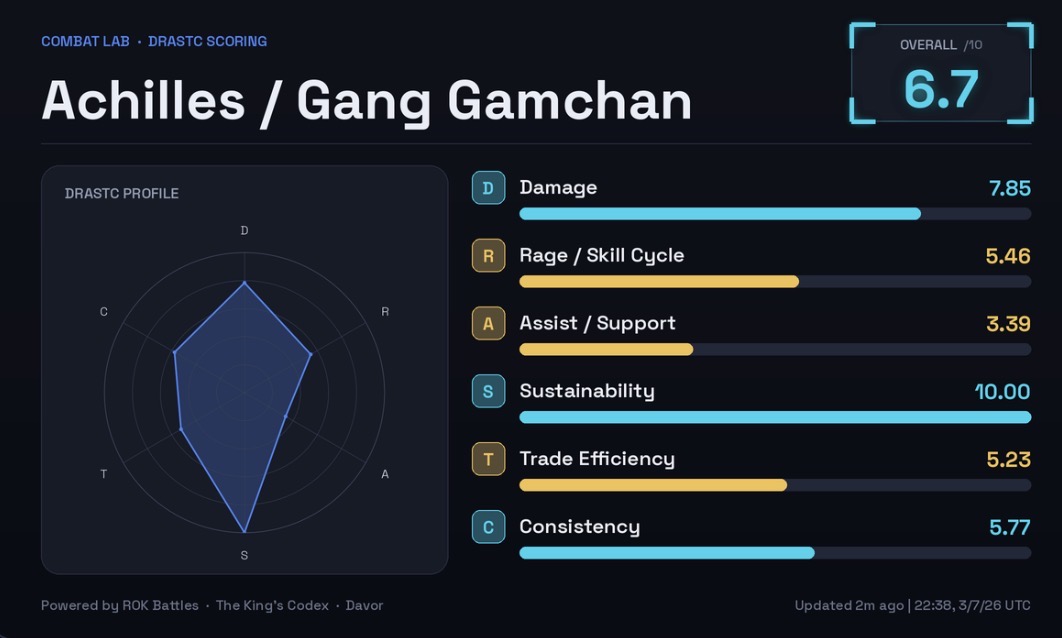
DRASTC (read Drastic) is a multi-dimensional evaluation system designed to measure commander pairings using real combat data.
Each letter represents a key aspect of a march’s performance:
D — Damage
Measures battlefield impact through wounded units inflicted over time (DPS), including both severely and slightly wounded units. Even slightly wounded troops matter, as they remove enemy fighting power from the field.
R — Rage / Skill Cycle Efficiency
Measures how efficiently a pairing generates rage and cycles through active skills. For sake of simplicty, this metrics had to stay static.
A — Assist / Support
Measures the value of buffs, debuffs, and other forms of battlefield support that cannot be fully captured by battle reports alone.
S — Sustainability
Measures a march’s ability to preserve its fighting strength over time, based on the rate at which it suffers wounded units while also accounting for healing.
This is a measure of observed battlefield sustainability, not theoretical tankiness. A low score does not mean that a pairing has no defensive ability; it means that, compared with other evaluated pairings, it is less effective at preserving its units over time in real battles.
T — Trade Efficiency
Measures the efficiency of a march's exchanges through the Weighted Trade metric.
Weighted Trade measures the overall efficiency of a pairing by comparing the total KP gained to the total KP lost across all battles. In this metric, every KP carries the same weight.
This differs from Average or Median Trade, where every battle carries the same weight regardless of its duration or the amount of KP exchanged. Those metrics provide a better indication of how a pairing typically performs in individual engagements.
For this reason, DRASTC uses Weighted Trade, as it provides the most representative measure of a pairing's overall battlefield efficiency.
C — Consistency
Measures how reliably a pairing delivers positive results across a large number of battles.
Overall Score
The overall DRASTC score is calculated from a weighted combination of the six categories. Each category contributes differently to the final score based on its relative importance in overall battlefield performance.
To ensure fair comparisons across all pairings, category scores are normalized using reference percentiles built from real battlefield data, with the 10th and 90th percentiles setting the 0–10 scoring range. Some categories also use a non-linear (curved) scoring model. This reflects the reality that the difference between a good pairing and an exceptional one is often much greater than a simple linear scale would suggest.
While the overall score provides a quick snapshot of a pairing's performance, the true strength of DRASTC lies in its category breakdown. Rather than reducing a march to a single number, DRASTC allows players to understand not only how well a pairing performs, but also why it performs that way, highlighting exactly where it excels and where it falls short.
From Idea to Reality
To bring this project out of the dust 😆, we needed one crucial ingredient:
Real data.
Because DRASTC only becomes meaningful when it is powered by actual battlefield performance.
That’s where the collaboration with RokBattles became the perfect match and a great opportunity.
A huge shoutout to Grigvar from RokBattles. It has been incredibly exciting to cook all these numbers, formulas, and ideas together.
And of course, thanks to Ruz from TKC and Dom from AQ/HQ, who are always looking to provide the best possible tools and resources to players.
Teamwork makes the dream work.
What’s Next?
From now on, players will be able to evaluate pairings through multiple lenses instead of looking exclusively at KP or Trade Ratio.
Future commander releases will also go through this new type of evaluation. Nothing will be exclusively subjective anymore.
No evaluation system will ever be perfect, but our goal is simple:
Less Opinion. More Data. The Complete Story of a Performance.
We’re incredibly excited to finally bring DRASTC to the Rise of Kingdoms community.
You can find the evaluation tool here in ROKBattles Combat Lab
And here in The King’s Codex Server and in AQ/HQ server.
And most importantly:
Give us your feedback.