


'Fire Colour'
by Sophie Friederike Mereau (née Schubart) (1770 – 1806)
I know a colour to which I am so dear,
I value it more highly than silver and gold;
I so gladly wear it around my brow and garments,
And have called it the 'colour of truth'.
The glowing rose blooms in lovely, gentle form,
But soon it fades.
Therefore it was consecrated as the flower of love;
Its charm is endless, yet it withers early.
The blue of the sky shines gloriously and mildly,
Therefore this friendly image was given to fidelity.
But many clouds cloud the ether so pure!
Thus, worries often creep into the faithful.
The colour of snow, so radiant and bright,
Is called the colour of innocence, but it does not last.
Soon the dazzling garment is darkened,
Thus, slander and envy also cloud innocence.
Why, you ask, have I so cherished the colour
The sacred name of truth?
Because a flaming gleam pours forth from it
And tranquil permanence embraces it protectively.
The drenching downpour does not harm it,
Nor does the sun's consuming light bleach it:
Therefore I so gladly wear it on my brow and garments
And have called it 'the colour of truth'.
'Feuerfarb'
Ich weiß eine Farbe, der bin ich so hold,
Die achte ich höher als Silber und Gold;
Die trag' ich so gerne um Stirn und Gewand
Und habe sie ,,Farbe der Wahrheit`` genannt.
Wohl blühet in lieblicher, sanfter Gestalt
Die glühende Rose, doch bleichet sie bald.
Drum weihte zur Blume der Liebe man sie;
Ihr Reiz ist unendlich, doch welket er früh.
Die Bläue das Himmels strahlt herrlich und mild,
D'rum gab man der Treue dies freundliche Bild.
Doch trübet manch' Wölkchen den Äther so rein!
So schleichen beim Treuen oft Sorgen sich ein.
Die Farbe des Schnees, so strahlend und licht,
Heißt Farbe der Unschuld, doch dauert sie nicht.
Bald ist es verdunkelt, das blendende Kleid,
So trüben auch Unschuld Verläumdung und Neid.
Warum ich, so fragt ihr, der Farbe so hold
Den heiligen Namen der Wahrheit gezollt?
Weil flammender Schimmer von ihr sich ergießt
Und ruhige Dauer sie schützend umschließt.
Ihr schadet der nässende Regenguß nicht,
Noch bleicht sie der Sonne verzehrendes Licht:
D'rum trag' ich so gern sie um Stirn' und Gewand
Und habe sie ,,Farbe der Wahrheit`` genannt.
xxxx
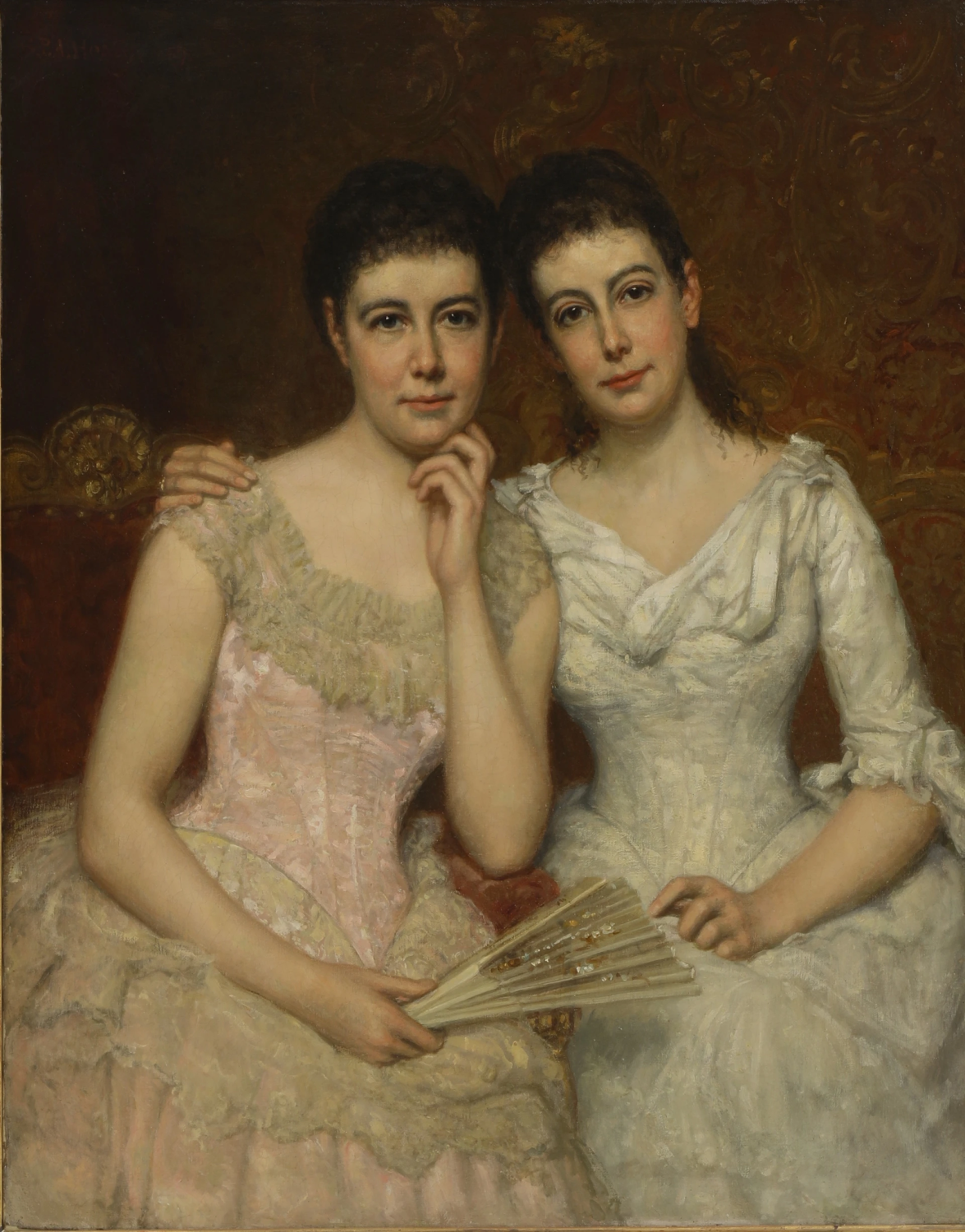
Portrait of Miss Sophie Burnley and Miss Charlotte Heath Burnley', 1887, George Peter Alexander Healy.
Georg Wilhelm Friedrich Hegel (1770 – 1831). Philosophy of Mind. Subjective mind.
§478
'Will as wilfulness is free for itself, in that it is reflected into itself as the negativity of its merely immediate self-determination. However in so far as the content, in which this formal universality of the will resolves itself into actuality, is still just the content of the urges and inclinations, the will is actual only as subjective and contingent will. It is a contradiction: it actualizes itself in a particularity, which is at the same time a nullity for it, and has a satisfaction in the particularity which it has at the same time left behind. As this contradiction, it is initially the process of distraction and of sublating one inclination or pleasure by another, and of sublating the satisfaction, which is just as much no satisfaction, by another to infinity. But the truth of particular satisfactions is the universal satisfaction, which the thinking will makes its purpose as happiness'.
- 'Philosophy of Mind'
The immediate self-determination of the will is a reference to the adoption of some particular urge, for instance the urge to drink, as its own, and yet the will is not entirely absorbed or engrossed in the urge to drink, as is someone who without reflecting at all merely gives way to his or her urge to drink. The will could have chosen to have sex rather than drink. and maybe it could have chosen to indulge neither urge and rather to go on the wagon or become celibate. And so the will is reflected into itself as the negativity and so on.....
The contradiction mentioned here is that between the fact that the will is reflected into itself, and so on, and not identical with or absorbed in any particular urge, and the fact that if it is to actualize itself, that is to say, will to do anything definite, it can only adopt some particular and contingent urge. In true Hegelian fashion the initial resolution of the contradiction is an infinite progression, moving from the satisfaction of one urge to the satisfaction of another urge: consult §426 on desire. Distraction is Zerstreuung, which literally means dispersion, scattering, strewing, an English relative of the root verb streuen, and so diversion, amusement. Happiness as it happens resolves both the contradiction and the infinite progression.
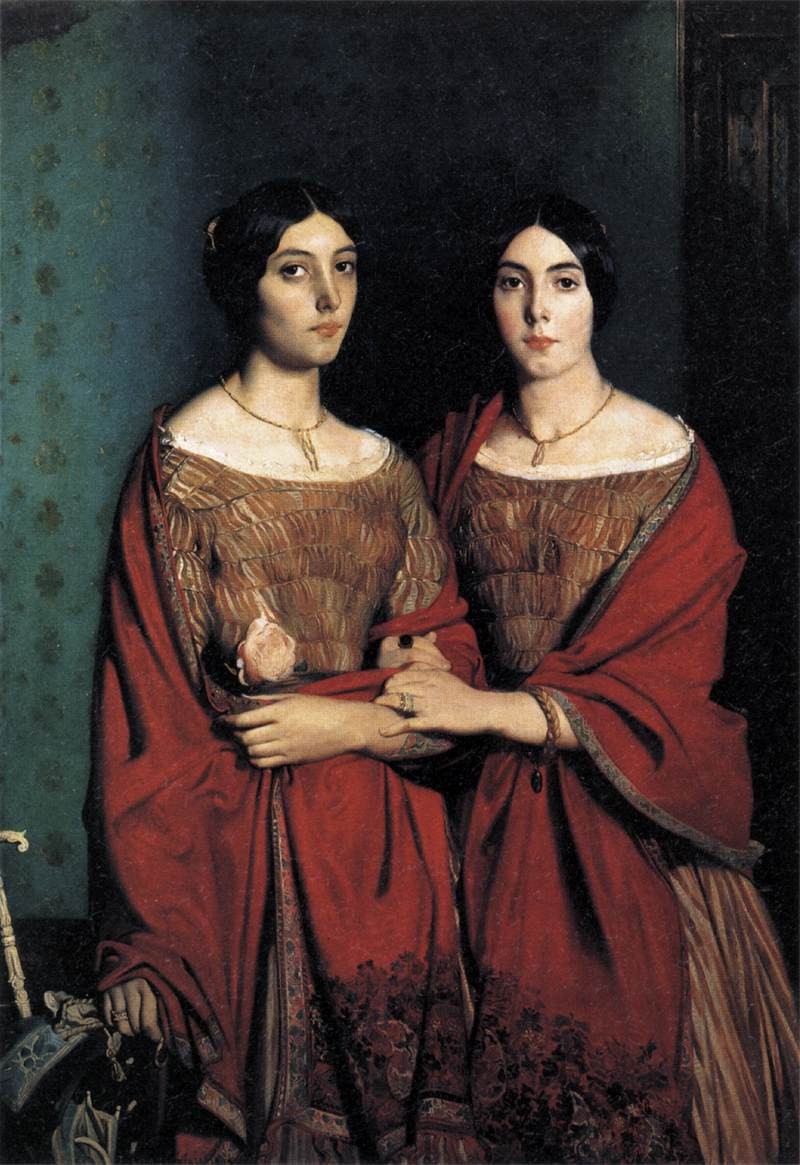
'The Two Sisters', 1843, Théodore Chassériau
( y) Happiness
§479
'In this representation, produced by reflective thinking, of a universal satisfaction, the urges, in respect of their particularity, are posited as negative; and they are supposed to be sacrificed, both sacrificed one to another for the sake of that purpose, and sacrificed to that purpose directly, in whole or in part. Their limitation by each other is, on the one hand, a mixture of qualitative and quantitative determination; on the other hand, as happiness has affirmative content in the urges alone, the decision lies with them, and it is subjective feeling and taste which must have the final say in deciding where its happiness lies'.
- 'Philosophy of Mind'
Happiness is in need of the sacrifice of one urge to another, for instance I do not drink as much as I would like because I also need to eat at some point. It also is in need of the sacrifice of the present satisfaction of an urge to the future satisfaction of the same urge, for instance if I decline a shot f vodka now I can have two shots of vodka later on.
What is meant by the sacrifice of an urge directly (direkt) to happiness?
Maybe the thought here is to do with such urges such as an urge to drink a bottle of vodka a day albeit one may equally consider the sacrifice of this urge as a sacrifice to a negative urge, such as an urge not to have a bloated liver or the alcoholic's dreary self-recriminations, rather than as a direct sacrifice to happiness.
If presented with an option between a peach and a pear I may opt for the peach because I prefer them to pears. This is one supposes a qualitative determination. And yet if I am presented with the option between one peach or one pear and a bunch of pears I might prefer the pears, a quantitative determination. Urges are limited by each other and yet they have the final word in the matter because what my happiness consists in depends upon what urges I happen to have (and I won't go here into what urges I happen to have).
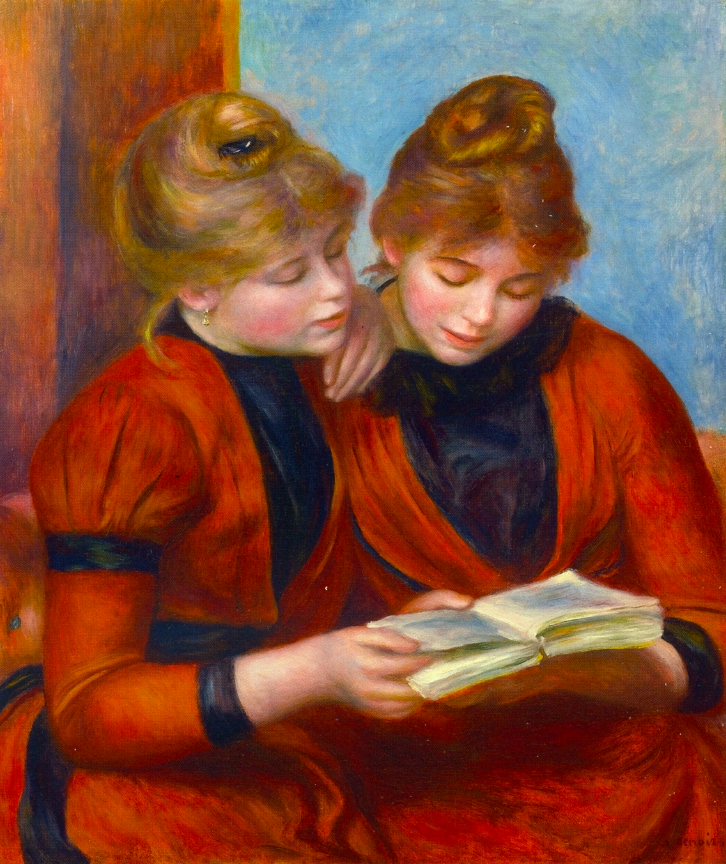
'Two Sisters', 1889, Pierre-Auguste Renoir
§480
'Happiness is only the represented, abstract universality of the content, a universality which only ought to be. But the truth of the particular determinacy, which just as much is as it is sublated, and of the abstract individuality, the wilfulness which both gives and does not give itself a purpose in happiness, is the universal determinacy of the will in the will itself, i.e. its very self-determination, freedom. In this way wilfulness is will only as pure subjectivity, which is pure and concrete at once, by having as its content and purpose only that infinite determinacy, freedom itself. In this truth of its self-determination, where concept and object are identical, the will is-actually free will'.
- 'Philosophy of Mind'
In contrast to the particular urges happiness is universal and yet its universality is simply represented (vorgestellte) by us, superimposed upon a collection of urges the intrinsic nature of which is not constituted or affected by it. In addition it is intrinsically empty, with no content of its own other than what it derives from the urges. And so it is abstract and not concrete universality: consult §§387, 445, 456, 469. As for the contention that this universality only ought to be (nur sein soll), this contains a certain ambiguity.
Does it mean:
(a) that it ought to be, but is not actual now, or
(b) that it is only supposed to be real, but is not actually real.
Contention (b) would follow naturally from the fact that happiness is merely represented and abstract, happiness is not real because it has no content of its own and is not inherent in the urges.
Contention (a) would present a new matter, happiness is always something that ought to be realized, but never actually is so.
We can bring together the two contentions given they are not unrelated.
Contention (a) appears to entail (b) albeit (b) does not entail (a).
Happiness is characterised in somewhat paradoxical ways. The particular determinacy, namely the urge, is sublated as much as it is, that is to say, it counts towards happiness and yet is sacrificed to other urges. Wilfulness gives itself a purpose, that is to say, it reaches a decision concerning what to do and yet it does not give itself a purpose, that is to say, it derives this decision from the urges. But there is something for the will to aim at which is not merely a function of the urges. This is the will’s own freedom, its self-determination and this is universal in a manner that a particular urge is not, pure that is. And yet it is in addition determinate, not merely a blank cheque waiting to be filled in by the urges, concrete that is, and were the will to make its own freedom its purpose it will be more fully self-determining, free, than it was before, because the concept, the will, and the object, the purpose of the will, are the same, namely freedom or the will itself. And now the will obtains its content or purpose from itself alone and does not depend upon contingent urges. Truth as well as freedom consists in the identity of concept and object: consult §§379, 381, 382. The formula makes for greater sense in the case of theoretical mind than in the case of the will for generally speaking we know what is meant by the claim that thought thinks about thought or that the mind thinks about the mind, and yet it is not so clear what is meant by saying that the will wills itself or wills freedom. For some elaboration upon this thorny subject consult §482.
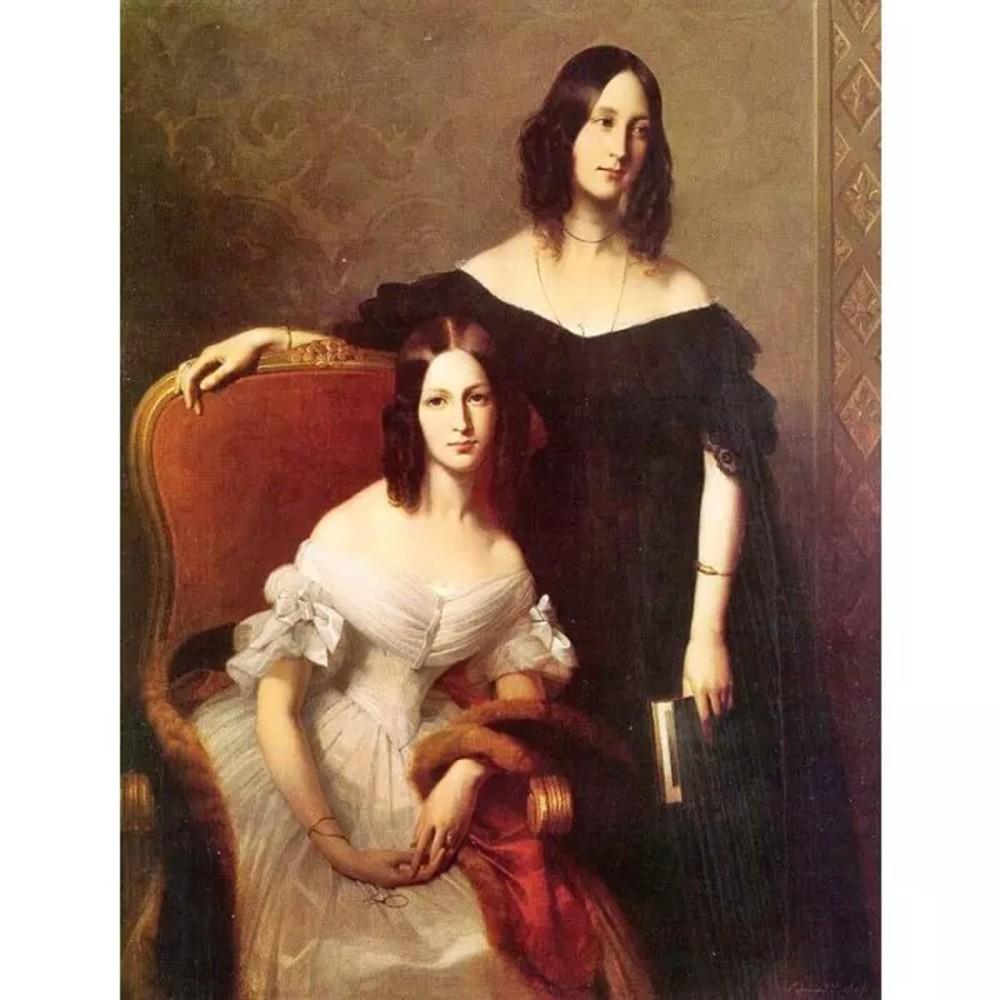
Portrait Of Two Sisters, 1840, Edouard Louis Dubufe
For my muse. Short and sweet this time.🌹
Love is only loneliness
Divided by another
Love is only living for the lonely
Love is only loneliness
Divided by another
And I know that life is lonely
Coming up next:
Free mind.
It may stop but it never ends.
,,