

In recent years, attackers have developed sophisticated techniques to breach air-gapped networks, raising critical questions about data security. Let’s explore how air-gapped attacks work and the methods cybercriminals use to bypass these high-security barriers.
In the world of cybersecurity, the concept of an air-gapped network is seen as one of the highest forms of defense against digital intrusion. An air-gapped system is physically isolated, meaning it is not connected to the internet or any other untrusted networks, making it much harder for attackers to gain access remotely. These systems are often used in high-security environments, such as military, critical infrastructure, financial institutions, or research facilities where sensitive data must be kept under strict protection. Yet, even with this extreme precaution, air-gapped systems are not immune to cyber threats.
What Are Air-Gapped Attacks?
An air-gapped attack is a cyber attack that successfully targets a network that is not connected to any other external network. Since air-gapped systems are typically isolated from the internet, attackers must use unconventional methods to bridge the gap. While it may seem nearly impossible to penetrate such systems, cyber attackers have proven otherwise.
The process of executing an air-gapped attack often involves physical access, trickery, and even manipulation of electromagnetic or acoustic signals to transmit data. This highly technical nature makes air-gapped attacks rare but very impactful.
How Do Air-Gapped Attacks Work?
To breach an air-gapped network, cyber attackers employ several techniques:
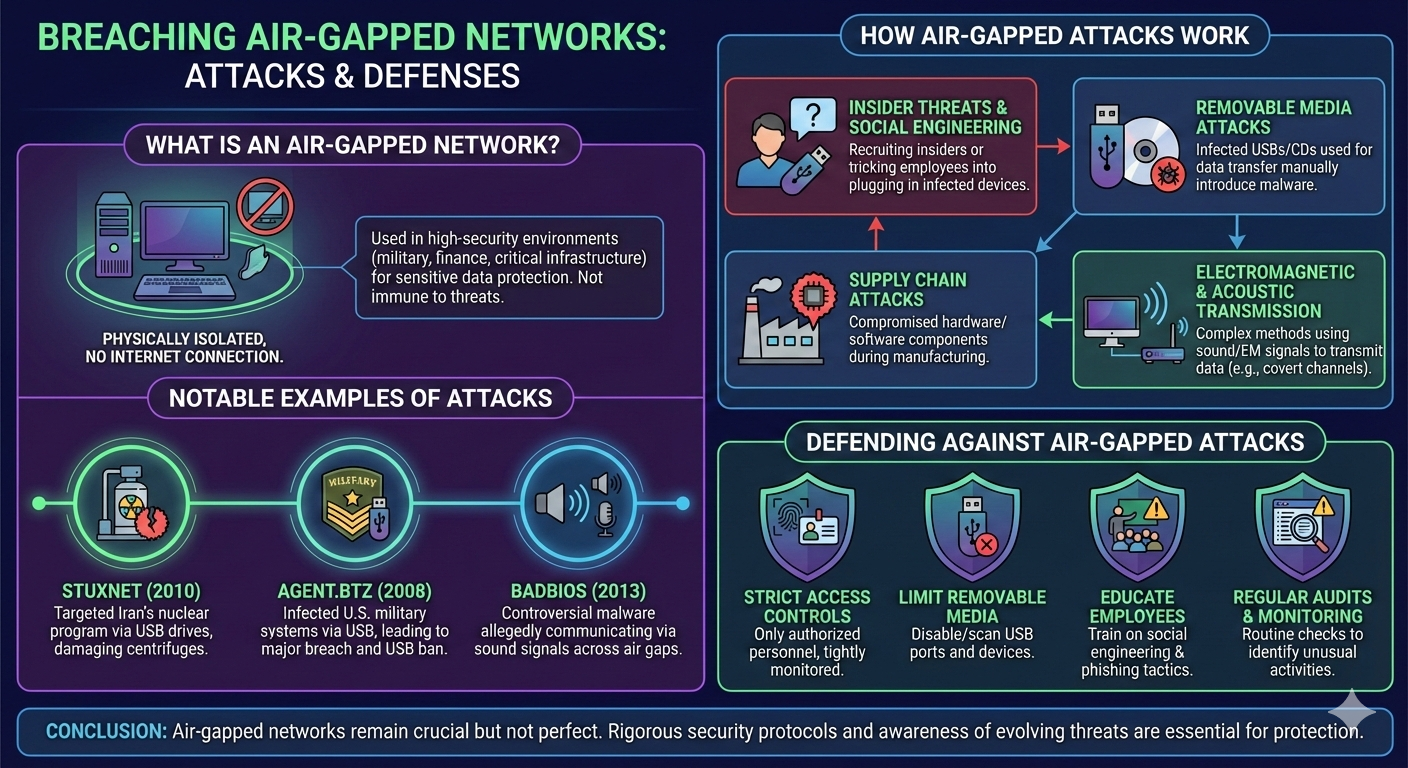
Insider Threats and Social Engineering: Attackers may attempt to recruit insiders within an organization or leverage social engineering to get someone to unknowingly introduce malware. A common tactic involves tricking employees into plugging an infected USB device into an air-gapped computer, allowing malware to infiltrate the system.
Removable Media Attacks (e.g., USB, CDs): Air-gapped attacks frequently involve removable media, as these are often allowed within isolated environments for data transfer. Malware can be loaded onto USB drives, DVDs, or CDs and later transferred manually to the targeted system.
Supply Chain Attacks: Attackers may compromise hardware or software components during manufacturing, allowing them to infect air-gapped devices once deployed. This method bypasses the organization’s initial security layers and leverages vulnerabilities introduced early in the supply chain.
Electromagnetic and Acoustic Transmission: In extreme cases, attackers use electromagnetic or sound waves to transmit data from an infected device within an air-gapped system to an external receiver. Techniques such as air-gap covert channels exploit the minute sounds and vibrations of computer components to send data, though these methods are highly complex and require specialized equipment.
Notable Examples of Air-Gapped Attacks
Some of the most significant cyber attacks in history have targeted air-gapped systems, showcasing the lengths attackers will go to breach even the most secure networks.
Stuxnet (2010): Perhaps the most famous air-gapped attack, Stuxnet was a cyber weapon allegedly developed by the U.S. and Israel to target Iran’s nuclear program. The malware was introduced via USB drives and spread through the network, eventually damaging Iran's centrifuges and setting back its nuclear capabilities.
BadBIOS (2013): Discovered by researcher Dragos Ruiu, BadBIOS was a sophisticated malware that supposedly could communicate across air-gapped systems by manipulating speaker and microphone signals, though its existence has been controversial and unconfirmed.
Agent.BTZ (2008): This malware was introduced to U.S. military systems through an infected USB drive, leading to a major security breach. The U.S. Department of Defense took significant countermeasures, including banning the use of USB devices for a period.
Defending Against Air-Gapped Attacks
Despite the risks, organizations can take several measures to secure air-gapped systems:
Enforce Strict Access Controls: Only authorized personnel should access air-gapped environments, and access should be tightly monitored.
Limit Removable Media Usage: Limiting or disabling USB ports and requiring scanning of all removable devices can reduce infection risks.
Educate Employees: Training staff on social engineering and phishing tactics can help prevent insiders from unknowingly introducing malware.
Regular Audits and Monitoring: Routine checks and auditing can identify unusual activities or possible breaches early.
Conclusion
Air-gapped networks remain a crucial element of high-security environments, but they are not a perfect shield against cyber attacks. As cybercriminals continue to develop sophisticated techniques, understanding and mitigating these unique risks becomes essential for organizations looking to protect their most sensitive data. By staying aware of evolving attack strategies and enforcing rigorous security protocols, organizations can better protect their air-gapped systems against even the most determined attackers.