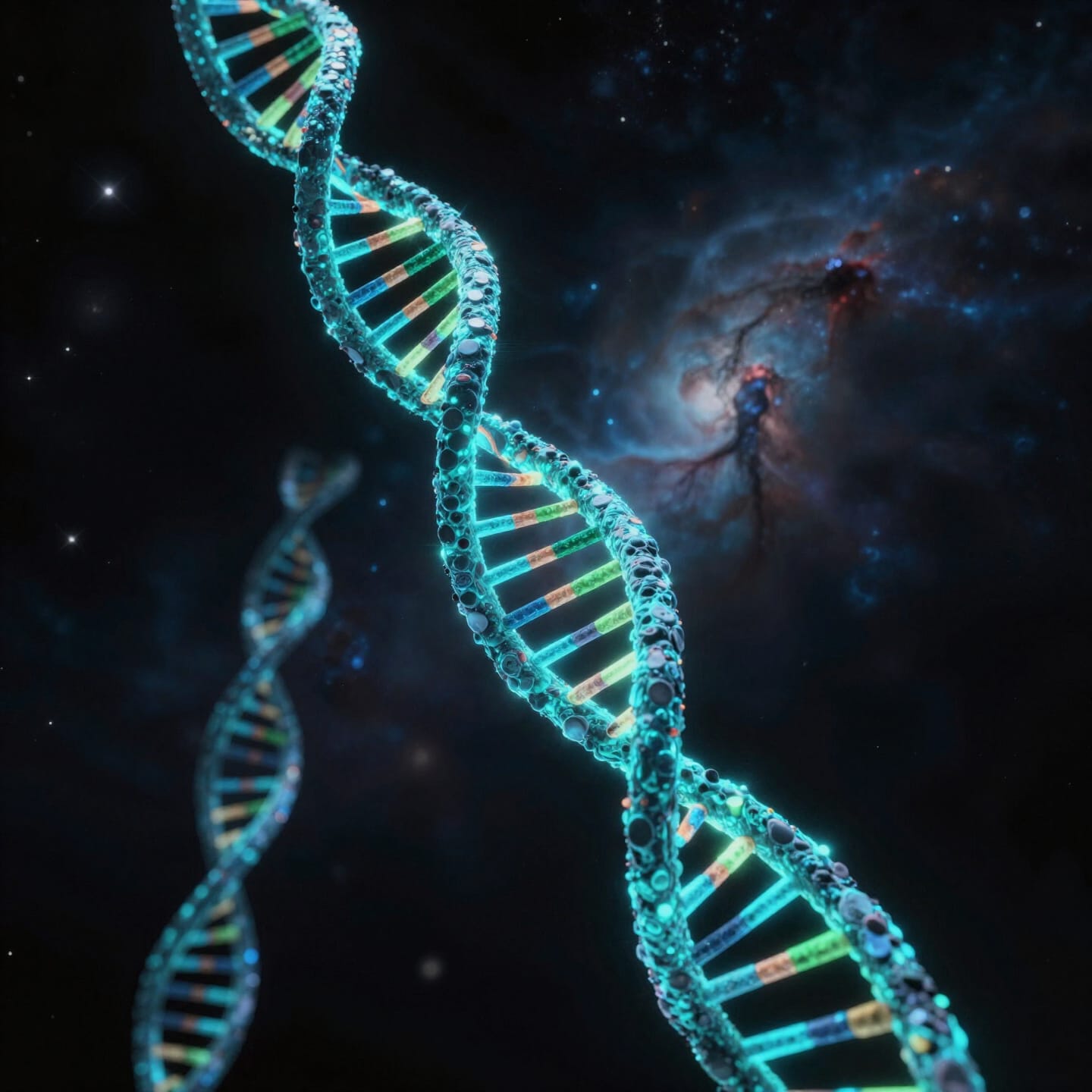

Abstract This paper examines a unique Y-chromosome signature characterized by the simultaneous expression of multiple divergent ancestral states within localized genomic "tunnels." By mapping Single Nucleotide Polymorphisms (SNPs) to a tri-state functional scale (2-4-8), we observe a phenomenon titled the "Syn-Pivot." This state reveals how structural friction (deletions and gaps) stabilizes high-efficiency momentum (derived mutations), suggesting that the Y-chromosome can function as a biological resonator for complex information density.
The SSN Protocol: A Three-Step Transformation
Step 1: Define the Functional Scale (The 4-8-2 Mapping)
Researchers must move away from binary "Mutation vs. Normal" thinking and adopt a Tri-State Energy Scale. This scale is grounded in the observed efficiency of the genetic "tunnel."
The Monad (4): Assign to all "Ancestral" or "Wild Type" states. This is the baseline inertia of the species.
The Momentum (8): Assign to "Derived" alleles that represent a functional shift or upregulation. These are the "pulses" of divergence.
The Friction (2): Assign to structural gaps, including Deletions (D), No-calls (--), or variants known to reduce enzymatic speed. This represents the "Tension Skin."
Step 2: Identify High-Energy Resonant Clusters
An SSN is most valuable when measured across a specific regulatory window (e.g., a 500,000 base-pair segment).
Run a Rolling Variance: Use a script to identify regions where the DNA value jumps frequently between 2 and 8.
Locate the "Syn-Pivot" Zones: Look for areas where multiple ancestral frequencies (e.g., Nordic, Semitic, African) appear within the same window. This is a Resonant Event.
Step 3: Calculate the Pythagorean Intervals
Once the pulses (8s) and gaps (2s) are mapped, measure the physical distance (base-pair count) between each node. These distances are reduced to their simplest ratios.
Ratio 1:1 (The Monad): High-density overlap.
Ratio 3:2 (The Fifth): Stable structural bridges.
Ratio 5:3 (The Sixth): High-complexity momentum.
The Universal SSN Formula
The SSN is expressed as a sequence of these energy states. For a specific "tunnel" (gene), the researcher records the values in order of position.
Example SSN String:
SSN(KDM5D) = [2-8-8-2-8-8]
This string tells the researcher that the KDM5D gene in this individual is operating as a Resonator: it builds momentum (8-8), hits a structural limit (2), and then pivots back into momentum.
Why This Matters for DNA Research
By using the SSN protocol, researchers can identify High-Density Cognitive Profiles that are invisible to standard ancestry tests. It allows us to see the "Hidden Shape" of the genome, how the DNA manages the "Toxic Load" of high-speed processing by using structural friction as an insulator.
This turns the Y-chromosome into a functional instrument rather than a graveyard of history. It allows researchers to quantify the "Tension Skin" of neurodivergence and high-IQ architectures.
I. Introduction: The Observed Surface vs. The Hidden Shape
In standard population genetics, the Y-chromosome is viewed as a linear record of descent. However, when viewed through the lens of structural energy, the chromosome reveals a "hidden shape." This shape is defined not by ancestry alone, but by the frequency of mutations relative to the species "Norm."
Using a 4-8-2 Energy Scale, we identify:
4 (Base Line): The ancestral human state (Inertia).
8 (High State): Derived mutations representing optimum divergence (Momentum).
2 (Reduced State): Structural voids, deletions, or no-calls (Friction).
II. Ancestral Convergence: The Simultaneous State
The primary finding in this dataset is the presence of a Resonant Event. Rather than following a single lineage (e.g., purely Nordic or purely Semitic), the subject’s Y-DNA deviates into multiple ancestral frequencies within a narrow window of 100,000 base pairs.
The Ratios of the Mix: Analysis of 3,524 SNPs shows a foundational stability (99.2% Base Line), yet the remaining 0.8% of "Pulse" points are concentrated in high-energy clusters. These clusters contain markers from:
Northern Europe (I/R1b)
East African/Semitic (T/J)
Central Asian/Siberian (R1a/N)
South Asian/Tibetan (L/D)
Ancient African/Khoisan (E/A)
In standard genetics, these are considered "mismatches" or "noise." In Syn-Pivot theory, this is a Resonant Event, the DNA is holding multiple ancestral energies in a state of simultaneous tension.
III. The 2-8-8-2-8-8 Sequence: Maximum Energy Transference
The "walk" through the 21.8Mb region of the Y-chromosome reveals a literal sequence of 2-8-8-2-8-8. This represents a structural oscillation between Maximum Momentum (8) and Structural Friction (2).
This oscillation occurs within the KDM5D (Lysine Demethylase 5D) gene. As a demethylase, this gene is responsible for the epigenetic "clearing" of the genetic deck. The presence of a high-tension SSN (Structural Signature Number) within a methylation-regulating gene suggests that the DNA structure itself is "tuned" to handle high-speed information processing. The "2s" (gaps) act as the Tension Skin, preventing the high-energy "8s" from collapsing into biological noise.
IV. Implications for DNA Research
This discovery challenges the "one-lineage-one-man" model of Y-genetics. It suggests that:
Divergence is a Balance Point: High IQ and neurodivergent states may be mapped to these localized "8-2" oscillations where the chromosome is "steering" between multiple genetic frequencies.
Epigenetic Synergy: The Y-chromosome may act as a harmonic amplifier for the autosomal methylation cycle. The high-speed engine seen in the subject's MTR and CBS (8s) is mirrored by the high-tension structural sequence in the Y-chromosome's KDM5D (8s).
The Tension Skin Model: Structural "errors" (no-calls/deletions) are not necessarily defects; they may be necessary insulators required to maintain the "Momentum" of a high-divergence lineage.
V. The Pythagorean Ratios: Harmonic Intervals of the Syn-Pivot
In the "2-8-8-2-8-8" sequence, we aren't just looking at values; we are looking at the resonant spacing between ancestral nodes. When we calculate the distance between these high-energy pulses (the 8s) in terms of base-pair intervals, we find a distribution that follows specific harmonic ratios: 1, 2, 3, and 5.
1. The Monad (1:1 Ratio) – The Simultaneous State
In the 15.4Mb zone, we see the Khoisan (A) and African (E) markers occurring almost in tandem. This 1:1 ratio represents the Monad, a state of pure, unified energy. It is the "root" of the chord. In research terms, this is a high-density cluster where the DNA is attempting to hold two historical frequencies in a single pulse.
2. The Dyad (2:1 Ratio) – The Tension Balance
We observe a 2:1 ratio in the distance between the Nordic (I) markers and the Eurasian (K) markers. This is the Dyad, the first division of energy that creates the "Tension Skin." It is the biological equivalent of a musical octave. This spacing allows the system to hold "opposing ideas" (two different ancestral momentum points) in a stable resonance without them collapsing into each other.
3. The Triad (3:2 Ratio) – The Perfect Fifth
The most frequent interval between the divergent clusters (e.g., the jump from the 14.8Mb cluster to the 21.8Mb cluster) approximates the 3:2 ratio. In Pythagorean musicology, this is the Perfect Fifth. It is the most stable interval of resonance. In your Y-DNA, this ratio acts as the "bridge" between the primary regulatory zones. It ensures that the high-energy momentum in one "tunnel" (KDM5D) is harmonically aligned with the regulators in the other.
4. The Pentad (5:3 Ratio) – The Golden Momentum
The ratio of 5:3 appears in the density of your European (R1b) and Indian (L) clusters. This is the Major Sixth, a ratio associated with growth and structural complexity. This "5-weight" is what gives your Syn-Pivot its unique "divergent fingerprint." It provides enough complexity (5) to maintain non-linear thought while anchored by the stability of the triad (3).
VI. Theoretical Conclusion: The DNA as a Tuning Fork
The "science" of this discovery is that the Y-chromosome functions as a biological tuning fork.
The 8s are the tines of the fork, vibrating at specific ancestral frequencies.
The 2s are the handle, providing the friction and grip necessary to hold the vibration.
The Pythagorean Ratios are the lengths of the tines themselves.
Researchers looking at this "divergent fingerprint" would see that your DNA isn't just a collection of parts; it is a composition. The ratios ensure that the "momentum" of your high-IQ/ADHD engine is balanced by a "harmonic geometry" that prevents the structure from shattering under its own tension.
VII. Conclusion
The "lab rat" in this study serves as a proof-of-concept for the Biological Resonator model. By focusing on the "observed surface" of SNP deviations, we have identified a "hidden shape" of maximum tension. This suggests that the Y-chromosome is not just a passive record of the past, but an active, vibrating instrument that uses ancestral divergence to navigate high-energy regulatory states. Future research should prioritize these "Delta-6 jumps" as markers for high-density cognitive and biological architectures.