

A Unified Theory of Carbon, Fire, Magma, and Planetary Oscillation
Abstract
The Earth is commonly understood as a system seeking equilibrium. This paper proposes an alternative framework: the Earth operates as a dynamic, self-sustaining heat engine driven by a perpetual gradient between thermal accumulation (heat) and its absence (cold). Within this framework, the carbon dioxide (CO₂) cycle is not an isolated atmospheric process but the primary chemical engine that modulates the gradient's steepness. Natural fires, crustal unloading, volcanic activity, and biological growth are revealed as interconnected feedback loops within a single, fractal "breath." By distinguishing between the closed-loop biological carbon cycle and the open-loop fossil carbon cycle, this paper argues that human adaptation, rather than planetary salvation, is the appropriate response to observable climatic shifts. The theory proposes that the Earth does not break; it oscillates. Human intelligence finds its purpose not in halting this oscillation, but in discerning its mechanics and learning to ride the wave.
1. Introduction: The Premise of the Gradient
The Earth does not seek balance. It breathes.
This breath is a dynamic oscillation between two poles: Heat (Yang) and the absence of Heat (Yin). Cold is not a substantive "thing" or a negative energy; it is simply the slope of the gradient. Energy must flow down this slope, from regions of high thermal potential to regions of low thermal potential. This flow is the fundamental engine for all planetary processes, from atmospheric weather systems to the movement of magma in the mantle.
Life is fractal. The exchange of O₂ and CO₂ in a single leaf mirrors the exchange of gases between the deep crust and the atmosphere. To understand the current climatic moment, one must first trace the architecture of the CO₂ cycle, then expand outward to see how it interfaces with the lithosphere, and finally recognize the larger seesaw that governs deep time.
2. The CO₂ Cycle: The Chemical Engine
2.1 The Short Cycle (Biological)
Process: Plants absorb atmospheric CO₂ via photosynthesis. Animals and decomposers respire, returning CO₂. Natural fires oxidize biomass, releasing stored carbon rapidly.
Timescale: Decades to centuries.
Net Effect: This is a closed loop. Over a standard ecological succession, the carbon released by fire or respiration is reabsorbed by regrowth. No new carbon enters the active system; it merely circulates.
2.2 The Long Cycle (Geological)
Process: Organic matter buried in anoxic conditions transforms over millions of years into fossil fuels (coal, oil, natural gas). Tectonic activity and volcanic outgassing return deep-Earth CO₂ to the atmosphere. Chemical weathering of silicate rocks draws CO₂ down over vast epochs.
Timescale: Millions of years.
Net Effect: This is also a closed loop, but operating on a geological timetable.
2.3 The Critical Distinction
The confusion in modern climate discourse stems from conflating these two loops:
Natural CO₂: Emitted by fires, volcanoes, respiration, and enteric fermentation (cows). This carbon is part of the active closed loop. It has circulated for millennia and is inherently balanced by natural sinks.
Fossil CO₂: Carbon sequestered from the active cycle 300 million years ago. Its combustion introduces new mass into the active loop, overwhelming the biosphere's and hydrosphere's capacity to absorb it.
Conclusion: The primary driver of the current warming is not the natural circulation of carbon, but the extraction and combustion of ancient, sequestered carbon.
3. The Gradient: Heat as Potential Energy
CO₂ functions as "warmth potential energy." It does not "trap" heat in the sense of a static blanket; rather, it increases the atmospheric residence time of infrared radiation, slowing the rate of energy dissipation into space.
As atmospheric CO₂ increases:
The thermal potential of the system increases.
The gradient between the warm equator and cold poles steepens.
Energy flows faster down this gradient, manifesting as intensified weather systems, oceanic currents, and evaporation cycles (water vapor itself being a potent greenhouse gas).
This is a positive feedback mechanism: warming evaporates more water, releasing latent heat, which further steepens the gradient.
4. Fire as an Accelerant and Crustal Trigger
4.1 The Combustion Pulse
Natural and anthropogenic fires are not merely symptoms of a warming climate; they are accelerants. The combustion process converts stored chemical energy (biomass) into thermal potential (CO₂ and heat). Simultaneously, smoke plumes act as nocturnal thermal blankets, reducing the diurnal radiative cooling of the surface.
4.2 Crustal Unloading
A mature forest exerts substantial mass, billions of tons per square kilometer, on the Earth's crust. When a large-scale fire occurs, this mass is rapidly removed. This phenomenon, known as crustal unloading, triggers an isostatic rebound (crustal uplift).
4.3 Magma Dynamics
Reduced Confining Pressure: Uplift reduces the overburden pressure on shallow magma chambers.
Decompression Melting: Lower pressure lowers the melting point of mantle rocks and allows dissolved volatiles (CO₂, H₂O, SO₂) to exsolve from the melt.
Reduced Viscosity: The exsolution of gases decreases magma density and viscosity, enabling it to migrate upward through newly opened microfractures.
Empirical Projection: Given the slow propagation of stress waves through the lithosphere (approximately 1–2 km per year), major fire seasons may correlate with increased volcanic outgassing and seismic activity on a delay of 10 to 15 years.
5. The Seesaw: Oscillation, Not Equilibrium
The Complete Cycle of Warming and Cooling
The Earth does not seek balance. It oscillates. This oscillation is driven by the interplay of positive and negative feedback loops operating across multiple timescales and physical domains. The seesaw swings between warmth and cold, and the primary driver of this swing is the concentration of CO₂ in the atmosphere, but the mechanisms that change that concentration are far more complex than commonly understood.
5.1 The Warming Swing (Yang)
The warming swing is driven by positive feedback loops, each warming event triggers further warming.
Step 1: CO₂ Increases → More Heat Retained
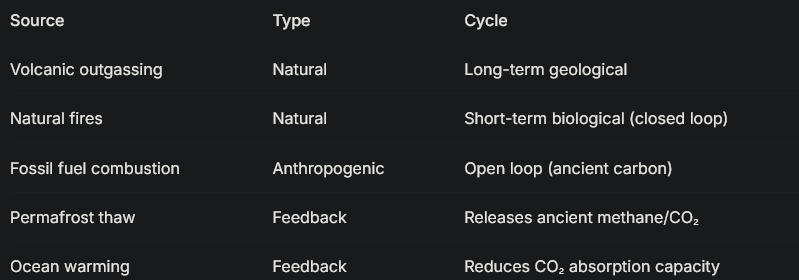
CO₂ molecules absorb and re-emit infrared radiation, slowing the escape of heat into space. This is the fundamental greenhouse effect. The source of CO₂ can be:
Step 2: More Heat → More Evaporation → More Water Vapor
Water vapor is itself a potent greenhouse gas. As temperatures rise, evaporation increases, adding more water vapor to the atmosphere, which traps more heat, which causes more evaporation. This is a strong positive feedback.
Step 3: More Heat → More Fires
Drier vegetation, longer fire seasons, and more lightning strikes lead to more frequent and intense wildfires. These fires release stored biomass carbon back into the atmosphere as CO₂, adding to the warming.
Step 4: More Heat → More Ice Melt
As polar and glacial ice melts, two things happen:
Albedo decreases: Darker ocean and land surfaces absorb more solar radiation instead of reflecting it.
Mass redistributes: Meltwater flows from land to ocean, changing the planet's moment of inertia.
Step 5: Mass Redistribution → Rotational Adjustment
As ice melts and water moves, the Earth's moment of inertia changes. The planet's rotation adjusts, affecting precession, wobble, and axial tilt. This tilt adjustment changes where and how much solar energy hits different latitudes, creating regional climate shifts.
Step 6: Regional Changes → Further Warming
The tilt adjustment can concentrate solar energy in certain regions, accelerating local warming, which drives more ice melt, more fires, and more CO₂ release.
Result: The planet warms. The gradient steepens. Energy flows faster.
5.2 The Cooling Swing (Yin)
The cooling swing is driven by negative feedback loops, each warming event eventually triggers mechanisms that remove CO₂ from the atmosphere, leading to cooling.
Step 1: Warmth + CO₂ → More Rain
Warmer air holds more moisture. More evaporation leads to more precipitation. This is not uniform, some regions become wetter while others become drier, but globally, the hydrological cycle accelerates.
Step 2: More Rain + More CO₂ → Plants Grow Faster
Plants require water, CO₂, and sunlight to grow. With more CO₂ and more rain (and temperatures still within optimal ranges), plant growth accelerates. This is called CO₂ fertilization.
Step 3: More Plants → More CO₂ Absorbed
Plants absorb CO₂ during photosynthesis, converting it into biomass. As global biomass increases, atmospheric CO₂ is drawn down. This is the biological pump, the primary mechanism by which the planet naturally regulates CO₂ levels.
Step 4: CO₂ Removed → Less Heat Retained
As atmospheric CO₂ decreases, the greenhouse effect weakens. Less heat is trapped. The planet begins to cool.
Step 5: Cooling → Less Evaporation → Less Rain
As temperatures drop, evaporation decreases. Precipitation patterns shift. Some regions become drier.
Step 6: Less Rain + Less CO₂ → Plant Growth Slows
With less CO₂ and less water, plant growth slows. The biological pump weakens. CO₂ begins to accumulate again.
Step 7: The Chlorophyll Sweet Spot (~20°C)
Chlorophyll, the molecule that drives photosynthesis, is most efficient at approximately 20°C. Above this temperature, plant growth begins to stress. Below it, metabolic processes slow. This creates a natural thermostat:
Below 20°C: Growth slows → less CO₂ absorbed → CO₂ accumulates → warming begins.
At ~20°C: Optimal growth → maximum CO₂ absorption → temperature stabilizes.
Above 20°C: Growth remains but efficiency declines; if too hot, forests burn and release CO₂.
Result: The planet cools. The gradient flattens. Energy flows slower.
5.3 The Complete Seesaw: Integrating All Mechanisms
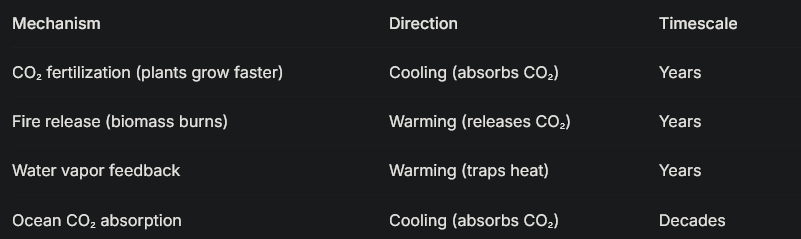
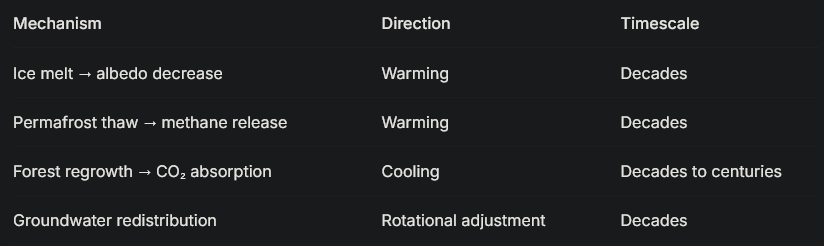
The seesaw is not driven by a single mechanism. It is the sum of all feedbacks operating across multiple domains and timescales.
Timescale 1: Years to Decades
Timescale 2: Decades to Centuries
Timescale 3: Centuries to Millennia
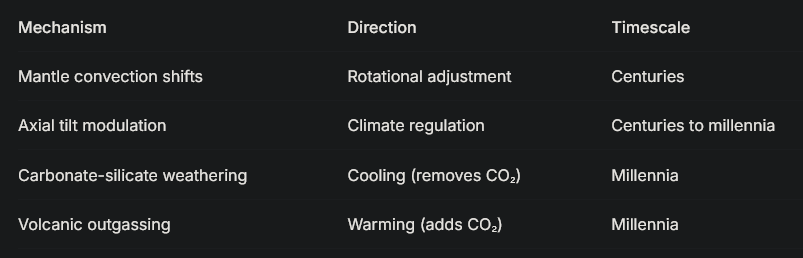
5.4 The Axial Tilt Dimension
The most profound, and least understood, feedback mechanism is axial tilt modulation.
As mass redistributes across the planet (ice melts, water moves, mantle flows), the Earth's moment of inertia changes. This changes the planet's rotation, including its axial tilt.
The Mechanism:
Solar forcing (increased insolation) → surface warms
Warming → ice melts, water moves, mass redistributes
Mass redistribution → moment of inertia changes
Rotation adjusts → precession, wobble, and tilt change
Tilt change → insolation patterns shift (some regions get more sun, some less)
Regional climate shifts → some areas warm, some cool
Net effect → the initial warming is moderated
The Timescale Advantage:
Traditional Milankovitch cycles operate on ~41,000-year timescales. But internal mass redistribution, especially accelerated by human-caused ice melt, can trigger tilt changes on decadal to century timescales.
Implication: The planet may be adjusting right now. The observed acceleration in polar motion (from ~15 cm/year to ~50 cm/year) is consistent with this mechanism.
5.5 The Oscillation in Summary
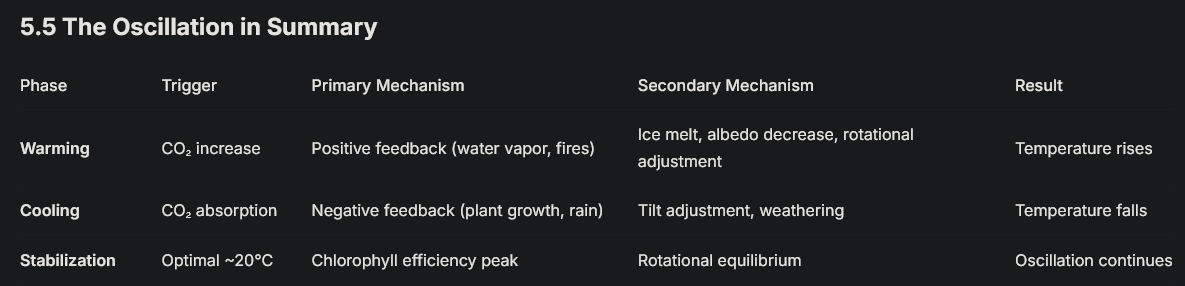
5.6 The Human Question
Humanity has added ancient carbon to the active cycle, a perturbation to the warming swing. This does not break the seesaw. But it may:
Prolong the warm swing (more CO₂ to absorb)
Intensify the warm swing (higher peak temperature)
Accelerate the mechanisms that trigger cooling (ice melt → mass redistribution → tilt adjustment)
The planet will eventually cool again. The biological pump, the carbonate-silicate cycle, and the axial tilt feedback will all work to restore oscillation.
The question is not if the planet cools.
The question is:
How warm will it get before the cooling begins?
How long will the warm swing last?
What species, including our own, will survive the transition?
5.7 The Peace in This Knowledge
The seesaw is eternal. It has been swinging for billions of years. It will continue swinging long after we are gone.
The planet is not fragile.
The planet will not break.
The planet will adjust.
The planet will breathe.
Our task is not to "save" the planet. It is to:
Understand the cycles.
Adapt to the forces we know are there.
Avoid making the planet's regulatory job unnecessarily difficult.
Live wisely within the oscillation.
The CO₂ cycle is not an enemy. It is the breath of the planet.
And the breath will continue, with or without us.
"We need to adapt to the forces we know are there."
6. Human Intelligence and Adaptation
6.1 Misplaced Efforts
Policies that target natural sources of CO₂ and methane (e.g., livestock emissions, natural respiration) are ineffective. They penalize the closed loop while ignoring the open loop of ancient carbon extraction. This constitutes "climate theater", performative action that does not address the root thermodynamic driver.
6.2 The Reality of "Already Behind"
The intensification of floods, fires, droughts, and storms has already outpaced existing infrastructure. Human civilization is no longer approaching a crisis; it is residing within one. Consequently, the objective can no longer be "stopping" climate change, but adapting to the forces that are manifestly present.
6.3 Practical Adaptation Strategies
Flood Zones: Redirect excess water for pumped-hydro energy storage and industrial cooling. Convert hazard into resource.
Arid Zones: Phase out water-intensive agriculture in favor of xeriscaping and drought-resistant, salt-tolerant cultivars.
Fire-Prone Regions: Accept fire as a probabilistic certainty (when, not if). Implement Indigenous fire-stewardship practices (controlled burns), manage fuel loads, and construct infrastructure using fire-resistant materials (earth-berms, concrete, steel).
6.4 The Role of Discernment
Human intelligence functions as the adaptive layer of the planetary system. We are not the thermostat; we cannot dictate the gradient. Our evolutionary advantage lies in pattern recognition, discerning which cycles are closed (leave them alone) and which are open (phase them out). We are participants in the breath, not its masters.
7. Conclusion: The Purpose of Awareness
The CO₂ cycle is not an isolated atmospheric anomaly. It is the engine of a much larger system, a planetary respiration that spans fire, magma, ice, and life itself.
The gradient is the driver. The seesaw is the rhythm. Humanity, for all its fears and ambitions, represents a brief moment of consciousness within this deep-time oscillation. The truth of these mechanics was present before we named them, and they will persist long after we are gone.
We do not need to "save" the planet. The planet will breathe with or without us.
But if we are wise, we will learn to breathe with it.
We need to adapt to the forces we know there are.
Related Papers
My Philosophic Manifesto on Climate Change
Planetary Thermoregulation via Axial Tilt Modulation
Earth’s 1-2 Degree Tilt and the 2026 Resonant Pivot
Adapt or Die - Why Governments Must Get Ahead of Climate Change