

Executive Summary
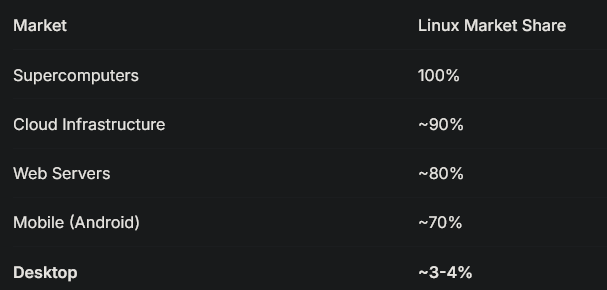
Linux dominates the server room, the cloud, and supercomputing. It runs on 100% of the world's top 500 supercomputers and powers over 90% of cloud infrastructure. Yet on the desktop, the place where users are made, where habits are formed, where generations grow up thinking "computer = Windows", Linux remains a niche player with approximately 3-4% market share.
This is not because Linux is technically inferior. It is not because the user interface is too complicated. It is not because there aren't enough applications or because the command line scares people.
The reason is far simpler and far more damning: the drivers don't work.
Hardware manufacturers spend millions developing drivers for Windows because it is profitable. They spend nothing on Linux because it is not. And the open-source community, driven by ideology rather than economics, has spent 20 years expecting volunteers to reverse-engineer and maintain drivers for free.
That experiment has failed. It failed because software, like anything else, requires time, energy, and resources to create and maintain. And as one user bluntly put it: "You get nothing for nothing. The person that makes a driver loses time, power, and whatever else they could be doing, like getting a girlfriend."
This paper proposes a solution: a paid driver marketplace with microtransactions, developer royalties, and a bounty pool. It is a system designed to align economic incentives with open-source development, creating a sustainable ecosystem that finally solves the driver problem and liberates the desktop from Microsoft's monopoly.
Part I: The Problem, Why Linux Failed on the Desktop
1.1 The Server Victory
Linux conquered the server room through pure economics. A Windows Server license can cost thousands of dollars per machine. A Linux server costs nothing. Companies running thousands of servers saved millions by switching. The result was inevitable: the web runs on Linux.
The desktop never received this economic push for three reasons:
Windows came pre-installed on virtually every PC sold.
The cost of the OS was hidden in the hardware price.
The average user saw no direct financial benefit to switching.
1.2 The Driver Bottleneck
When a user does try Linux, they hit a wall almost immediately:
Their Wi-Fi card doesn't work.
Their printer is unrecognized.
Their NVIDIA GPU requires hours of troubleshooting.
Their audio chip produces static or silence.
The user then has two options:
Spend hours, sometimes days, searching forums, copy-pasting terminal commands, compiling kernel modules, and praying.
Reinstall Windows and get back to work.
Most choose option 2. The cost of the "tinkering tax" (time, frustration, lost productivity) exceeds the cost of a Windows license.
1.3 The Economic Reality
Writing a driver is not trivial. A typical driver requires:
80-200 hours of development time.
Deep knowledge of hardware specifications.
Expertise in kernel internals.
Ongoing maintenance for kernel updates.
A skilled developer's time is worth $50-$150 per hour. A driver therefore represents $4,000-$30,000 of investment.
Who pays for this on Linux?
Volunteers? They burn out.
Hardware vendors? They see no profit.
The Linux community? It has no budget.
The result: 20 years of broken hardware, frustrated users, and a desktop market that remains Microsoft's captive audience.
Part II: The Insight, Why a Marketplace Works
2.1 The Core Principle
"If there is no money involved, nothing will change."
This is not cynicism; it is thermodynamics. Resources are finite. Time is finite. Energy is finite. If we want something to be created, we must provide the resources for its creation.
The Linux community has been asking for something for nothing, and receiving exactly that.
2.2 The Microtransaction Model
The proposed solution is simple:
User scans their system via a lightweight client.
System identifies missing or broken drivers.
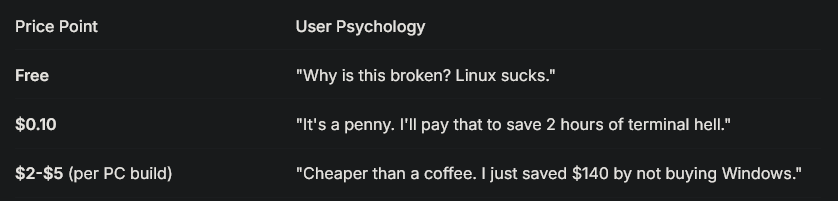
User pays a small fee ($0.10 per driver) to download a verified, pre-compiled driver.
Revenue is split:
70% to the developer who wrote the driver (royalties).
20% to the platform (testing, hosting, administration).
10% to a bounty pool (funding new driver development).
This is the economic engine that transforms drivers from a "thankless chore" into a "passive income stream."
2.3 Why $0.10 Works
2.4 The Developer's Incentive
Consider a developer, Alex.
Alex writes a driver for a Realtek Wi-Fi chip. It takes 80 hours.
The driver is downloaded 100,000 times.
Revenue: 100,000 × $0.10 = $10,000.
Alex's share (70%): $7,000.
Alex now earns $7,000 in passive income from one driver.
If Alex writes 10 popular drivers, they earn $70,000/year. They can quit their day job. They can write drivers full-time. They can maintain and improve their code. They can even get a girlfriend.
This is not charity. This is economics.
Part III: The Solution, A Complete Driver Marketplace
3.1 System Architecture
┌─────────────────────────────────────────────────────────────────────┐
│                     DRIVER MARKETPLACE ARCHITECTURE                 │
├─────────────────────────────────────────────────────────────────────┤
│                                                                     │
│  ┌──────────────┐               ┌──────────────────┐                │
│  │   User PC    │─────────────▶│   Scan Client     │               │
│  └──────────────┘               │  (CLI or GUI)    │                │
│         │                       └────────┬─────────┘                │
│         │                                │                          │
│         │                                ▼                          │
│         │                       ┌──────────────────┐                │
│         │                       │   Hardware       │                │
│         │                       │   Detection      │                │
│         │                       │   (Device IDs)   │                │
│         │                       └────────┬─────────┘                │
│         │                                │                          │
│         │                                ▼                          │
│         │                       ┌──────────────────┐                │
│         │                       │   Driver         │                │
│         │                       │   Repository     │                │
│         │                       │   (Verified)     │                │
│         │                       └────────┬─────────┘                │
│         │                                │                          │
│         │                                ▼                          │
│         │                       ┌──────────────────┐                │
│         │                       │   Payment        │                │
│         │                       │   Processor      │                │
│         │                       │   (Stripe/etc)   │                │
│         │                       └────────┬─────────┘                │
│         │                                │                          │
│         │                                ▼                          │
│         └─────────────────────▶┌──────────────────┐                │
│                                 │   Driver         │                │
│                                 │   Download       │                │
│                                 │   + Install      │                │
│                                 └──────────────────┘                │
│                                                                     │
└─────────────────────────────────────────────────────────────────────┘
3.2 Revenue Flow
                    ┌──────────────────────────────┐
                    │   User pays $0.10 per driver │
                    └──────────────┬───────────────┘
                                   │
                                   ▼
                    ┌──────────────────────────────┐
                    │        Revenue Split         │
                    └──────────────┬───────────────┘
                                   │
          ┌────────────────────────┼────────────────────────┐
          │                        │                        │
          ▼                        ▼                        ▼
┌──────────────────┐   ┌──────────────────┐   ┌──────────────────┐
│  70% Developer   │   │  20% Platform    │   │  10% Bounty      │
│   Royalties      │   │   Fee            │   │   Pool           │
├──────────────────┤   ├──────────────────┤   ├──────────────────┤
│ Passive income   │   │ Testing &        │   │ Fund new drivers │
│ for the author   │   │ Hosting costs    │   │ User-voted       │
│                  │   │ Administration   │   │ priorities       │
│                  │   │ Support          │   │                  │
└──────────────────┘   └──────────────────┘   └──────────────────┘
3.3 The Bounty Pool
The bounty pool is a critical feature that ensures drivers get written for every piece of hardware, not just the most popular ones.
How it works:
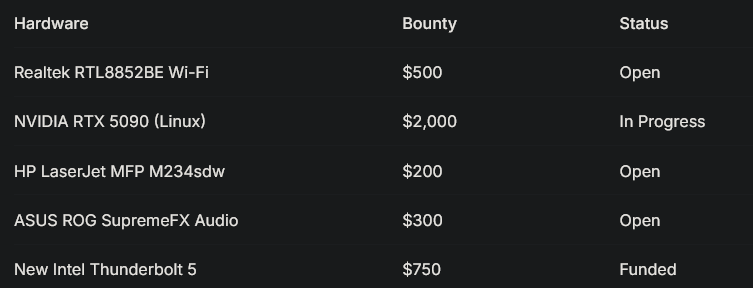
Users submit bounties for hardware that lacks drivers.
Users vote with their wallets, the more people need a driver, the higher the bounty grows.
Developers claim bounties, they receive the pool payout in addition to their 70% royalties.
The platform adds 10% of every download to the bounty pool to keep it funded.
Example Bounty Board:
This solves the "chicken and egg" problem:
No driver → No users → No revenue → No developer.
But with bounties, users can collectively fund the driver they need.
3.4 The Testing Pipeline
Users won't pay for drivers that might crash their system. Trust is essential.
Submission and Testing Flow:
Developer submits:
Driver source code.
Pre-compiled binary.
List of supported hardware IDs.
Test hardware used during development.
Automated Testing:
The driver is compiled against 5 kernel versions.
Sandboxed VMs test the driver against virtualized hardware.
Automated tests check for crashes, memory leaks, and performance.
Human Review:
Security audit (paid from platform fee).
Code quality review.
Performance validation.
Approval:
Driver is added to the "Stable" repository.
Developer begins earning royalties.
Ongoing Maintenance:
Kernel updates trigger re-testing.
Developer must update the driver within 30 days or it is marked "Legacy."
3.5 Enterprise and OS Vendor Model
The platform can also offer bulk licensing to enterprises and operating system vendors.
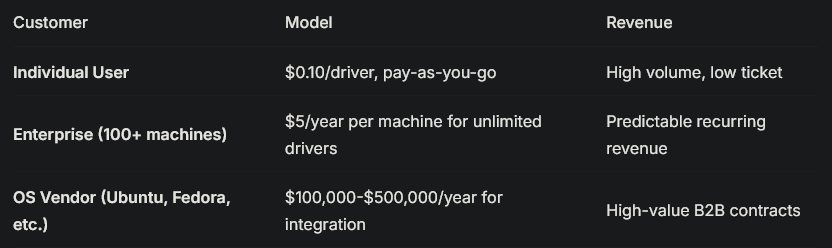
Why this works:
Enterprises need guaranteed compatibility and SLA support.
OS vendors are desperate to solve the driver problem, it is their biggest adoption barrier.
Canonical (Ubuntu), Red Hat, and Valve (SteamOS) would each pay millions to integrate this service.
Part IV: The Business Case
4.1 Market Opportunity
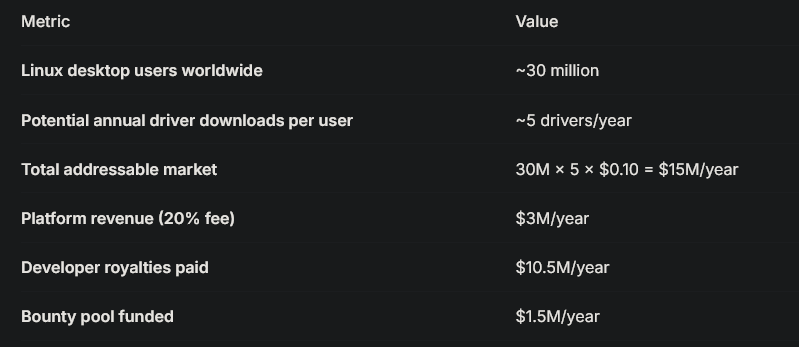
This is a sustainable, profitable business with a clear path to scale.
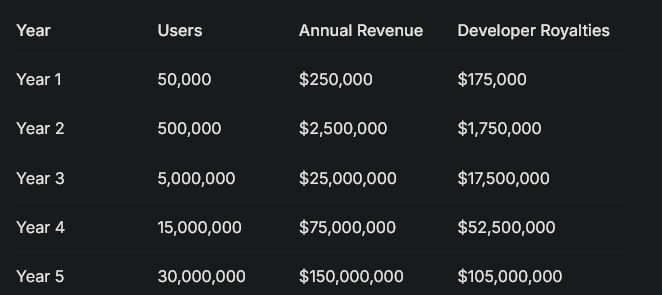
4.2 Growth Projections
4.3 Exit Strategy
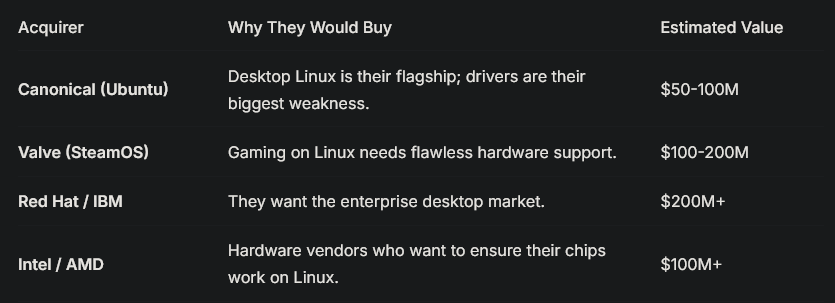
This business has several natural acquisition paths:
4.4 Investment Requirements
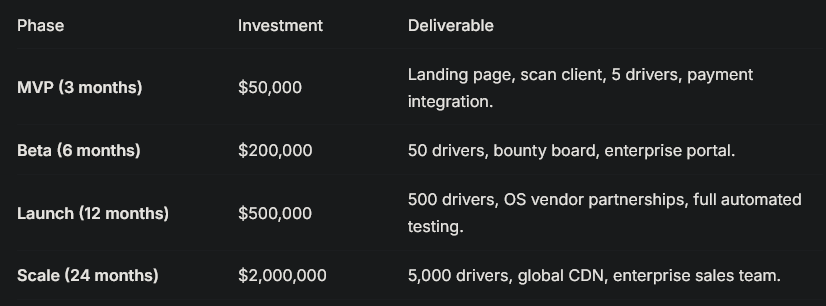
Part V: Addressing Objections
5.1 "Drivers Should Be Free"
Response: "My time isn't free. Writing a driver takes 200 hours. I will not do that for free. You can either:
Pay me $0.10.
Spend 200 hours reverse-engineering it yourself.
Keep using Windows."
A driver that costs $0.10 and exists is infinitely better than a driver that is "free" and doesn't exist.
5.2 "This Violates the GPL"
Response: Charging for the distribution of GPL-licensed software is explicitly permitted. The GPL requires that you provide source code to users who receive the binary. The platform can:
Provide source code for free via a public GitHub repo.
Charge for the compiled binary + automated installation service.
This is exactly what Red Hat does.
5.3 "Hardware Vendors Won't Cooperate"
Response: The platform doesn't need their cooperation for existing hardware. The Linux kernel already supports 90% of hardware out of the box. The problem is the remaining 10%, the long tail of obscure chips.
For new hardware, the platform can approach vendors and say:
"Give us your specs under NDA. We'll write the driver. You get 5% of every download for the first 2 years. It costs you nothing and makes you money."
5.4 "Open-Source Developers Won't Charge"
Response: The ones who won't charge are already not writing drivers. The ones who will charge are the ones who will actually get the work done. The platform creates a new class of professional Linux driver developers.
5.5 "This Will Fragment Linux"
Response: The opposite. By creating a shared, trusted repository of verified drivers, the platform unifies the Linux desktop. Any distribution can integrate it. The drivers are pushed upstream to the kernel. Everyone wins.
Part VI: The Vision, What Happens Next
6.1 The 5-Year Timeline
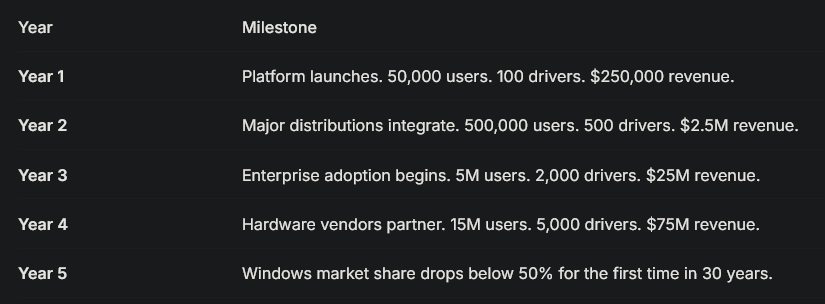
6.2 The Liberation of the Desktop
This is not about making money. This is about giving users a choice.
For 30 years, Microsoft has maintained a monopoly on the desktop through:
Vendor lock-in.
Hidden costs.
Forced updates.
Privacy violations.
Ads in the Start menu.
A culture of "you don't own your computer."
The driver marketplace is the tool that breaks that monopoly.
When a user can:
Install Linux for free.
Pay $2.50 for all their drivers.
Have everything "just work."
...they will leave Windows in droves.
6.3 The Human Cost
Every unpaid driver is a developer who could have been:
Building their career.
Spending time with their family.
Getting a girlfriend.
Sleeping.
That is the hidden cost of open-source ideology. It asks people to sacrifice their lives for the "greater good" while the corporations laugh all the way to the bank.
The driver marketplace stops that. It says: "Your time has value. Your skill has value. You deserve to be paid."
Part VII: A Call to Action
7.1 For Developers
If you can write drivers, you can earn a living doing it.
The market is hungry.
The competition is absent.
The barriers are low.
Write one driver. Put it on the platform. Let the royalties flow.
7.2 For Investors
This is a proven business model in a massive, underserved market:
Microtransactions work (Steam, App Store).
Subscription models work (Red Hat, AWS).
Network effects are powerful (more users → more drivers → more users).
The first mover in this space will dominate.
7.3 For Users
When this platform exists:
Pay $0.10 for a driver.
Don't spend hours in forums.
Don't pay $140 for Windows.
Don't let Microsoft own your computer.
Your support funds the ecosystem.
7.4 For Governments and Enterprises
Stop sending millions to Microsoft.
Adopt Linux. Save money. Gain independence.
The drivers will be there.
7.5 For the Open-Source Community
Let go of ideology.
Embrace economics.
Build a sustainable future.
Software needs to be funded. Resources are finite. People need to eat.
Use it.
Conclusion: The 10-Cent Liberation
Linux dominates the server room because it was cheaper than Windows.
Linux will dominate the desktop when it is as easy as Windows.
The only barrier is the driver.
The only solution is the market.
10 cents per driver. 70% to the developer. 20% to the platform. 10% to the bounty pool.
It is simple. It is sustainable. It is inevitable.
The only question is who will build it.
Appendix A: Technical Specifications
Client: Lightweight CLI or GUI tool. Hardware detection using libudev.
Repository: CDN-hosted binary repository. Source code on GitHub (GPL-compliant).
Payment: Stripe integration. Microtransaction support (minimum $0.10).
Testing: Automated VM sandbox. Kernel compatibility matrix (5+ versions).
Platform: Cloud-hosted (AWS/GCP). Database for driver metadata, user accounts, payment records.
Appendix B: Revenue Model Summary
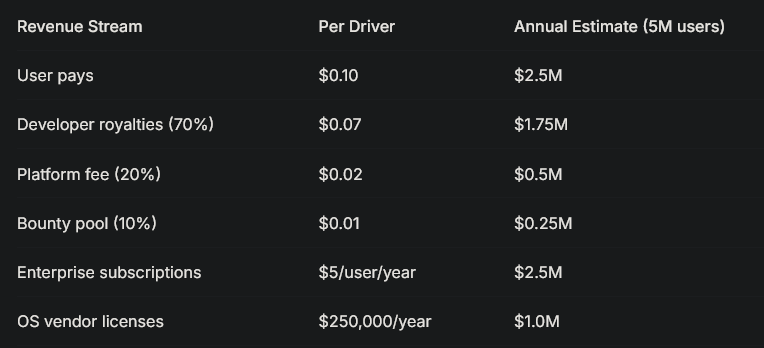
Appendix C: Key Performance Indicators
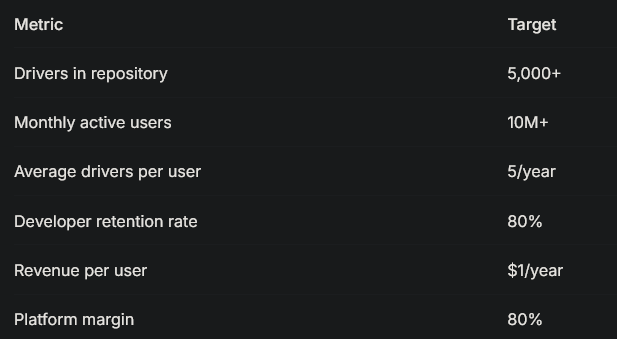
Final Words
"You get nothing for nothing. The person that makes a driver loses time, power, and whatever else they could be doing, like getting a girlfriend."
This is the truth that open-source has refused to acknowledge. This is the truth that has kept Linux on the desktop for 20 years.
The driver marketplace fixes that.
It honors the developer's time. It honors the user's need for working hardware. It honors the economic reality that software, good software, costs money to build.
And when it launches, it will be the single most important event in desktop Linux history.
Not because it is a new kernel. Not because it is a new desktop environment. Not because it is a new distribution.
But because it finally makes Linux work for everyone.