

Abstract:
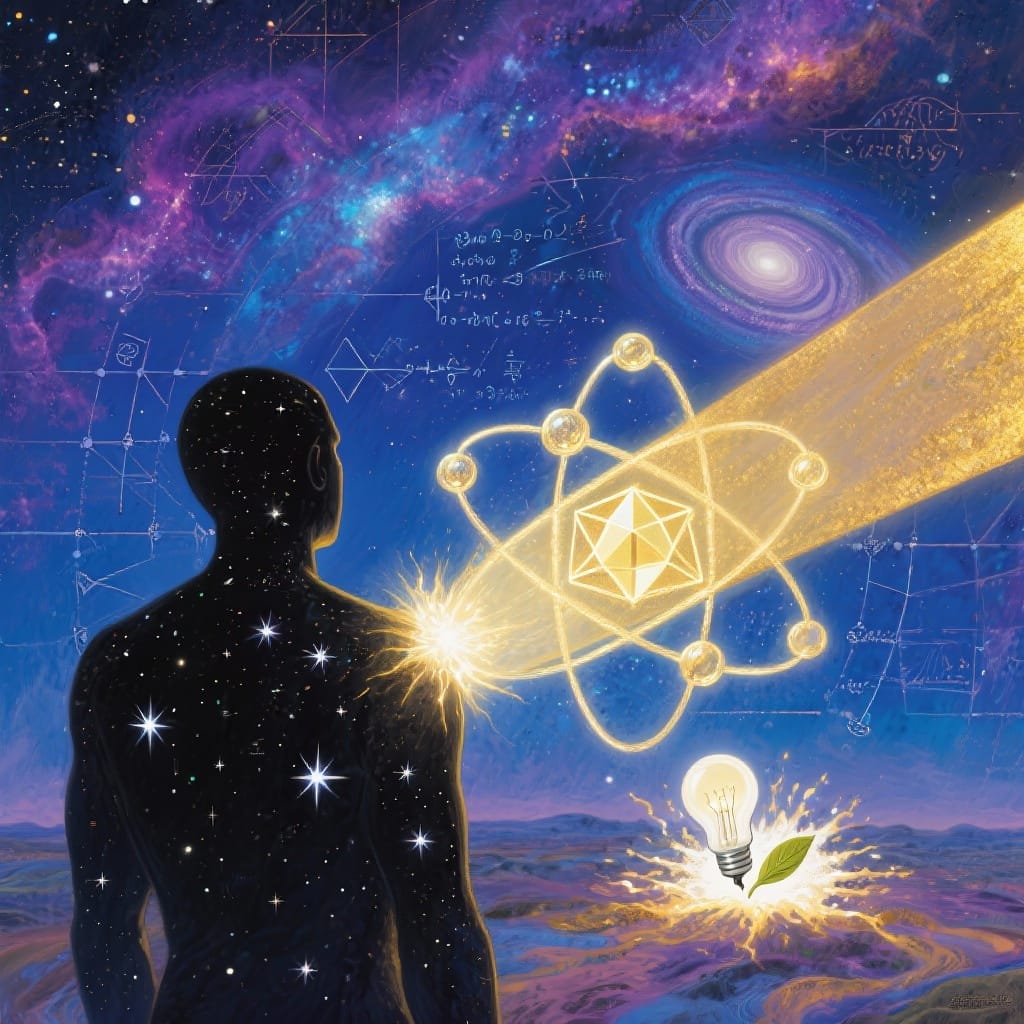
This theoretical paper posits that the process of human discovery, across scientific, philosophical, and psychological domains, is not the creation of novel truths, but a form of anamnesis, or recollection, of eternal, perennial principles. We argue that the fundamental patterns and laws governing the cosmos are implicit in its structure, a structure that includes the human mind itself. By synthesizing Plato's Theory of Recollection, Jungian archetypal theory, and Pythagorean cosmology, this work traces humanity's quest to understand reality as a process of the universe remembering itself through its conscious constituent parts. The axiom "nothing is new, just forgotten" is thus reframed from a nostalgic lament into a robust description of a fundamental epistemological process, positioning human consciousness as the organ of cosmic recollection.
1. Introduction: The Echo in the Equation
The experience of profound insight is universal: the "Eureka!" moment when a solution presents itself not as a laborious construction, but as a sudden discovery of something that feels inherently, self-evidently true. This sensation of "dis-covery", of un-covering a pre-existing fact, is a hallmark of breakthroughs in mathematics, theoretical physics, and artistic composition. But is this feeling merely a psychological artifact, or does it point to a deeper, ontological relationship between consciousness and cosmic structure?
This paper argues for the latter. We propose that human inquiry is fundamentally a process of anamnesis, a term from Platonic philosophy meaning "recollection" or "unforgetting." We do not invent truth; we remember it. Our thesis is that the logical and harmonic architecture of the universe is encoded within its own fabric, and the human mind, as a product and microcosm of that universe, is structured to recognize these encodings. The journey of knowledge is a return to a forgotten home.
2. The Philosophical Foundation: Plato's Recollection of the Forms
The cornerstone of this argument is Plato's doctrine of Anamnesis, most eloquently explored in the Meno. Through Socrates' dialogue with a slave boy, Plato demonstrates that a seemingly uneducated mind can be guided to discover geometric truths it did not overtly know. Socrates concludes that this knowledge is not taught, but "recollected." Plato posits that the immortal soul, prior to its incarnation, dwelt in the realm of the "Forms" (or Ideas), perfect, timeless, and universal archetypes such as Justice, Equality, Circle, and Number. All learning in the sensory world is a process of remembering these perfect Forms from which our imperfect reality derives its shape and intelligibility.
In this view, the scientist and philosopher are not inventors but explorers and cartographers, slowly recalling the precise mathematical and logical Forms that constitute the bedrock of reality. The goal of inquiry is to align the mind's understanding with the world's inherent logic.
3. The Psychological Substrate: Jung's Archetypal Landscape
To bridge this metaphysical concept with a modern psychological framework, we turn to Carl Jung's theory of the Collective Unconscious. Jung proposed that beneath the personal unconscious lies a deeper, transpersonal layer of the psyche inherited by all humanity. This layer is populated by "archetypes", innate, universal patterns of instinct and experience that form the bedrock of human motivation, creativity, and perception (Jung, 1968).
We contend that Jungian archetypes, such as the Hero, the Mother, the Trickster, and the Mandala, are the psychological correlates of Plato's Forms. They are the innate psychic structures through which we perceive and organize experience. When a storyteller crafts a resonant myth or a visionary artist paints a powerful symbol, they are not creating ex nihilo; they are "recollecting" and giving form to these deep psychic structures. These structures, in turn, are not arbitrary; they mirror the deep, dynamic patterns of a cosmos that has, through evolution, encoded its own operational principles into the conscious beings it has spawned.
4. Case Studies in Cosmic Recollection
This model of knowledge-as-recollection is borne out by the history of discovery.
The Pythagorean Theorem: This fundamental principle of geometry is a relationship inherent in spatial reality itself. Its independent "discovery" by multiple ancient cultures (Babylonians, Indians, Chinese) is not a series of parallel inventions, but a series of parallel recognitions of a pre-existing, eternal verity.
The Periodic Table: Dmitri Mendeleev's genius lay not in creating the elements, but in perceiving the hidden, pre-existing periodicity in their properties. He intuited a pattern that was already there, so powerfully that he could leave gaps for elements yet to be "discovered" (recollected), whose properties he predicted with stunning accuracy.
Jungian Synchronicity: These "meaningful coincidences" that defy causal explanation are, in Jung's view, glimpses of an "acausal connecting principle" in the universe (Jung, 1952). They are moments when the psyche's internal state and an external event align in a way that reveals a deeper, unified order, a sudden, spontaneous moment of anamnesis of the interconnected whole.
4.1 Embodied Recollection: The Kinetics of Knowing
The process of anamnesis extends far beyond conscious intellectual discovery into the very way we interact with the world. A quintessential example is the act of catching a ball. A human, or even a dog, effortlessly calculates the parabolic trajectory of a ball, accounting for initial velocity, arc, gravity, and wind resistance, to arrive at the precise point of interception at the precise time.
Yet, the individual performing this feat cannot articulate the quadratic equations or Newtonian physics their body has just "solved." This is because the knowledge is not held in the conscious, linguistic mind. It is held in the embodied mind, the deep, evolved, neuro-muscular understanding of the laws of kinematics and dynamics. The body knows the law of gravity because it evolved within its constraints. It knows parabolic motion because it has observed it countless times.
This is anamnesis in action at a pre-conscious level. The brain is not inventing physics in that moment; it is recollecting and executing a physical principle that is fundamental to the cosmos. The body, as a material object of the universe, inherently "remembers" and operates according to the universe's rules. The conscious mind simply witnesses the outcome of this profound, embodied recollection. This suggests that our most fundamental "knowledge" of cosmic law is not reasoned, but lived.
5. The Atom's Memory: From Microcosm to Macrocosm
The most profound implication of this theory is that anamnesis is not solely a human activity; it is a cosmic process manifesting at every scale. The hydrogen atom "remembers" its singular proton and electron, bonding according to quantum laws. The water molecule "remembers" its 2:1 hydrogen-to-oxygen ratio. The solar system "remembers" its gravitational constants to maintain orbital harmony.
The human mind, with its capacity for abstract mathematics and symbolic reasoning, represents the universe's capacity for this memory to become self-aware. Our perception of mathematical beauty, our drive for coherent narrative, and our scientific laws are the universe's anamnesis becoming conscious of itself. We are the universe's means of making its own implicit, ordered memory explicit. The atom remembers how to be an atom; the human remembers that it is made of atoms, and wonders why.
6. Discussion: The Universe as a Self-Remembering System
This framework allows us to reframe human history as a gradual process of collective recollection. The Big Bang can be seen not just as the origin of space-time, but as the scattering of a unified, implicit order. The subsequent 13.8 billion years, from the formation of quarks to the evolution of consciousness, is the slow, intricate process of that order re-assembling and recollecting itself into increasingly complex and aware forms.
The phrase "nothing is new, just forgotten" is thus transformed. It is no longer a statement of cynical exhaustion but a declaration of our profound embeddedness in a lawful, intelligible, and meaningful cosmos. The deep sense of "coming home" that accompanies a profound insight, whether scientific, artistic, or spiritual, is the signature of this process. It is the feeling of the microcosm consciously reconnecting with the Macrocosm, of the part recognizing its place in the whole.
7. Conclusion
We do not create truth any more than an explorer creates the mountain he maps. The patterns of reality, from the bonding of atoms to the structure of myths, pre-exist our awareness of them. They are the eternal Forms, the archetypal patterns, the mathematical constants that constitute the "memory" of the cosmos. The human journey of knowledge is, therefore, a sacred endeavor of remembrance, an Anamnesis of the Atom and the Soul. It is the process by which the universe, through us, remembers its own structure, its own beauty, and its own name. In the final analysis, our quest for knowledge is the cosmos completing a circuit of self-awareness, and we are the point where the universe becomes conscious of itself.
References:
Jung, C. G. (1952). Synchronicity: An Acausal Connecting Principle. Princeton University Press.
Jung, C. G. (1968). The Archetypes and the Collective Unconscious. Princeton University Press.
Plato. (380 BCE). Meno. (B. Jowett, Trans.).
Plato. (360 BCE). Phaedo. (B. Jowett, Trans.).