

Still, this is a great game!
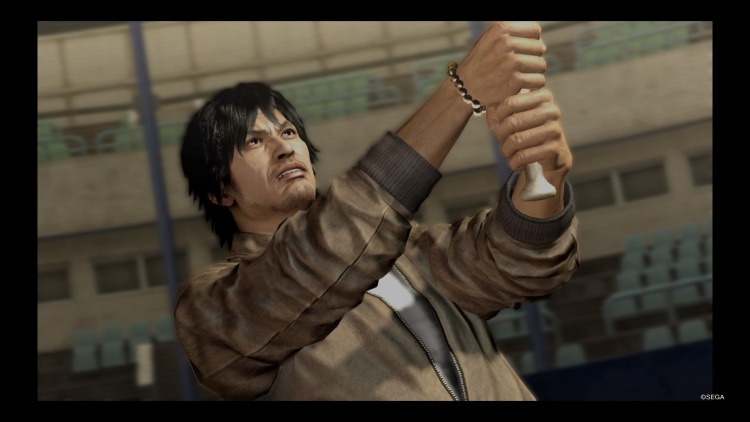 The more Yakuza games I play, the more I realize that Sega is the perfect example of consistency. There isn’t a single bad game; at worst, there is the rare average release, such as Ishin. Instead, every release has been good, closing in on great, but other than Like a Dragon and Infinite Wealth, none have achieved excellence. Yakuza 5 has the makings of a game that could have been fantastic, but a few hold-ups and not enough improvements with the remake prevent it from reaching epic.
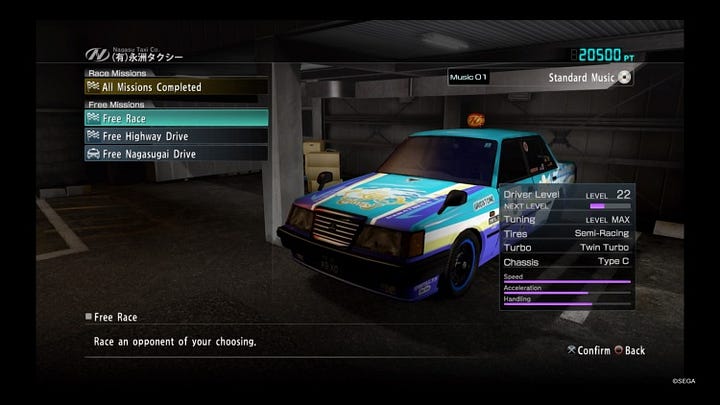
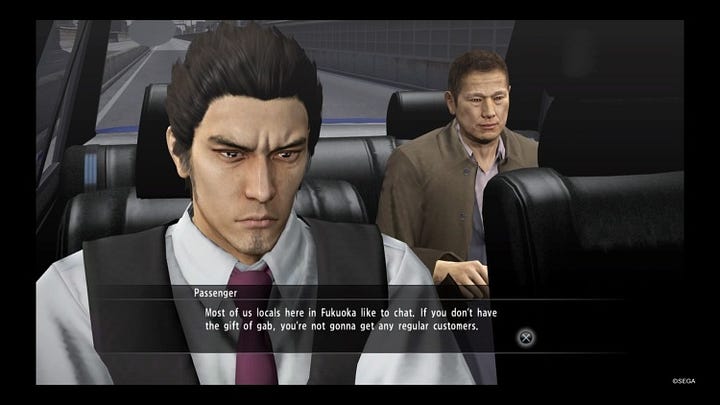 Like a Dragon aside, there is no Yakuza game without Kazuma Kiryu (Kaz). After the events of Yakuza 4, it was a bit of a shock to find him working as a taxi driver in a new city. Especially after his hard work in 3, where he started, maintained, and tried to help his orphanage thrive. It was a bummer to see he had left that behind. But in the same sense, I get it: he doesn’t want people to know about his past, wants to start over, and wants to allow the children from his orphanage to thrive and follow their dreams without his shady past and connections getting in the way. It was refreshing to be away from Kamurocho, too. On paper (as described in the tutorial), the taxi side stories didn’t initially entice me, but they were a lot of fun. Some involved racing, others getting someone from point A to B in a specific amount of time, still others following someone suspicious or trying to escape a sketch ball, while many involved talking and choosing the right dialog options. Plus, I thought Kaz’s boss was a nice guy, and you got to see some nuance to his personality later in the game during a few specific events.
 The heavy-hitting Saejima makes a return too. A decent chunk of his story is once again within a maximum-security prison because he voluntarily decided to get an assault charge, for reasons. I guess committing a serious crime somehow “absolves him of his past sins”; at least that is the logic used. He is met by one of the grossest, most abhorrent antagonists in any of the first 5 Yakuza games, Kugihara. The temptation to jump through the screen (Persona 4 style) and smack him around was at an all-time high. Saejima shows better restraint than most would in the interest of maintaining pristine behavior to earn parole. The way he and his fellow inmates pass the time is intriguing, and I think it helped him keep his sanity and avoid trouble. Plus, a friendly gesture from an unexpected source, one of my favorite NPCs in the Yakuza series! Anyway, Saejima and his three cellmates tell stories. He closes his eyes and reimagines these scenes, and you get to play through them as the story is told. I enjoy Saejima as a character, but in this game and 4, his portion of the story drags. The prison parts of 4 and 5 are too drawn out. Thankfully, unlike in 4, he has free rein once he reaches the city of Sapporo.
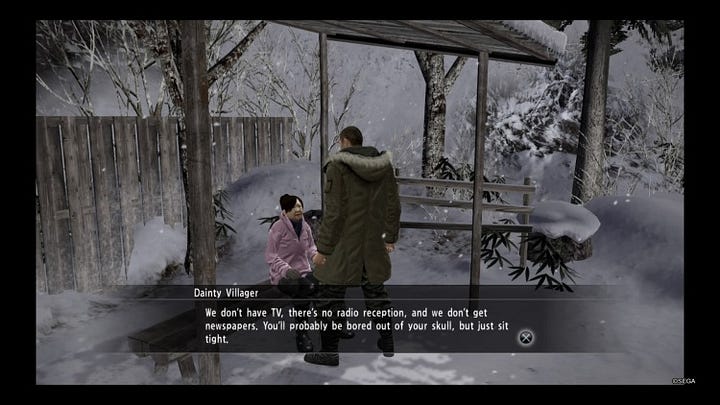
Sapporo comes only after one extra ordeal on the way to the city, which includes being rescued by a man in a small, secluded village with the most miserable winter imaginable. In this village, the main side story for Saejima appears, and it turned out to be more interesting than initially anticipated. I thought I would hate hunting, but the climax of this substory was engaging and maintained tension until the resolution. The controls require some getting used to.
 Hakura shows up again, this time as a playable character. I enjoy her as one of the most important NPCs in other Yakuza games, but as a starring role, I disliked her part of the story as it involved mandatory dance competitions that would (and should) serve as no more than mini-games in any other game. I couldn’t wait to finish her part of the game. Plus, it takes screen time away from the more fascinating Akiyama, the generous loan shark with 0% interest and no required collateral. Of course, he puts potential clients through several rounds of difficult tests to prove they are worthy of such generous terms.
Growing up, I played Little League, and I was good. One of the better players on a team that finished second, and the next year, one of the top players on a team that was first, before an injury to one of our stars derailed the season; it lowered morale too much. Having said that, it’s been over two decades since I’ve played baseball, perhaps even a quarter of a century. Which leads me to a new character in the Yakuza series, Shinada, a washed-up pro baseball player hard on his luck and living paycheck to paycheck. His claim to fame is hitting a home run off a legendary pitcher in his first professional at-bat and promptly being banned, Pete Rose style, from the Japanese pro leagues shortly after. Now working for a racy magazine, he soon must confront his past and the truth behind why he was banned. I enjoyed the last button-pressing prompt as it brought back memories of my childhood and playing baseball with my best friend. I didn’t like his sub-story as much and found the controls for the batting cages more confusing than the ones in Yakuza 2. As a whole, Shinada is a solid, likable character. While he was no Tanimura, whom I missed a lot in 5 as he never shows up, they were equally as goofy, just in different ways.
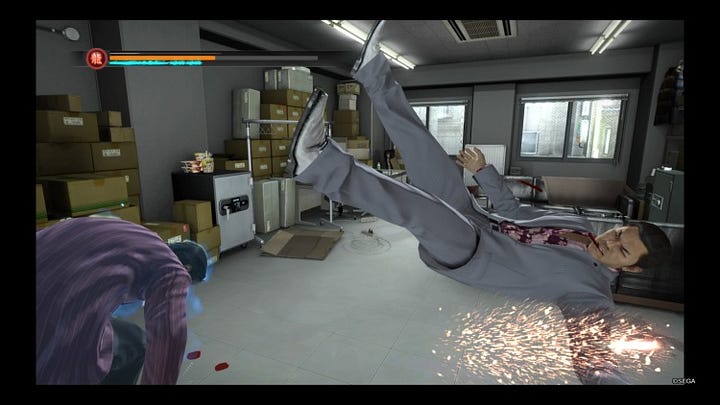
 Playing as 5 characters, 4 of which fight, comes with advantages and disadvantages. Granted, you never get tired of any of them, but for some players, especially newbie Shinada and Akiyama, you don’t get enough time with them. I wouldn’t have minded longer portions with both characters. As mentioned, I didn’t like Hakura’s dance portions, but I managed to chug through them. Kaz, Shinada, and Saejima are different variations of the same brawling style. Saejima is the slowest, most plodding, whereas Shinada and Kaz are a little quicker on their feet. It can feel cumbersome at times to take on many enemies and lumber through them, especially if you have poor timing and get knocked down. But there is usually a plethora of items strewn across the city to pick up and knock the crap out of the many annoying enemies. Akiyama is the fastest and most graceful fighter of the four, and I enjoyed playing as him as a change of pace. He has a kickboxing/judo style. Annoyingly, though, you can see enemies on screen; once they see you, it is unlikely they can be avoided, and there are an abundance of foes in each city. After being spoiled by Judgment, another Sega brawler RPG hybrid where you could run away from enemies with ease, granted they’d chase you practically halfway around the city, Yakuza 5 was a tough adjustment. Be prepared for all sorts of thugs to pick fights with you, constantly.
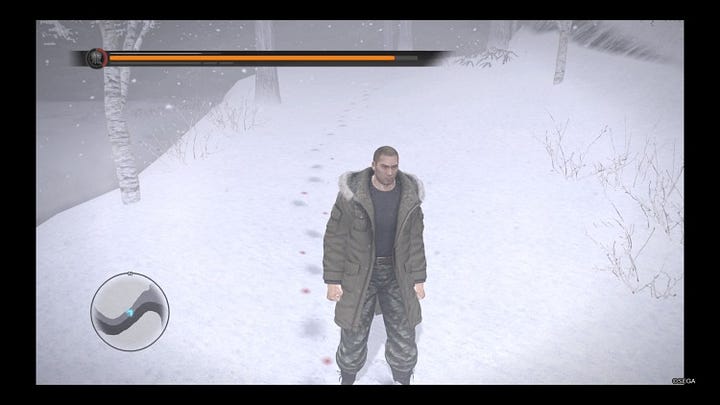 As expected, this is a massive game. To put things in perspective and show just how gigantic it is, I finished 58/78 side quests, 100% finished the taxi and hunting sub-stories, and still only had a 14.25% total completion rate after the end credits rolled. To me, that is excessive, but for completionists, it is heaven. I seem to have run into a glitch with Hakura and Akiyama regarding the locker keys. I collected them all in Yakuza 2, and not only do I not mind it, but it is also fun. But the keys I collected with Hakura never showed up later when Akiyama checked out the lockers, and trust me, I went several times well into the Final chapter. It was annoying, and I felt deflated to search for the remaining keys, for obvious reasons.
Anyway, as with any other Sega game since the first Yakuza, there is tons to do. I took just over 36 hours, but I am sure others could easily surpass 100 hours for completion. On normal, it is not a hard game; no Yakuza game has given me trouble on normal, and I keep thinking I need to try one of these games on hard at some point.
 There are limited musical tracks, but when they hit, they hit heavy and fit the mood, usually urgent or when serious stuff is about to go down. Most of the game, downtime included, is filled with ambient noises like honking horns, conversations, and occasionally harassment from some jerkwad looking to pick a fight. I know what to expect from a Yakuza game regarding audio.
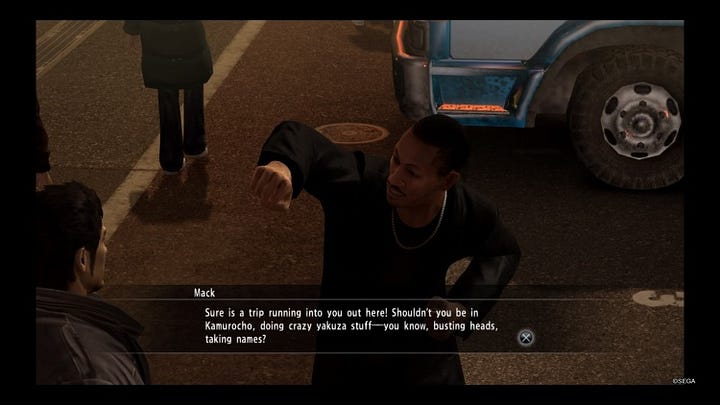 However, coming from the Yakuza 1 and 2 remakes, titled Yakuza 1 Kiwami and Yakuza 2 Kiwami, as well as Judgment, the graphics, interface, and lack of quality-of-life enhancements in Yakuza 5 were somewhat jarring. With time, they were manageable and didn’t hinder progress in any meaningful way, other than a difficult camera during hunting missions, but they were always noticeable. There is a unique style in the layout and details of any Yakuza game. Anything from the introduction, every main character gets to the taunts and jeers of some random thug with an overinflated sense of self. Each city has a vibe and is filled with so much going on they are inviting and encourages exploration and paying attention to the subtle. Going to Japan in the next few years is a must at this point, a sentiment strengthened by the game’s presentation.
Overall, Yakuza 5 is an interesting game. Even though 1 and 2 are chronologically before it, I might be inclined to advise gamers to play 3, 4, and 5 before going back to 1 and 2, if playing the remakes of those 2, as in many respects, Kiwami 1 and 2 are superior, especially as far as gameplay and QOL enhancements. Nonetheless, Yakuza 5 is chock-full of content and is a game that is easy to recommend.