
Subscribers get bonus perks: ask me unlimited gameplay questions about any review and get personal responses within 24 hours!
Have you ever been hesitant to try something new and put it off way too long, only to, once finally getting to it, love it so much that you desire more of the same? That’s my experience with the Mass Effect (ME) trilogy. Growing up, my friends loved Golden Eye, but I found the first-person view too disorienting, often got lost, and couldn’t get into these types of games, no matter how much I tried. In a word, I sucked.
Sadly, this distaste and ignorance of shooters extended to 3rd-person shooters for far too long until I tried Mass Effect. The first wasn’t easy to get into; it was a steep learning curve with plenty of confusion and mistakes. Eventually, with perseverance, I got the hang of it, and by the end of the first game, it felt like second nature. After finishing the 3rd title, I felt like a seasoned veteran and wanted more! I gave Outer Worlds a shot despite being first-person, and to say the learning curve was a slog would be an understatement. I stumbled my way to the end and somehow managed to beat it. It certainly didn’t help that a crash erased 2 hours of progress by corrupting the most recent saves. It was a game I wanted so much to like, but too many issues got in the way. So that lingering feeling of wanting more remained, mostly in the background of my gaming psyche, which is where “The Ascent” eventually came into play. But does it scratch that itch?
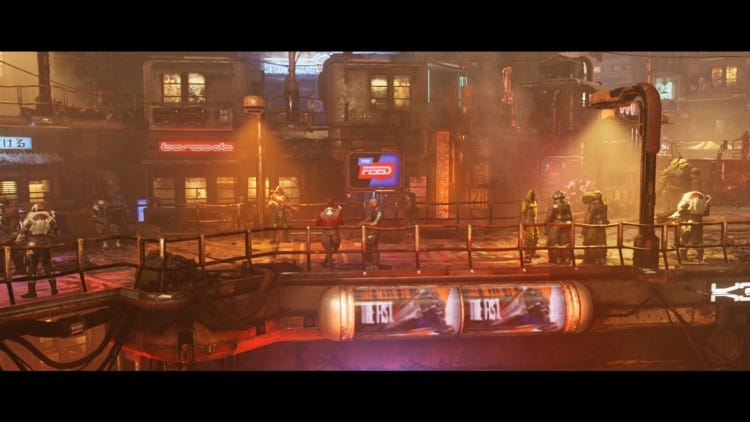 If Shadowrun (SNES) mixed with tidbits of ME in some glorious amalgamation that is, ideally, what The Ascent would be. However, I’ll be upfront and address it immediately: the game has some serious problems. For one, I couldn’t even get past the title screen after three attempts when trying to play for the first time. I had to move some games around so I could move this one from external storage to internal, after which I could finally pass the title screen.
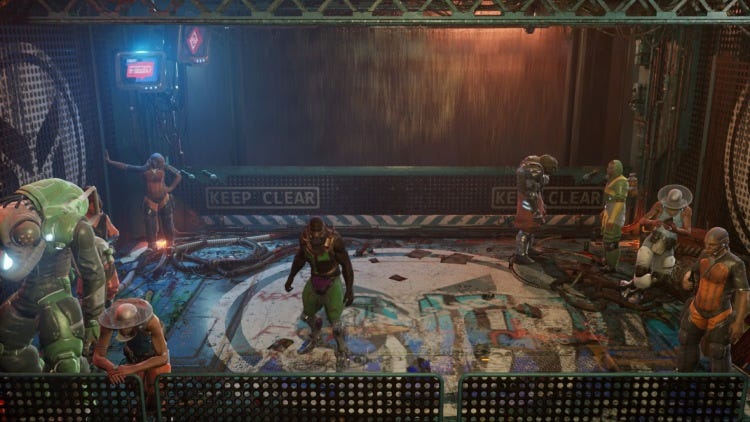 But that was just the start of the problems. The loading time is inexcusable, and I struggle to find any PS4 game that comes close to taking that long to load up from the menu or to go between scenes. While I never took out a stopwatch to measure the exact time, taking taxis, the metro, or elevators between levels took an excessive amount of time, to the point where I started to perform short household errands like taking out the trash (granted it’s four floors down and right outside the building), folding laundry or making lemonade with freshly squeezed lemons. No joke. Yes, I know, get a PS5, but I had no issues with the more demanding Mass Effect, which managed to perform better! If this were the only issue, I wouldn’t even complain, after all, the long wait times encouraged me to keep up to date with chores. But I also had to contend with random crashes, one every 3 or 4 hours, and 2 or 3 instances of the game freezing.
 Occasionally, areas I had to go to that were grayed out. I had to wait for them … to load, I guess? Or the foreground would obscure everything, making it cumbersome and clumsy to get around or fight enemies. But I found no way to control the camera so I could get a vantage point, for example, to look ahead when taking cover. Other minor issues included the waypoint sending me off in the wrong direction, only to correct itself 50 or 100+ meters down the path and send me in the opposite direction, or NPCs not being where a quest said they would be. Finally, while I’m likely the last person to complain about frame rate, you will rarely, if ever, see it in my other reviews; slowdown was noticeable in towns and busier moments of The Ascent; it has to be mentioned. I’d prefer lower FPS but steady rather than what I got here, occasionally high but not steady.
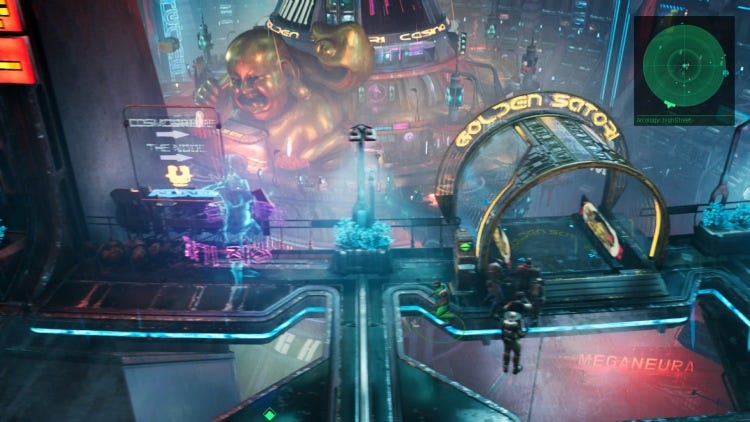 That’s such a pity because the world is intriguing and waiting to be explored. It reminded me of Blade Runner and the aforementioned Shadowrun with its unique slang, though not to the extent of Shadowrun. There is a distinct style, part Neo-noir, part dystopian hellscape with some modern Asian architecture and advertising mixed in. It’s a dark world and at times a pain to navigate around all the obstacles and citizens, especially when criminals start jumping out of nowhere, like Pennywise (IT), hiding in the gutters ready to pounce. Still, this was a world I wanted to investigate, but it felt too cluttered. I appreciated the character models, and the bosses looked imposing and dangerous. If I had the chance to visit a similar town, as long as it was on the upswing, I might be interested in exploring, perhaps because of my morbid curiosity about Kowloon Walled City (RIP).
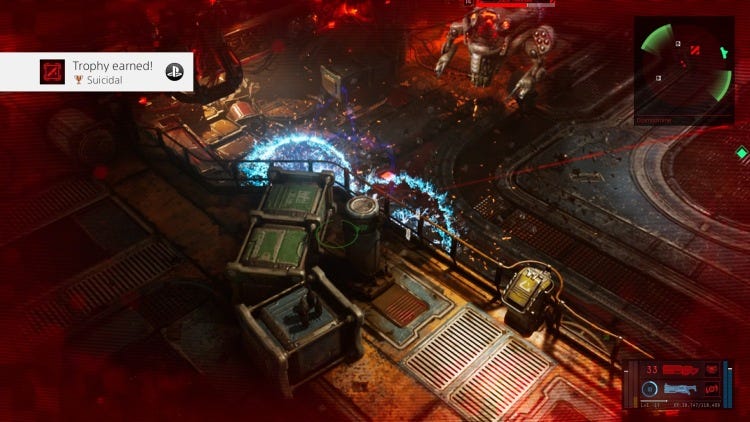 I found ME to be shockingly effortless and painless once I was familiar with it, but The Ascent is tough as nails throughout. The game won’t hesitate to chew you up and spit you out. It gets quite obnoxious at times, so learning how to use the metro and finding enough money to pay for $1000 taxis is paramount to keeping sane.
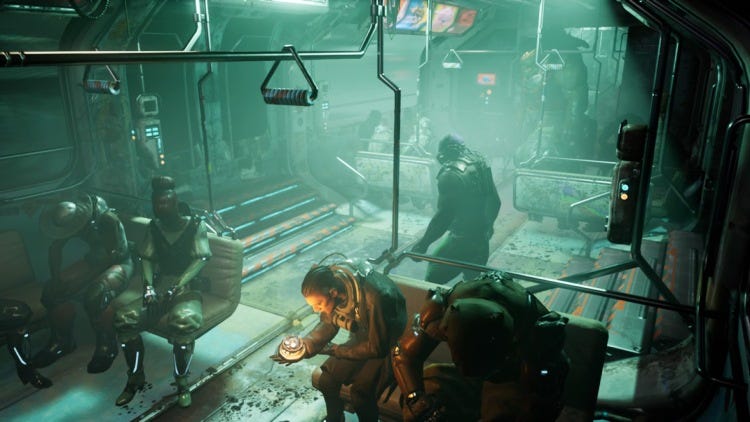 On the flip side, eventually money isn’t a worry, so that’s a positive, so taking taxis isn’t a big deal in the second half of the game. There are different levels of Veles, and from what I could tell, the taxi can only take you to different points on the level you are currently on; they don’t travel between levels.
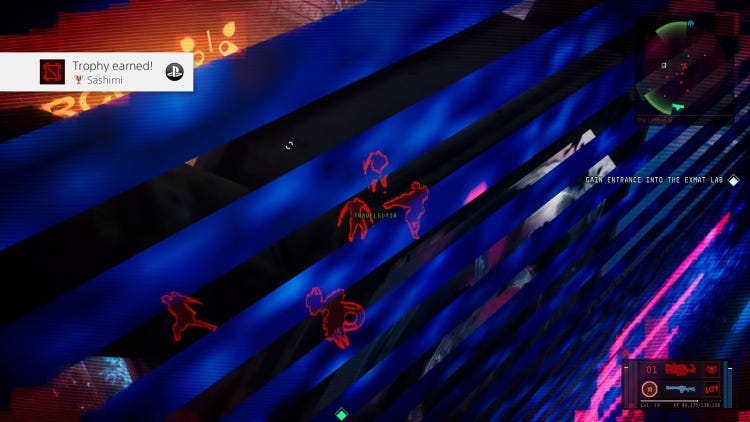
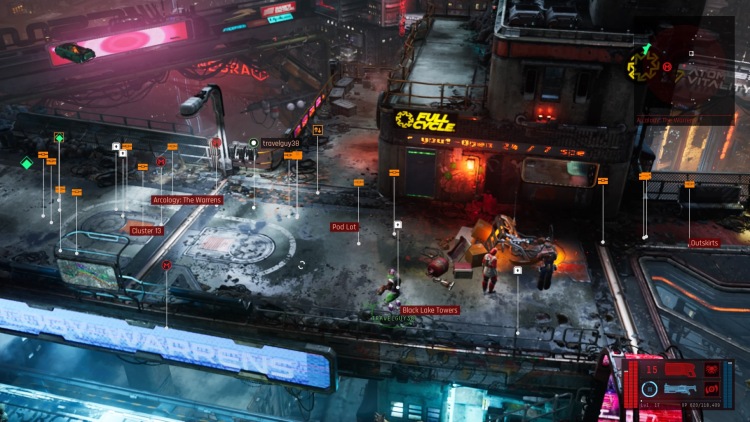 Sadly, I didn’t find the map very helpful and, if anything, it was a confusing mess. The on-screen mini-map served more as a radar for immediate surroundings and was useful when approaching a nearby side quest or chest, or showing enemies within maybe 20 meters, but not much else. A few times, the map icons remained on the screen after exiting the map, as shown above.
While running around, enemies can suddenly and quickly overwhelm and overrun your character. They move at breakneck speed and outnumber your hero tenfold or more. Taking cover works to an extent, but not as well as ME. Plus, the enemies move as if they are on turbo, and pressing X to dive out of the way only goes so far, with a surprising cool-down period before being able to push X again. Not until the final few chapters was I able to move fast enough to bypass most foes. That could be my mistake, as I pumped most skill points into evasion, critical, and HP during the first 20 levels, so I probably missed something that lets me move faster. Later, I finally got a piece of equipment that let me perform something resembling a sprint.
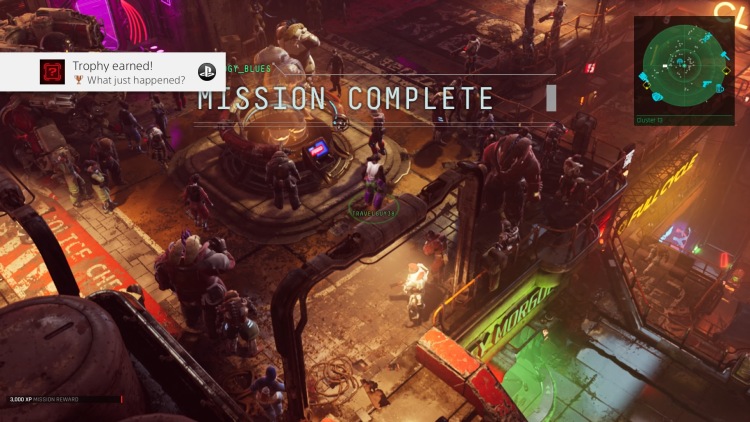 Speaking of side quests, I found 22 and finished 21. They give decent rewards, are mostly worthwhile, and usually amount to running between areas to kill something specifically, deliver an item one NPC wants to give to someone else, or find something important that an NPC lost. One pet peeve of mine is that I couldn’t find a way to tell how long I’d been playing. Some people might not care, but it bothers me not to see an in-game clock. I imagine I took around 15–18 hours to complete this game, but without the side missions, this could be beaten in 10–12 hours. A second pet peeve is no manual save; you are at the mercy of whenever this game wants to autosave. I strongly dislike this, though I think it saves after any screen transition. But I was never 100% certain of when a save would come.
Keeping in mind all that I’ve said so far, it might be a shock that I still managed to play nearly the entire game on normal, but my goodness, were bosses another story. Even taking off 1/2 HP on normal was a moral victory (for me). I had to switch to easy to beat the majority of bosses, and even then, just barely, after several attempts. I died a lot in The Ascent, I won’t mince words. Bosses hit hard, which isn’t the most difficult thing on its own, but every fight includes countless enemies out for blood swarming around in a tight space, and bosses can launch projectiles into dozens of different spaces at once. This game wants you to take cover, but how can you when a boss has a huge AOE attack that blows up the limited amount of places to take cover? In the end, it’s a war of attrition, and usually the bosses win. You need to jump out of the way and look for small gaps in time to get a shot off and hope it connects. This game’s version of easy for bosses is normal for other games, no doubt, maybe even the upper levels of normal or hard-lite, if such difficulties existed. The developers didn’t hold back! My ratio for time spent on normal to easy was maybe 9:1.
Another area I had to switch to easy mode was timed events. Having to contend with swarms of enemies in cramped areas was just one aspect of a tense few minutes. But eventually the timer hits 0:00, so all is good, right? Wrong, get ready for a boss fight, your health is likely on life support after the recent onslaught. Plus, as usual, projectiles are flying from every which way, and the limited areas to take cover are rapidly exploding. The result is hoping against hope to somehow hold on until the end. Plus, in many of these events, you need to stay in a designated circle, as leaving it will reset the timer.
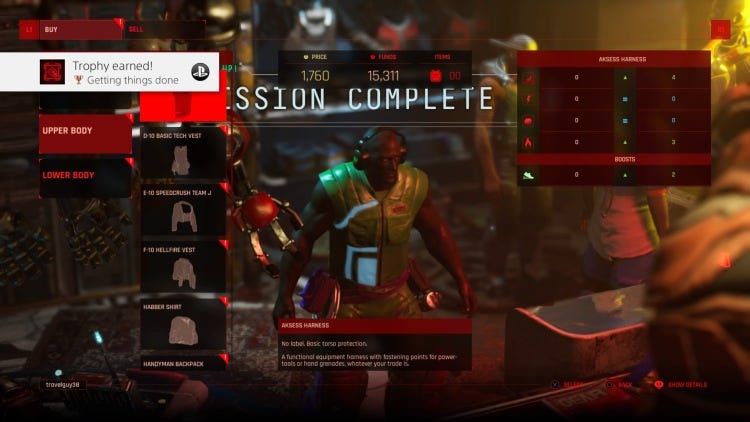 There are a lot of different weapon types, as well as plenty of armor (helmet, torso, legs) that can be purchased and upgraded, so the opportunity to experiment and find what works for your personal play style exists. Switching techniques and equipment helped to take down some of the most challenging bosses. Various augmentations can also help in progressing, but I stuck with two as they saw me through the majority of the game. Spiderbots in particular were a godsend in getting rid of the pesky enemies, so I could focus on taking down the larger enemies and bosses.
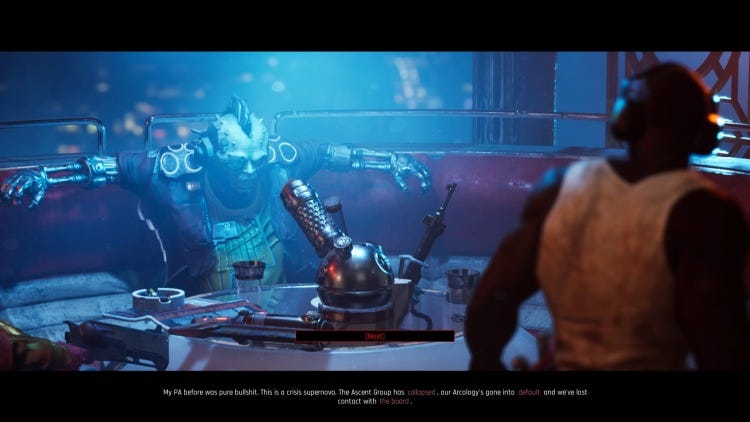 To complement its cyberpunk setting, the electronic, sometimes industrial tracks add another layer, helping Veles stand out. Intoxicating beats fill the nightclub, and intense, fast-paced techno tracks accompany your infiltration of an enemy stronghold, which won’t be forgotten soon. Most of the tracks have a gritty, down-at-the-heels vibe matching the desperation many of the NPCs show in the world of Veles. Later on, you reach a place that reminded me slightly of the Citadel from ME, and it had that (attempted) utopia, “perfect” city vibe, enhanced by the music, more subtle than any other track, serving as a foil to the rest of the game. In a better game, these are the types of tracks that push a great game into the stratosphere of excellence. Here, they simply stand out in a game that otherwise struggles to be competent.
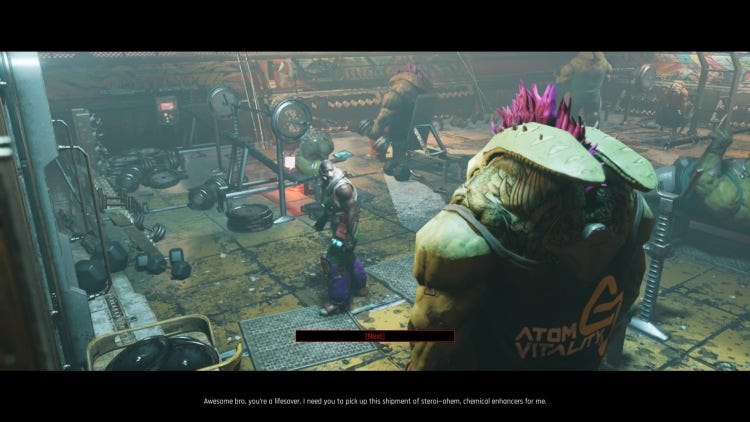 My critiques might sound harsh, but there is a decent, even awesome game ready to break out from this husk of mediocracy. There is so much potential, and the developers are capable of doing better, but The Ascent is too rough around the edges to recommend to anyone but the most dedicated fans of the shooter genre.
Monday Misfires Part 1: Genopanic
Monday Misfires Part 2: Book Quest
Monday Misfires Part 4: Micetopia
Monday Misfires Part 5: Lisa
Monday Misfires Part 6: South Park: The Fractured But Whole
Monday Misfires Part 7: Cookie Cutter
Monday Misfires Part 8: Final Fantasy Type-0
Monday Misfires Part 9: The Outer Worlds
Monday Misfires Part 10: Evoland 2
Monday Misfires Part 11: Gurumin: A Monstrous Adventure
Monday Misfires Part 12: Edge of Eternity