

Recently, I asked the fine folks at r/Solo_Roleplaying what separates a solo RPG that feels like an adventure for one from one that feels like homework for a creative writing class. You can read the whole thread here, but I wanted to summarize my key takeaways, and think out loud about how they apply to my current project.
From the thread, four non-negotiables emerged, which read almost like a solo-design checklist:
Provide a clear gameplay loop
Generate complications
Reveal setting through play
Avoid information islands
Now I'd like to walk through this checklist and describe each element while evaluating my current project Terminus X7Z: A Latticeverse Game.
Provide a clear gameplay loop
One of the strongest throughlines in the responses was this: a solo game lives or dies on the clarity of its gameplay loop. Players want to be guided by a repeatable cycle that answers the constant question: “What next?” You can think of the gameplay loop like plumbing. Everything in the game needs to be connected to the mainline, or you risk flooding your players with (at times smelly) ambiguity.
Terminus X7Z: A Latticeverse Game was designed explicitly around this concern. The game defines the gameplay loop at multiple levels. Missions contain Sessions. Sessions contain Scenes. Scenes contain Actions. Each layer has a defined beginning and ending procedure, and each layer feeds the next. You’re never staring into the void wondering what to do; you are either beginning a mission, opening a scene, envisioning the situation, making a choice, or escalating toward a decisive action. The structure itself answers “What next?”.
At the scene level in particular, the plumbing is visible. The Action Loop repeats: Make a Choice, then Roll, then Interpret, and repeat. Instead of feeling like you’re inventing structure on the fly, you’re riding the pipes of a well plumbed system, where everything is connected.
Generate complications
Another strong theme in the thread was that to support solo play, the system must generate complications on its own. Commenters were clear on this point: pass/fail isn’t enough. In traditional RPGs, a GM is responsible for injecting friction, adding twists, and generally managing the level of tension. In solo play, if the mechanics don’t do that work, then the player is forced to do it themselves, which is not only asking a lot, but also makes the whole thing feel like a creative writing exercise.
Ideally, the core action resolution mechanics naturally produce costs, complications, and consequences to create narrative pressure to drive the story forward on its own. Complications don't just make things harder; they make the world feel alive by introducing new threats and revealing unexpected truths. This is how a game can surprise the player and create the feeling that something beyond their control is shaping events for them to react to.
Terminus X7Z leans into this philosophy at the most fundamental level: every meaningful roll risks adding pressure. The core resolution system does not result in a binary pass/fail. Even when a character achieves what they intended, the system often insists on a complication. And because players can push their luck to chase a cleaner outcome, at the risk of making things worse, the mechanic naturally tempts escalation. The drama doesn’t need to be manually injected. It emerges naturally every time you pick up the dice.
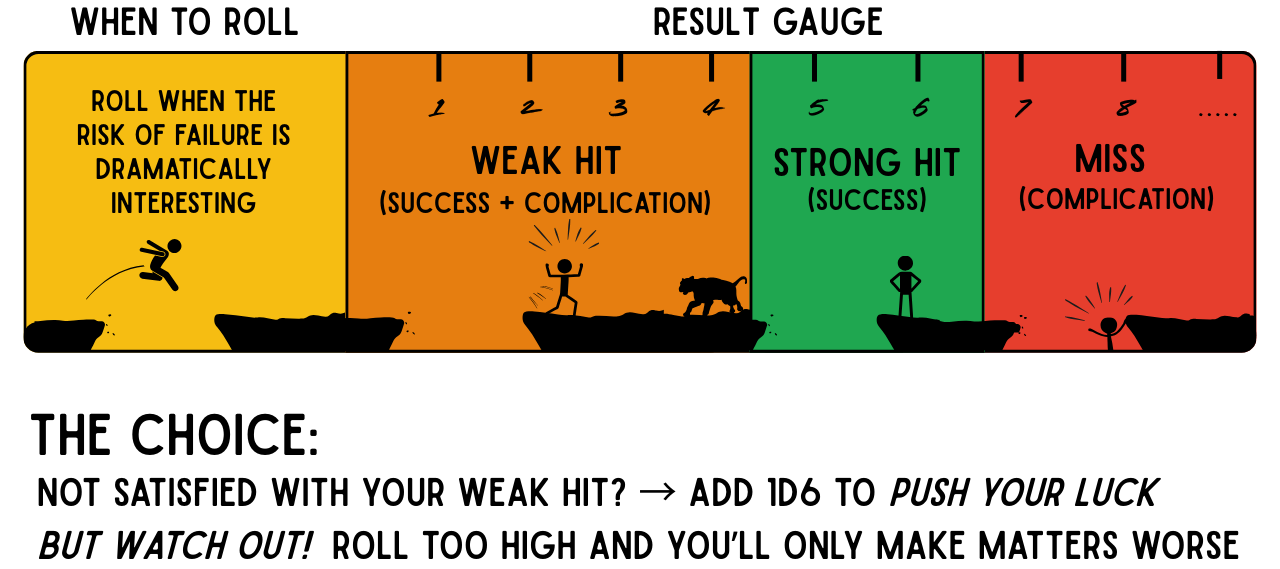 Even the main oracle reinforces this principle. When you ask a question about the world, you don’t just get a neutral answer. You declare what’s most likely and what you hope and then roll. If you get the likely result, you can push your luck to get your hope, but risk the worst possible answer becoming reality.
It is the element of surprise, and escalating tension that keeps the story feeling reactive, rather than authored.
Reveal setting through play
Another clear pattern in the responses was a desire for games that reveal their setting through play rather than requiring it to be preloaded. Many are drawn to RPGs precisely for the feeling of discovery. Several commenters praised systems that let them discover locations, factions, NPCs, rumors, and unfolding threats as a natural result of following the procedure. When setting details emerge at the moment they’re needed, tied to a clear procedure, the world feels less like a blank canvas and more like a place with its own momentum.
Terminus X7Z begins embodying this principle from the very start with a character creation process that gives each character meaningful connections to the setting, and seeds the world with tension. By the time play begins, the setting has already started revealing itself through the relationships between characters.
Scene framing continues that discovery. Scene Titles reference specific species, political figures, religious beliefs, locations, and simmering conflicts. Manifestations, a part of Dynamics, surface social pressures, cultural rituals, ideological contradictions, and political unrest at the moment they become relevant.
Because these elements are wired directly into the scene loop, the world reveals itself when you need it. You’re not tasked with inventing lore in advance. You discover it through conflict, through relationships, and through consequences
Avoid information islands
Another subtle but important theme in the thread was that tables that aren't directly connected to the gameplay loop aren't very useful. What makes some systems stand out for solo play is the way that they connect every resource in the game to the gameplay loop. The usefulness of a table doesn't come from its content alone, but from knowing exactly when and why to use it.
In other words, a table that floats in the appendix is optional inspiration. A table that is wired into the gameplay loop is an engine for discovery. Without procedural triggers, players are forced to decide when to consult a generator, which adds ambiguity and slows momentum. Solo play especially benefits from systems that reduce that ambiguity.
This is an area where I think I could still improve things in future iterations of the system I've constructed for Terminus X7Z. Certainly, many elements are well connected: you roll on Scene Title and Manifestations tables when framing a scene. You roll on the complications table during action resolution. But at the same time, there are a lot of tables that currently are a bit adrift and disconnected from the core gameplay loop. I'm not sure yet whether that means those tables are unnecessary fluff, or if it means that the gameplay loop is deficient in this regard.
What I Learned
My revelation from this discussion is that solo design isn’t about how many tools you include, it’s about how well they interlock. A solo-native game is not a collection of inspiring prompts. It needs well designed plumbing that will generate friction and reveal the setting through play. When those elements align, solo play stops feeling like self-directed storytelling and starts feeling like exploration inside a system that pushes back.
Looking at Terminus X7Z through this lens has been both affirming and instructive. In many areas, nested loops, pressure-generating resolution, setting-forward scene framing, the plumbing is already doing the job of supporting solo play quite well. In others, I see opportunities to tighten connections and reduce ambiguity, better answering that persistent "What's next?" question.
Ultimately, the challenge I'm chasing: building games that surprise their players, even when the player is me. If the system can generate momentum, escalate tension, and reveal a living world without demanding constant creative heavy lifting, then it’s doing what a solo-native RPG should do.
If this whole conversation about solo-native design resonates with you, I’m currently putting that philosophy into print.
My Kickstarter, One Night Worlds: 4 RPG Zines, is live right now. It’s a collection of four GM-less, zero-prep tabletop RPGs designed to be learned and played in a single evening. No lore homework. No campaign binders. Just a tight loop, rising tension, and worlds on the brink.
And yes, every one of them includes built-in tools for solo play.
For this campaign, the games have been remastered into expanded zine editions with refined layout and additional clarity. My goal with these has always been the same question I explored above: how compact can a complete RPG engine be without losing its ability to generate friction, momentum, and discovery?
If you’d like to check it out, I'd love your support:
https://www.kickstarter.com/projects/brianhazzard/one-night-worlds-a-ttrpg-zine-collection