

Someone I admire greatly is the underrated indie RPG designer Cezar Capacle. In many ways, he opened the door for me to begin designing games: by creating games that spoke to me more deeply than anything I had played before, by publishing system reference documents with open licenses that invited others to build on his work, and by making time in his busy schedule to help me design and edit my own games.
It was his Push SRD that served as the basis of the One Night Worlds series. It was the oracles from his game Lisergia that provided some of the raw creative seeds that established the setting of The Fires of Chaterra. And recently, I found myself drawing from yet another of his works for inspiration to solve a creative challenge I was facing.
The challenge was this: roleplaying games are often structurally and procedurally ambiguous. Many players buy their first RPG book excited to see what the hobby is all about, but never get the game to the table due to uncertainty around how to get started, how to pace play, and how to know when they are “done.” The problem isn’t imagination. It’s onboarding. The whole thing can be deeply intimidating for new players.
When I first discovered roleplaying games, I borrowed a copy of a Dungeons & Dragons rulebook with the intention of running a session with friends. Several years later, I still hadn’t brought the game to the table because I couldn’t really picture how it all worked in motion. I later had a very similar experience with the Cypher System. The idea of being the GM, the person who is supposed to know how this stuff works, while not really understanding how to run the system was a non-starter for me.
Eventually, I decided to try solo roleplaying. I figured I could stomach awkwardly figuring things out during play if I wasn’t wasting anyone else’s time or embarrassing myself. I downloaded a free copy of Ironsworn and loved what I read. And yet… it still felt overwhelming. There were pieces that made perfect sense, but I couldn’t quite imagine how they all fit together. When I finally decided to start without understanding everything, I had an awkward, but genuinely enjoyable first session.
Looking back, I understand that tabletop RPGs are, to an extent, an inherently freeform activity. Attempts to emulate the more procedural nature of board games come with tradeoffs that often aren’t worth it. Even so, clear sequential procedures can act as invaluable training wheels for new players, helping them internalize the rhythms of play until those structures are no longer needed. Even better is when procedures reinforce the thematic and experiential design goals of a game.
As I mentioned before, my wife has become a very active contributor to this project. She represents the new player perspective that’s all too easy to lose once you’ve read and played dozens of systems. Her constant skepticism toward hand-wavy, ill-defined procedures has acted as a reality check against designer brain, pushing me to better express the tacit vision I had for how this game ought to be played.
Which brings me back to Cezar Capacle. The first actual play I ever recorded for YouTube was for his game The Outcast. One thing that makes the game stand out in the wider RPG landscape is that it defines a clear end condition, with systems that allow your actions throughout play to accumulate mechanically and meaningfully affect your odds of success or failure at the end of the game. I realized I wasn’t looking for more rules, I was looking for clear next steps, all the way to a clear ending.
That structure mapped beautifully to the mission-oriented nature of Terminus X7Z, so I adopted and hacked it into something that I think works very well for this game.
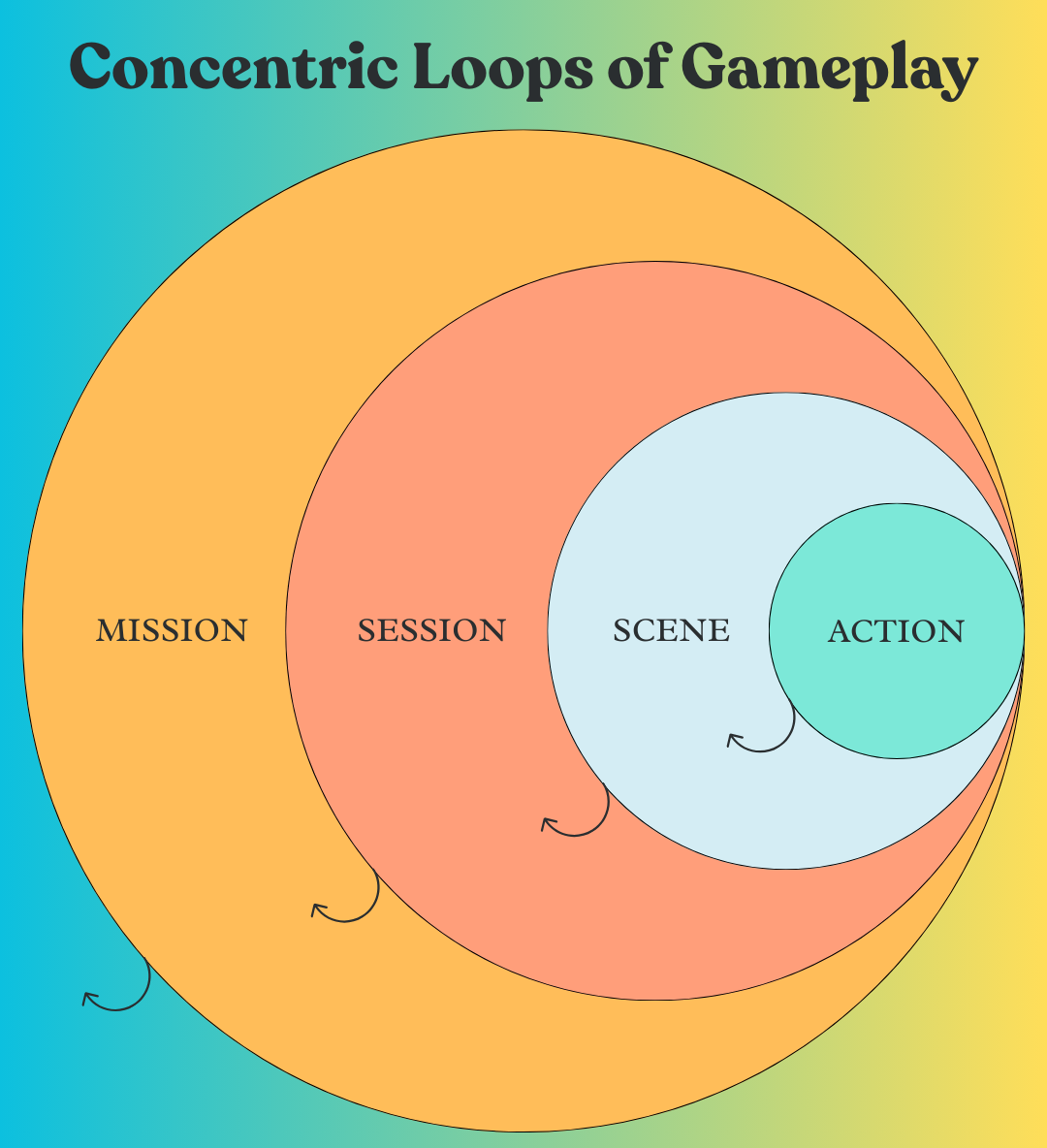 The rules now define several concentric loops: the Mission Loop, the Session Loop, the Scene Loop, and the Action Loop. The intent is that, in any gameplay situation, it’s always clear how to proceed. You don’t need to hold all of these loops in your head at once, each only matters when you’re operating inside it. All of these interlocking systems culminate at the end of each session in a final resolution roll with three possible outcomes:
Complete Success: The mission succeeds with no loose ends
Success with a Twist: The mission succeeds, but with a surprising twist to feature in the next mission
Cliffhanger: A disastrous twist to overcome in the next session as the mission continues
I love this structure because it aligns so well with touchstone shows like Deep Space Nine. Sometimes stories are episodic. Sometimes they unfold across multiple episodes. This system supports both naturally.
Progress this past week:
Crystal continued making progress on the book’s layout
I wrote rules for the Mission, Session, and Action Loops (the Scene Loop was completed last week)
Crystal and I both started drawing our own interior art for the book
We launched the Terminus X7Z Kickstarter, and it is fully funded
We posted a video about why we made Terminus X7Z
Goals for the coming week:
More of a hope than a goal: surpass 100 backers on the Terminus X7Z Kickstarter
Complete the playtest draft of Terminus X7Z (no layout or art)
Continue drawing interior art for the book
What I’m worried about:
I continue to worry about how big this book is becoming. I don’t yet have a final page count, but it’s clearly grown into a full-fledged standalone RPG. While it will be satisfying to hold a hefty book in my hands, it represents a meaningful increase in both workload and production cost and marks a real shift from small experimental projects to a flagship system.
What I’m excited about:
I’m especially enthusiastic about our decision to draw our own interior art. As beginners, we’re not producing ultra-detailed realism, but that limitation is part of the appeal. Experimenting with more accessible, expressive styles feels well-aligned with the approachability we want the game itself to have, and I’m genuinely enjoying the results so far.
Thank you for reading. I post weekly Creative Journals like this one privately for members of The Wandering Workshop. If you are interested in my work and enjoy behind the scenes insights into the thinking behind the games I make, I hope you'll consider joining. I appreciate your support.