

Curio Science Study Edition (Offline)
$9
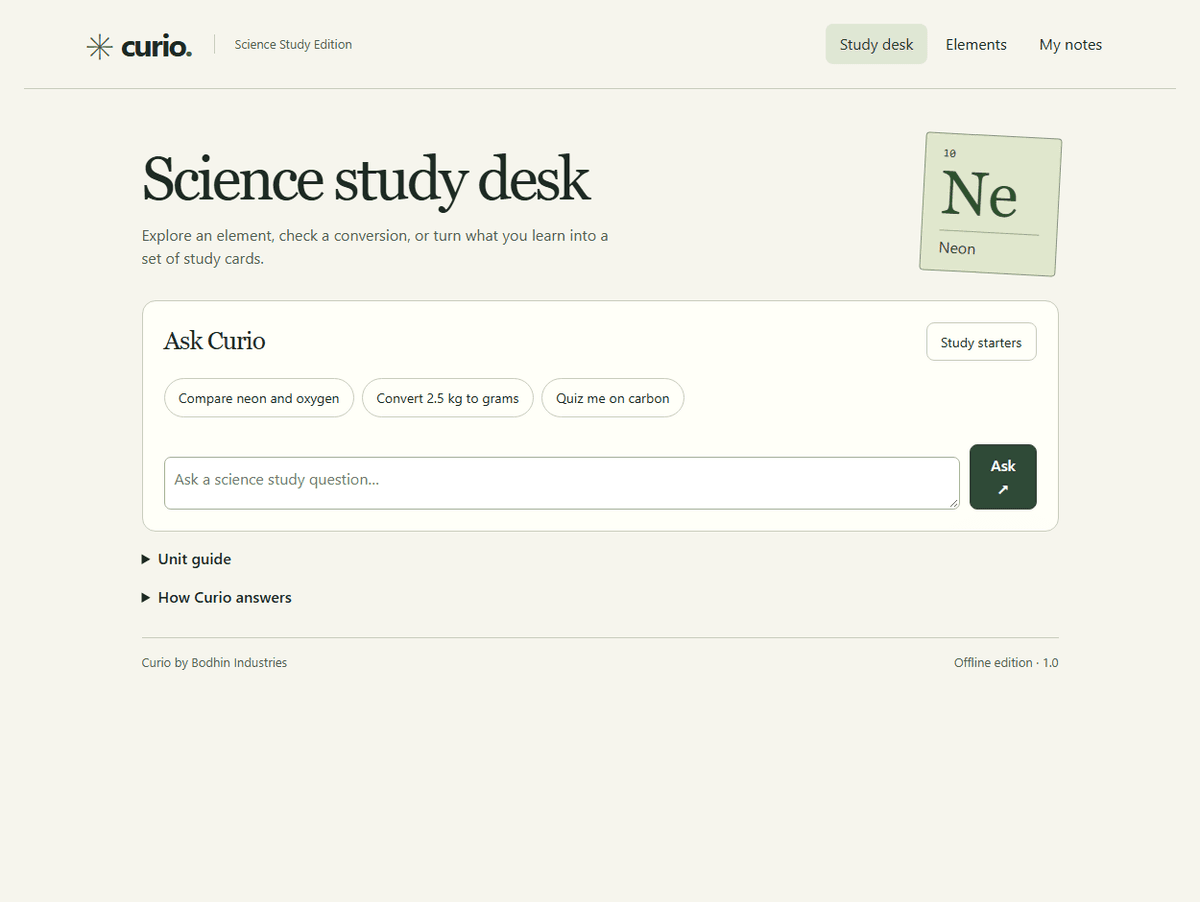
Open Curio on your laptop to compare elements, practice with revealable study cards, and save what you learn. The ZIP includes the offline app, an optional desktop tutor, quick-start instructions, a personal-use license, and the element data notice.
Browse all 118 elements by name, symbol, or atomic number. Compare two elements, convert units of length, mass, volume, time, or temperature, and export your notes as a text file. A small on-device classifier recognizes supported study questions. Curio answers from its bundled reference, calculator, and card templates.
Optional local AI tutor (Windows)
The download also includes a desktop tutor that explains six study cards covering helium and neon, seasons, Moon phases, and three length conversions. Each card shows a reference answer. To generate an explanation on your own computer, you supply Python 3.10+ with Tk, Ollama, and the supported stock Qwen3 8B model (about 5.2 GB, downloaded separately). The browser study desk works on its own.
Free study preview
Which has more protons, neon or oxygen? Neon has 10 per atom and oxygen has 8. Follow up with “Which one is heavier?” Their average atomic masses are about 20.18 u for neon and 16.00 u for oxygen.
Extract the ZIP and open Curio.html in desktop Chrome or Edge with JavaScript enabled. The $9 one-time purchase includes personal use on your own devices. The browser study desk works offline from the first launch and requires no account, subscription, or AI credits.
$9
Enter a fair price
$
$9