

 Happy Autumn everyone!
I’m taking a short break from publishing the next instalments of my series on inner work to write about something that’s been on my mind for a while.
It’s about a tradition that I’d like to revive. In the past, when most people in Europe lived in rural areas and worked in agriculture, the end of the harvest was a major occasion. For centuries, completing the harvest was the most important time of the year. When the last cart of grain was brought in from the fields, it ensured survival through the winter. People celebrated with huge communal feasts and dancing, expressing deep gratitude for the Earth’s gifts.
In fact, the harvest is still celebrated around this time of year in several European countries:
Erntedankfest: This is a traditional harvest festival celebrated in Germany, Austria and Switzerland. It usually takes place on the first Sunday in October. Churches are beautifully decorated with large displays of fruit, vegetables, and grains of wheat, after which there are parades and country fairs accompanied by music.
Festa del Ringraziamento: Throughout autumn, local communities in Italy hold harvest festivals on various Sundays. Farmers bring their tractors to the town square, where they are blessed by a priest. Everyone then gathers for a giant feast made from the local harvest.
Harvest Festival: In the United Kingdom, churches and schools celebrate the harvest in late September or early October. People bring baskets of fresh produce and tinned goods to donate to local charities and food banks.
As most of the population moved to the cities over time, this festival lost its significance. It’s a sad state of affairs. I firmly believe it should be revived. As I have written many times in my series on inner work and in this article, the human psyche has existed and developed in tune with the rhythms of nature and the changing seasons for millennia. Life in the city, with its fast pace and disconnection from one’s roots, takes its toll on the psyche. Hence the depression, anxiety and addictions that plague modern Western society. More and more often, we buy ready-made products from the supermarket instead of eating fresh meals. These products satisfy our hunger, but they do not nourish us. We have become disconnected from the land; many children do not even know where bread comes from or how cheese is made. Reviving the harvest festival would provide an opportunity to pause and reflect on what we have and what we need to care for. Think of it as the European equivalent of Thanksgiving in the US, except that we’re not copying this festival from the Americans, but reviving our own long-forgotten tradition.
It doesn’t have to be anything grand or officially recognised. Simply organise a family dinner featuring the Earth’s autumnal bounty around the equinox in September or October, on a Sunday. It’s the peak season for fruit and vegetables, so we should make the most of it. Bringing the family together to share a meal would be a symbolic way of thanking the Earth and the Heavens for their care and generosity. If we have good relationships with our neighbours, we could extend the celebration to the whole community. Perhaps we could organise a street party where each neighbour brings a dish to share? Reviving the tradition of community harvest celebrations would be incredibly meaningful in today’s divided and fragmented society. A European Thanksgiving would be a wonderful way to reconnect with the changing of the seasons and honour the old rural traditions that used to bring whole villages together. We could call this meal the ‘Autumn Abundance Feast’.
I think this is important because the period between the end of the summer holidays and Christmas is practically devoid of celebrations. The only festival during this time is All Souls’ Day, but this, of course, is not a time for joy or merriment. As the harvest festival has lost its place in the collective consciousness, autumn has no celebrations to mark the change of season. Easter signals the beginning of spring, Midsummer’s (St John’s) Night – summer, and Christmas – winter. We need a festival to announce the start of autumn, to restore balance to our calendar and our psyche.
Personally, I would gently suggest that, as a celebration of the Earth’s bounty, the meal on this day should be vegetarian. Please don’t worry – beans, lentils, chickpeas and peas will leave you feeling full. If I were to put together a menu for such an occasion, it would consist of the following:
a butternut squash stuffed with rice, beans and sweetcorn
sweet potato purée
a lentil and buckwheat loaf with wild mushroom sauce
savoury buckwheat muffins
roasted chestnuts
an apple pie
pumpkin and cranberry scones
pear or plum and almond crumble.
The entire meal consists of seasonal grains, nuts, seeds, pulses, vegetables and fruit. If you’re interested, I can share the recipes for all these dishes. This is what I would serve, but of course you can decide on your own menu according to your tastes. What would you prepare? Would you like to celebrate at all? Do you think it’s important? Let me know in the comments.
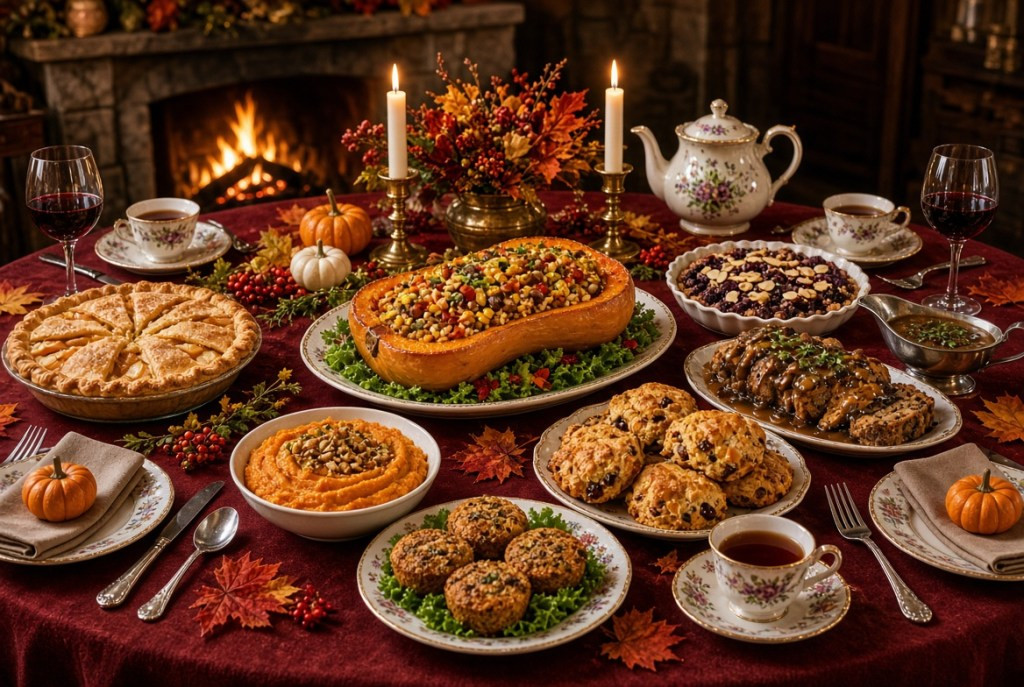
A picture illustrating the concept of the article generated by Grok
This is a part of the As Within So Without, a series of essays on how nature influences your soul. You may also want to read: Time of the Light’s Return.
We Need To Revive The Harvest Festival In Europe © 2026 by Blanka Solun is licensed under CC BY-ND 4.0
Pictures used in the logo: spring, summer, autumn, and winter.