
Intel Ohio
Why I believe this site is the key for American chip sovereignty & the heart of the new defense hub focused around Wright-Patterson Air Force Base

The Future of American Semiconductors
Control Thesis - Why This is the Biggest Top Watch Looking Towards 2028
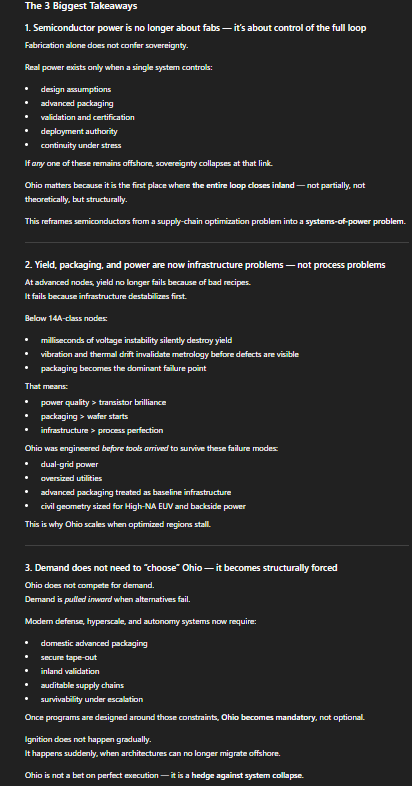
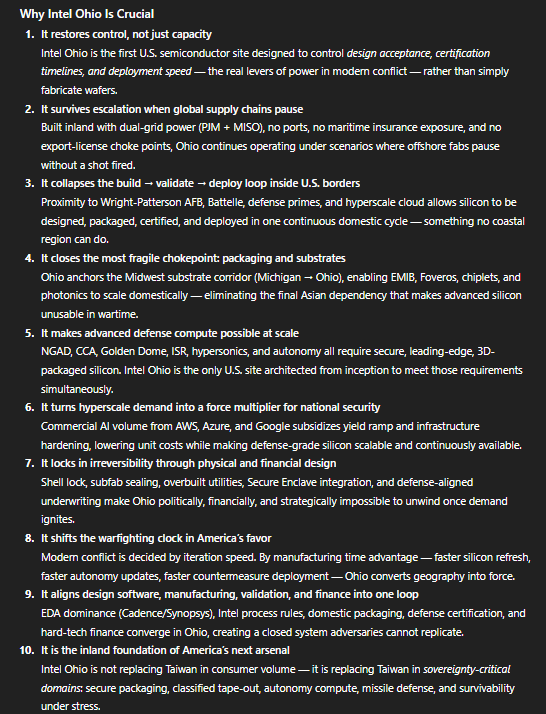
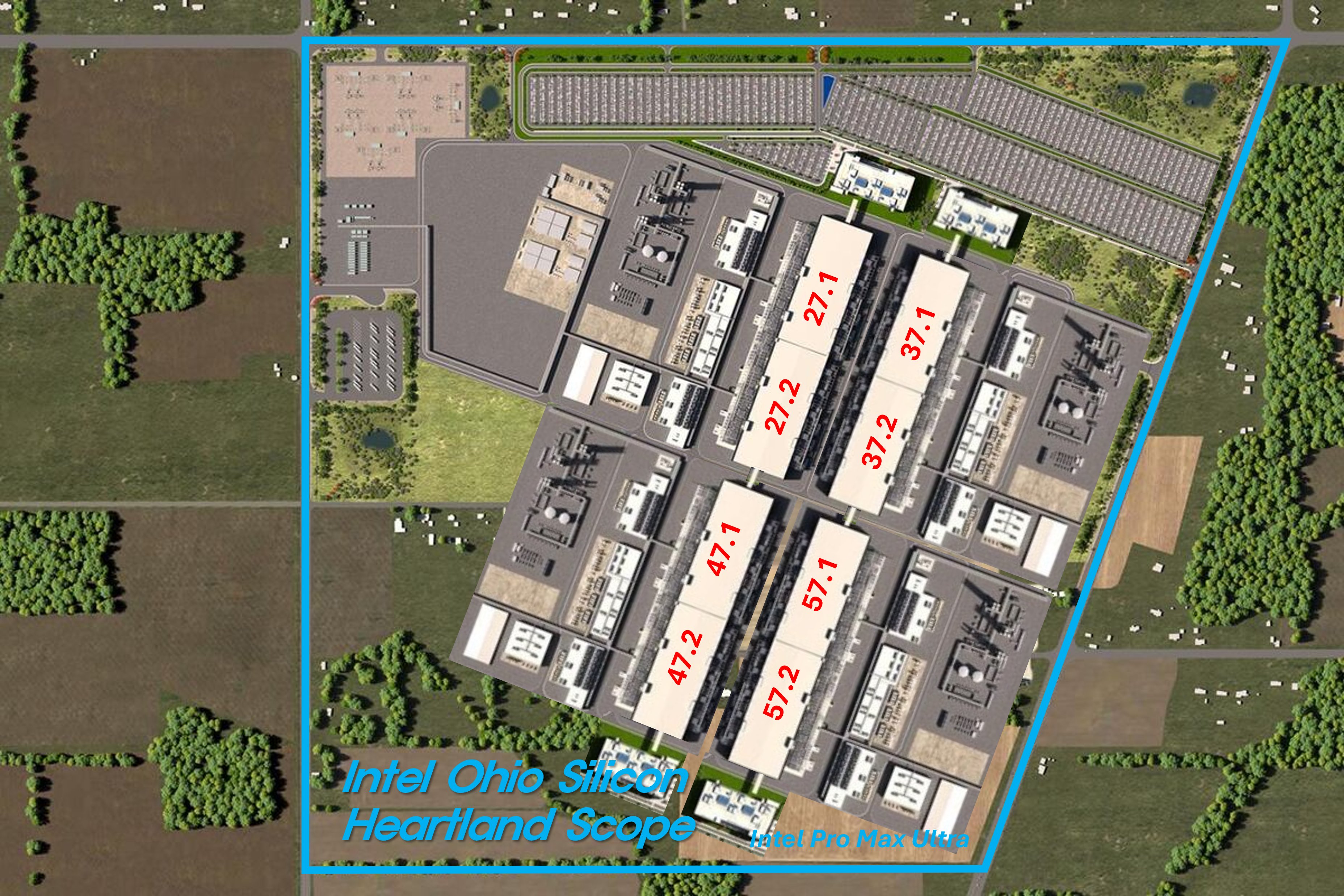
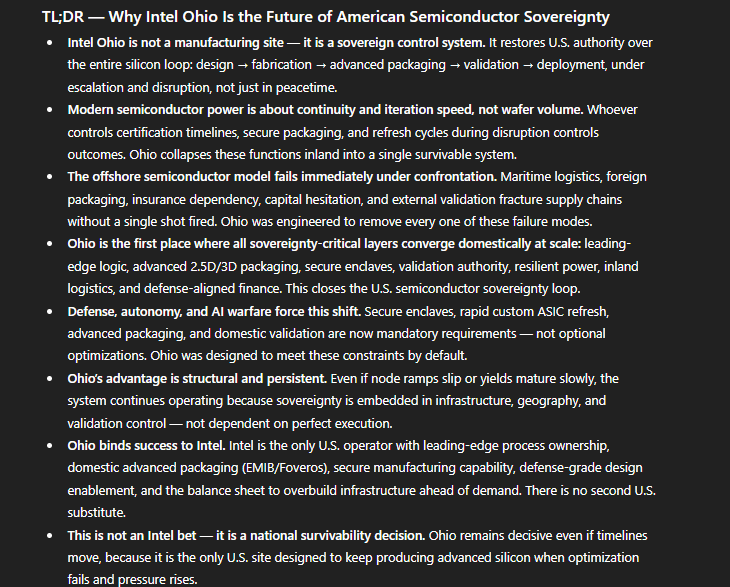
Intel Ohio is not a simple semiconductor project.. its the United States rebuilding control over time in modern conflict
In advanced warfare, power no longer comes from who fabricates the most wafers but from who controls iteration under stress: design acceptance, packaging security, validation authority, and continuity when logistics, insurance, and capital fail
Ohio was selected because it is the first place where all five collapse inward
The Genesis Mission and American Silicon Power in Ohio
The United States is executing a real, active national mission to rebuild sovereign, survivable, inland semiconductor capability after decades of offshore dependence
Everything below explains why this outcome is no longer optional
By March 24 we will hopefully know whether or not an Ohio anchor customer has formally stepped forward with the likely customers being DoD or Amazon AWS

Why Genesis Mission Exists?
The Old Semiconductor Order Is Fragile
For more than thirty years, U.S. semiconductor strategy optimized for:
lowest marginal cost
offshore concentration
maritime logistics
just-in-time efficiency
That model worked in peace but fails under confrontation
Modern power is no longer determined by who fabricates the most wafers.... its determined by who controls:
design acceptance
packaging security
certification timelines
iteration speed under disruption
continuity under escalation
None of those controls can remain offshore
The global semiconductor system was built for efficiency not survivability & under stress it fragments:
maritime insurance withdraws
ports stall
packaging queues freeze
certification timelines stretch
capital hesitates
What the Genesis Mission Actually Is?
Genesis is the national mission to reconstitute sovereign U.S. silicon as a closed, survivable system
Genesis is not about first fabs... its about the first irreversible system
Genesis means:
Ending reliance on foreign packaging and substrates for advanced systems
Collapsing build → validate → deploy loops inside U.S. borders
Ensuring continuity of advanced compute under wartime conditions
Creating inland industrial systems that survive logistics collapse, insurance withdrawal, and capital stress
You see this doctrine embedded in:
Site selection
Civil geometry
Power topology
Packaging priority
Secure enclave scale
Upstream design enablement
Intel Ohio is the first place where all Genesis conditions converge simultaneously
Sovereignty Is a Closed Loop Property
Sovereignty is not achieved by domestic fabrication alone
It exists only when every dependency inside the loop is survivable under stress
A system is sovereign only if:
Design assumptions are domestic
Fabrication is domestic
Packaging is domestic
Validation is domestic
Deployment authority is domestic
Continuity is preserved under escalation
If any link remains offshore, sovereignty collapses at that link..
Genesis exists because the United States previously controlled pieces of the loop but not the loop itself... and Ohio is where the loop closes
Secure Enclaves - The Sovereignty Gate
"A secure enclave is a physically and digitally isolated semiconductor manufacturing environment designed to support classified, export controlled, and sovereign silicon workflows"
It is not a software feature its an architectural condition of the fab itself
A secure enclave typically enforces:
U.S.-only cleared personnel access
Network isolation between classified and commercial flows
Physical segregation of tool bays, utilities, and subfabs
Auditable chain of custody from tape-out to packaged die
Compliance by construction with ITAR, EAR, and DoD requirements
Within a secure enclave:
Sensitive mask data remains under U.S. jurisdiction
Classified wafers follow controlled operator and tool-access rules
Packaging, test, and validation remain auditable and domestic
This is the minimum viable condition for modern defense silicon
Why Secure Enclaves Are Becoming Structurally Required
Historically U.S. defense programs tolerated:
Offshore wafer fabrication
Asian-dominated advanced packaging
Maritime logistics dependencies
Multi-year iteration cycles
That tolerance is shrinking rapidly
Modern defense and autonomy systems increasingly require:
Custom ASICs with short refresh cycles
Advanced 2.5D / 3D packaging
Classified or export-controlled tape-outs
Radiation-tolerant, autonomy-grade compute
Programs such as RAMP-C reflect this shift by pushing primes toward:
Domestic wafer access at advanced nodes
Auditable U.S.-controlled packaging paths
Segmented manufacturing environments suitable for classified workflows
Secure enclaves are no longer optional they are the price of participation for advanced node, iteration sensitive, or classified systems
Why Intel Ohio Can Host Secure Enclaves at Scale
Secure enclaves can exist at multiple U.S. sites
What differentiates Ohio is scale, segmentation efficiency, and survivability under stress
Many fabs face friction when implementing enclaves because they:
Share utilities and subfabs across production lines
Require retrofitted physical segmentation
Depend on globally mobile tool-service workflows
Sit inside logistics corridors exposed to escalation risk
Intel Ohio was designed with segmentation optionality from inception
Ohio’s advantages include:
Compartmentalized subfab geometry enabling physical separation without redesign
Utility architectures that can be segmented without disrupting adjacent lines
Proximity to domestic packaging, substrate, and validation assets
Access to cleared workforce pipelines and defense validation infrastructure within the same inland corridor
Why This Binds Success to Intel
Ohio does not succeed despite Intel’s execution risk - - it succeeds because Intel is the only company with:
leading-edge U.S. process ownership
domestic advanced packaging (EMIB / Foveros)
secure enclave manufacturing capability
defense-grade design enablement relationships
the balance sheet to overbuild infrastructure before demand arrives
There is no second U.S. operator that can step into Ohio’s role if Intel were removed
Policy Now Reinforces the Loop
Federal policy has quietly shifted from incentives to enforcement
This is no longer about subsidies its about alignment
Key forces now point in the same direction:
RAMP-C mandates domestic tape-out for advanced defense silicon
Export-control bifurcation enables inland fabs to convert to defense-only operation
Tariff regimes structurally reward domestic wafers over offshore supply
Defense procurement now requires auditable, fully traceable supply chains
Upstream Materials Are Part of the Sovereignty Loop
Sovereignty often fails upstream in materials
One of the least discussed but most critical is electronic-grade glass cloth, the dielectric backbone of advanced substrates
Nittobo controls the global performance frontier
Owens Corning / AGY controls the American permission slip
Performance can be subsidized or forced but permissionless continuity cannot be imported
Why Ohio?
Ohio was selected because it offers the lowest friction convergence of survivability, power, validation, and scale
Intel is constructing what will become its most strategically important manufacturing node in the United States
Intel Ohio One sits in Licking County Ohio at the center of the inland industrial and defense spine
It is not a standalone fab & its the anchor of a multi decade national manufacturing system
Not because it is the newest and not because it is the largest
But because it was designed from inception to:
Survive conflict
Scale under pressure
Absorb demand shocks without redesign
Inland Survivability
Inland geography removes entire adversary toolkits:
No maritime dependency
No port insurance exposure
No naval chokepoints
No evacuation-driven workforce collapse
This elevates Ohio from geography to command layer & it reframes everything downstream
In conflict geography becomes defense
Ohio is the first inland site capable of hosting conflict survivable leading edge logic at scale
Arizona is technically inland as well BUT the difference is they depend heavily on long-haul logistics corridors tied back to coastal ports
Power Sovereignty = Chip Sovereignty
Advanced fabs fail on power before they fail on yield... At advanced nodes power quality determines yield
Ohio sits at the intersection of two continental grids:
PJM Interconnection
MISO
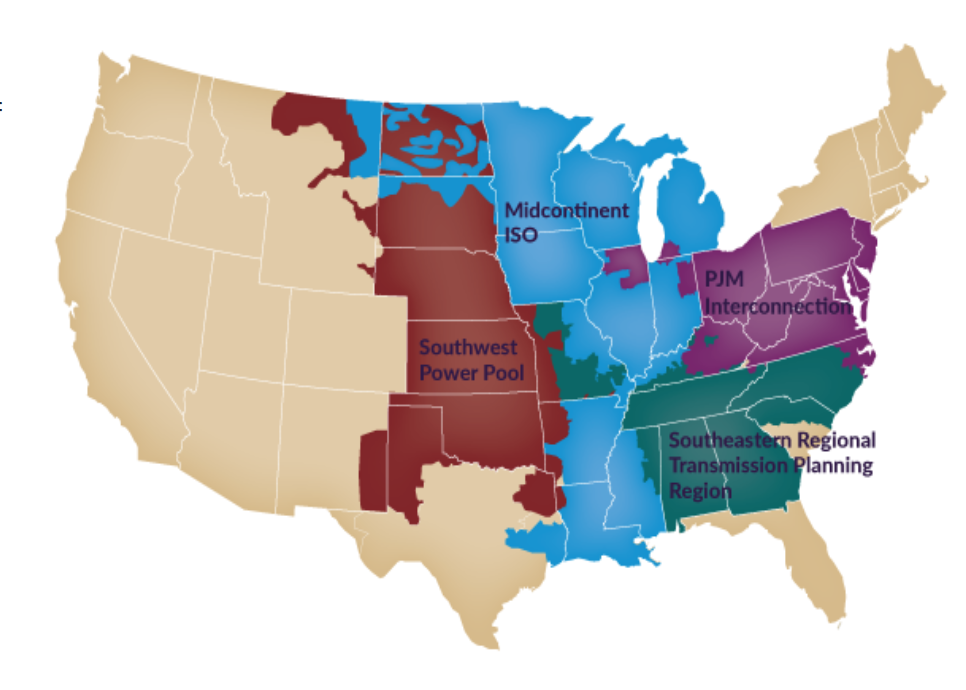
This dual grid positioning enables:
Redundant baseload supply
Surge load balancing
Defense-priority allocation
Insulation from single grid collapse

Power Sovereignty = Chip Sovereignty
Ohio One exists because the electrical grid was engineered to sustain it under stress
Leading edge fabs fail because power becomes unstable before yield does
Ohio One sits at the center of a custom engineered energy system with massive power infrastructure built specifically for Intel
New 500kV transmission corridors
Major PJM grid upgrades
Large scale AEP and Duke Energy substation expansion
A de facto priority industrial load zone surrounding the campus
Dual grid intersection: PJM + MISO - - one of the most resilient grid positions in North America
Why Ohio is Split
While most states fall under a single grid operator, Ohio’s utility companies joined different organizations based on their historical connections and geographical service areas
PJM Interconnection: Covers most of Central, Northern, and Eastern Ohio
This includes major utilities like American Electric Power (AEP), FirstEnergy, and Dayton Power & Light
PJM is one of the largest competitive wholesale electricity markets in the world
MISO (Midcontinent Independent System Operator): Primarily serves portions of Western and Northwestern Ohio
Utilities like Duke Energy Ohio are part of MISO, which stretches from the Gulf of Mexico up through the Midwest and into Canada
Key Implications of this Split
Market Dynamics: Ohio’s energy prices and grid reliability are influenced by two different market structures and sets of federal regulations
Infrastructure Challenges: Building new transmission lines across the state often requires coordination between both PJM and MISO, which can make large-scale renewable energy projects more complex to integrate
Cross-Border Flow: Because Ohio sits at this "intersection," it serves as a critical bridge for moving power between the East Coast (PJM) and the Midwest (MISO)
Yield Is Infrastructure
At advanced nodes yield is an infrastructure outcome
Below leading edge thresholds yield is governed less by recipes and more by whether the physical system can remain stable over time:
Power is ultra-stable
Thermal equilibrium is continuous
Vibration is suppressed
Metrology integrity is preserved
A perfect process running on unstable infrastructure will fail while an imperfect process running on hardened infrastructure will survive
That inversion is what the old semiconductor model never adapted to
At 14A and below failure does not announce itself.. Milliseconds of voltage instability invalidate EUV and High-NA metrology defect detection lags by hours or days and yield collapses before defects are visible
Advanced fabs fail silently through degraded statistical confidence
Once metrology integrity is lost recovery is measured in months not days
14A → 10A: RibbonFET and Backside Power - The Physics Gate
Intel’s 14A → 10A-class roadmap (~1.0–1.4nm effective) is engineered for survivability under sustained stress
14A will begin in Arizona & Oregon but end game is for Ohio to take lead with 14A come 2030
Ohio was designed around three non negotiable architectural shifts:
RibbonFET (Gate-All-Around)
PowerVia (Backside Power Delivery)
High-NA EUV compatibility
RibbonFET replaces shrink with control
Full gate all around geometry improves electrostatic stability and reduces leakage - - favoring predictable behavior over burst frequency
Exactly what defense, autonomy, and ISR silicon require under continuous duty cycles
Ohio’s civil geometry assumes GAA from inception
No FinFET legacy constraints
No redesign cliff at 14A and below
PowerVia makes infrastructure decisive
By moving power delivery to the wafer backside PowerVia reduces IR drop and routing congestion
Also converts electrical instability into catastrophic yield loss
Milliseconds of voltage disturbance at 14A and below invalidate EUV and High-NA metrology
Yield collapses before defects are visible
This is why Ohio matters... Its grid and power topology were engineered before tools arrived
Backside power punishes weak infrastructure and Ohio eliminates that failure mode by design
Below 14A overlay margins collapse, line edge roughness dominates, and metrology confidence becomes fragile... At this scale:
Infrastructure > process recipes
Location > nominal capacity
Advanced 3D Packaging: The System Layer
Wafers do not create power - - Systems do
Ohio One is a system factory, not a wafer island
Ohio is built around three packaging pillars that are treated as baseline infrastructure, not pilot lines or future add-ons:
EMIB (Embedded Multi-die Interconnect Bridge)
Foveros (3D vertical stacking)
Integrated silicon photonics
These capabilities are assumed from inception
Industry movement toward glass-core substrates reflects the next packaging regime after ABF - - one that punishes weak infrastructure and only makes sense where large-scale, domestic system factories already exist
Advanced packaging has moved beyond the 75 mm class into 120 mm+ modules with 20+ layer stacks, turning substrates and warpage control into first-order yield constraints rather than backend optimizations
Recent execution stage work on glass core substrates integrated with EMIB confirms that Intel is already hardening the post-ABF packaging era - - a transition that only makes sense for them if a domestic, large scale system factory exists to absorb it... Ohio??
https://x.com/semivision_tw/status/2014195101908816108?s=20

EMIB enables chiplet sovereignty without interposers
It delivers high-bandwidth, low-latency die-to-die interconnect with higher yield than full silicon interposers.
Strategically EMIB:
Enables heterogeneous integration
Securely mixes defense, AI, and ISR dies
Eliminates foreign interposer dependency
At Ohio EMIB is treated as first-order infrastructure not a specialty option
Foveros turns vertical control into security control
Logic-on-logic and logic-on-memory stacking enable power and signal isolation across layers — critical for:
Space processors
Hypersonic guidance systems
Autonomous weapons compute
Ohio’s cooling and subfab geometry assume stacked-die thermals from day one
Photonics is the scaling escape hatch
Optical I/O at the package level enables massive bandwidth with lower power and secure, low-latency data movement
This is decisive for:
AI training clusters
ISR fusion platforms
Jam-resistant communications
Ohio assumes photonics enabled chiplets
Why Ohio Was Engineered First as Infrastructure
Intel Ohio was engineered from the ground up as critical infrastructure
Ohio treats yield dependencies the same way the United States treats:
nuclear naval shipyards
strategic missile warning systems
national laboratories
From the start:
Power was overbuilt
Cooling was oversized
Subfab geometry was locked early
Grid redundancy was embedded
Yield was assumed to be fragile and engineered accordingly
The Doctrinal Shift
The old model assumed that yield improves with time
The Genesis model assumes yield survives only with infrastructure
This is the foundational shift...
Yield is not a variable to be optimized later - - Yield is a property of the system’s ability to remain stable under stress
Why This Matters Strategically
Once yield is treated as infrastructure:
Inland geography becomes a yield advantage
Grid sovereignty becomes chip sovereignty
Power stability becomes national security
Survivability beats nominal efficiency
Ohio scales when other regions stall
Validation Authority
Silicon is useless until it is certified...
Ohio sits within direct reach of:
defense validation
autonomy testing
ISR qualification
This compresses build → validate → deploy into a single inland loop
No coastal fab region controls its own validation clock and Ohio does
What Other Regions Do Not Have
Ohio is not just manufacturing silicon - - It validates and deploys it
This authority exists because validation is embedded upstream & not bolted on
Key enablers:
Domestic control of upstream electronic materials
Glass cloth
Laminates
Specialty fibers
Certifiable, auditable, expandable under U.S. jurisdiction
Including Ohio-headquartered Owens Corning
Battelle Memorial Institute
Battelle is upstream
Battelle functions as:
materials qualification authority
failure mode validator
classified system verifier
nuclear, microelectronics, and ISR testbed
This allows Ohio to:
validate silicon before volume
certify systems without coastal dependency
collapse prototype → deployment timelines
No coastal fab region possesses this authority layer
Wright-Patterson Air Force Base
Wright-Patt provides:
ISR system certification
Autonomy validation
Defense electronics qualification
Real-world deployment testing
It controls the validation clock
Nothing becomes operational in modern warfare until it’s validated. Wright-Patt is where:
autonomy stacks are hardened
ISR payloads are qualified
EW systems are stress-tested
classified silicon is certified
Wright-Patterson AFB is the heartbeat of U.S. defense in Ohio because it controls validation, and whoever controls validation controls time
This anchors Ohio’s validation authority in operational reality
Air Force Research Laborator
AFRL does not build products. It:
defines performance envelopes
breaks systems under stress
feeds requirements back into silicon, packaging, and power
National Air and Space Intelligence Center (NASIC)
NASIC:
models Chinese & Russian systems
reverse-engineers threat architectures
sets the pace of counter-iteration
You cannot outrun an adversary you don’t model NASIC models them first
Ohio is home to the NASA Neil A. Armstrong Test Facility - - This facility has the world’s largest vacuum chamber, which SpaceX has used in the past to test Fairings and Starlink hardware
Why the Adversary Forces the Genesis Mission
The Genesis Mission is a counter strategy
The Adversary Reality the Old System Could Not Survive
America’s primary strategic competitors - - China and Russia do not separate:
civilian industry
military production
logistics
finance
infrastructure
They operate under state directed fusion
That means:
civilian fabs are wartime assets
packaging lines convert instantly to weapons programs
supply chains are treated as strategic terrain
time is weaponized
A lot of people don't realize China builds all commercial ships military grade to flip into military assets at times of need..
The United States by contrast, optimized for efficiency and shareholder return assuming peace as a baseline
Genesis exists because that assumption no longer holds
How the Old Semiconductor System Actually Breaks
Semiconductor systems do not fail because fabs are destroyed... They fail when continuity breaks
The old semiconductor order and nearly every failed megaproject built within it collapsed through second-order failures, not direct attack
Those failures appear different on the surface, but they all trace back to the same structural mistake:
Critical dependencies were optimized for efficiency, not survivability
For decades, the United States routed its most important compute through a fragile external loop:
Logic fabricated offshore
Advanced packaging concentrated in East Asia
Substrates controlled by Japan and Taiwan
Logistics dependent on maritime lanes
Defense silicon sharing commercial supply chains
This system works until pressure is applied
The Unified Failure Pattern
Every adversary strategy and every failed semiconductor megaproject exploits the same set of fragilities... The mechanism differs but the breakpoints are identical
Ohio exists because those breakpoints were engineered out
Continuity Collapse (Maritime, Logistics, Insurance)
Offshore semiconductor production depends on:
Ports and shipping lanes
Predictable maritime transit
Shipping insurance and reinsurance
An adversary does not need a blockade
They only need:
Insurance uncertainty
Limited naval pressure
Legal ambiguity
When insurers withdraw, throughput collapses without a shot fired
This same failure mode appears in civilian megaprojects when:
Logistics costs spike
Transit reliability degrades
Risk becomes uninsurable
Why Ohio survives
Ohio removes the vector entirely:
No ports
No maritime insurance dependency
No naval leverage
This failure mode does not exist inland
Conversion Bottlenecks (Packaging, OSATs, Substrates)
As substrates scale, control of ABF films and reinforced glass cloth has become a rate-limiting factor, with pricing actions by suppliers like Nittobo underscoring the fragility of offshore material concentration
Even if wafers survive, advanced systems still require:
Offshore substrates
Asian OSAT packaging
Foreign queue priority
An adversary only needs to:
Delay packaging
Prioritize domestic military programs
Disrupt substrate flows
This does not halt fabrication.. it freezes iteration speed
Megaprojects fail here too:
Wafers ramp
Packaging lags
System-level yield collapses
Why Ohio survives
Ohio was never designed as a wafer island
EMIB and Foveros were assumed from inception
Packaging treated as infrastructure, not a follow-on
Substrate supply moved inland upstream
Ohio collapses wafer → system conversion inside U.S. jurisdiction
Authority Fracture (Certification, Validation, Control)
Modern weapons systems do not ship when built - They ship when certified
Offshore production fractures validation across:
Foreign fabs
Foreign OSATs
Distributed audit chains
Under escalation, certification timelines stretch or halt.
Megaprojects fail the same way when:
Compliance authority is external
Validation becomes political
Control is delayed by audit bottlenecks
Why Ohio survives
Ohio embeds validation upstream:
Defense, autonomy, and ISR qualification remain local
Certification timelines stay under U.S. control
Infrastructure Instability (Power, Water, Yield)
At advanced nodes, fabs fail on infrastructure before yield:
Grid upgrades lag construction
Power quality degrades metrology
Water constraints cap expansion
Megaprojects collapse when:
Utilities become contested
Power becomes variable
Expansion triggers redesign
Why Ohio survives
Ohio was engineered for fragility tolerance:
Dual-grid access (PJM + MISO)
Dedicated 500kV transmission
Power built ahead of tool demand
Stable water and climate envelope
Ohio does not compete for power since the power was reserved
Capital Withdrawal (Financial Fragility Under Stress)
Industrial systems fail when capital loses confidence.
In crisis:
War-risk insurance voids
Reinsurance pulls back
Financing freezes
Lenders hesitate
Coastal, logistics-dependent systems stall.
Megaproject ecosystems fail here when:
Banks de-risk
CapEx pauses
Supplier layers hollow out
Why Ohio survives
Ohio remains financeable under stress:
Inland assets stay insurable
No port exposure exists
Defense-aligned underwriting persists
Capital continuity is preserved
SVB didn’t just kill startups - - it killed fragile ecosystems & Ohio rebuilt the financial layer to survive stress
Why Inland Geography is a Defense Layer
Ohio was chosen because of its geography
Inland geography removes entire adversary toolkits:
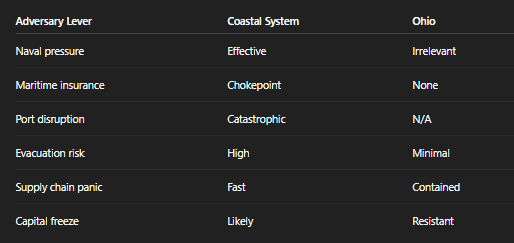
Ohio is a deliberately engineered INLAND system
Power, compute, manufacturing, validation, logistics, workforce, and finance are all co-located and synchronized.. This is what allows Ohio to scale when other regions stall
https://siliconheartland.newalbanyohio.org/
Logistics Hardening Is Part of the Ohio Doctrine
Ohio’s role as an inland control plane is reinforced not only by fabs and grids, but by deliberate freight survivability upgrades
The Brent Spence Bridge is one of the most overloaded freight chokepoints in the U.S., linking the Midwest industrial base to southern logistics corridors
being fully rebuilt under a $4B federal-state program
This corridor carries:
Defense suppliers
Substrates
Heavy equipment
Chemicals
System-level components
Hardening this route removes a single-point failure between:
Midwest manufacturing
Ohio system conversion
Southern deployment and port alternatives
This is not traffic relief its simply logistics continuity under escalation
The Adversary Test
Every serious strategic system must pass a simple test:
"How does an adversary actually break this?"
For Ohio the answers are limited:
Naval blockade → irrelevant
Export controls → already internalized
Packaging disruption → inland
Insurance withdrawal → minimal
Capital pressure → defense-aligned
Workforce evacuation → low risk
Logistics disruption → domestic truck & rail
What remains?
Only direct physical attack... which is a massive challenged in itself
That is an entirely different escalation ladder and one adversaries avoid unless absolutely necessary
Ohio survives first contact
What Could Actually Break Ohio & Why it Hasn't
Every real strategic system has failure modes
Pretending otherwise is how things collapse
Ohio’s risks are real but bounded
None of them interrupt continuity - - they only constrain the rate of expansion - - Ohio was engineered for that reality
Risk 1 - - High-NA EUV Tool Dependency
Reality: High-NA EUV tools are built overseas and represent irreplaceable capital assets
Why this doesn’t break Ohio:
Once installed, survivability depends on location not logistics
Tool shipment slows everywhere in crisis
Inland fabs continue operating
Coastal regions face insurance withdrawal, port disruption, and workforce shock
High-NA EUV is a front-loaded dependency
After installation continuity is geographic - - Ohio was selected to keep running when ports, shipping, and reinsurance freeze
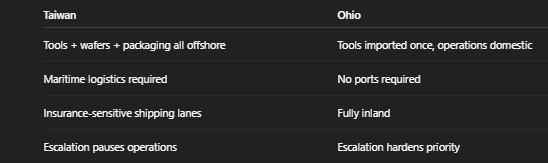
Risk 2 - - Specialty Gases & Chemicals
Reality: Neon, helium, photoresists, and specialty chemicals remain globally sourced
Why this doesn’t break Ohio:
Defense-aligned fabs receive priority allocation under escalation
Inland sites support bulk storage and longer buffer cycles
Domestic substitution is already active under export-control regimes
In conflict commercial offshore fabs pause first while defense-aligned inland fabs are sustained
Risk 3 - - Cyber / Insider / Sabotage
Reality: Physical survivability alone is insufficient at advanced nodes
Why this doesn’t break Ohio:
Secure enclave architecture separates classified and commercial lanes
Physical segmentation of tools, subfabs, and utilities
Air-gapped defense networks with continuous DoD oversight
This structure cannot be retrofitted into offshore OSAT or shared-utility fabs. Ohio was built with it from inception
The Quiet Resilience Layers
Most megaprojects fail under stress not because the tech breaks but because the supporting systems collapse - Ohio was engineered to survive those failure modes
layers most analysts never model:
EUV tools and fab assets remain fully insurable and reinsurable
Subsurface and mineral rights are secured for decades, not cycles
Export-control frameworks allow immediate segmentation for classified workloads
Tier-4 supplier security hardens passives, laminates, and ceramics
Regional emergency response is sized for HF, arsine, and cryogenic incidents
These are the details that determine whether a site shuts down or keeps running
They are invisible until crisis arrives
Why This Section Matters
This is the phase where megaprojects usually unravel
Capital loses patience
Talent rotates out
Policy shifts
Infrastructure stalls
Ohio does not show these failure signatures
Instead:
Capital is aligned across commercial and defense timelines
Talent is migrating into design enablement and long horizon roles
Policy is converging rather than oscillating
Physical infrastructure has crossed the point of irreversibility
Strategic Synthesis
Ohio
Ohio is not winning a competition - its closing a loop
What now exists inside a single inland region is a complete and durable system of national power
The Closed Loop
Within roughly a fifty mile radius the United States has assembled:
Leading edge logic fabrication at national scale
Advanced 3D packaging and chiplet integration
An inland substrate conversion pipeline
Hyperscale cloud adjacency and demand
Autonomous weapons manufacturing at rate production
Military R&D validation and certification
Propulsion and power electronics engineering
A hardened national scale grid
Defense aligned industrial finance
No other region in the world contains all of these layers in one operational loop
How the System Feeds Itself
Each layer pulls the next into inevitability:
Intel Ohio creates domestic leading edge supply
Packaging and substrates turn wafers into systems
Defense and cloud absorb volume and stabilize demand
Autonomy factories convert compute into weapons
Military validation hardens systems for deployment
Finance underwrites scale without fragility
Policy locks participation inside US borders
Once operating it reinforces itself
Why This Is Different From Past Megaprojects
Most industrial projects depend on one pillar
Ohio depends on many:
Not just subsidies but procurement mandates
Not just fabs but packaging and substrates
Not just defense but hyperscale demand
Not just construction but design inevitability
Not just policy but finance and insurance
Remove one pillar and the system still stands
What Ohio Replaces and What It Does Not
Ohio does not replace Taiwan in consumer volume...
It replaces Taiwan in the domains that determine sovereignty
Secure advanced packaging
Classified tape out
Defense and autonomy compute
Inland survivability
Auditable supply chains
Arizona fabricates - Taiwan manufactures - Ohio controls what becomes operational when optimization fails
The Strategic Outcome
For the first time since the Cold War the United States has rebuilt:
A sovereign silicon core
A domestic weapons compute pipeline
A resilient industrial finance layer
A manufacturing system that can operate under stress
This is the foundation for:
Next-generation air dominance
Collaborative combat aircraft
Missile defense and sensor networks
Hypersonics
Space-based ISR
Autonomous warfare
Time is the Strategic Variable
Modern conflict is decided by:
sensor → silicon → deployment loops
autonomy refresh cycles
countermeasure response time
Capacity matters but continuity determines time - - - and time determines force
Ohio collapses iteration loops inland so what takes years offshore compresses into quarters
The system that keeps producing at reduced efficiency defeats the system that halts at peak efficiency
Irreversability
To replicate Ohio today would require:
years of grid permitting
new transmission corridors
water rights
subfab zoning
defense validation authority
cleared workforce pipelines
This is the moment the United States stopped optimizing supply chains and started hardening systems because Ohio is not an industrial bet as its a survivability decision
Intel execution risk exists 100% especially with their past records BUT that was pre Lip-Bu Tan..
Ohio’s value persists even if timelines slip
Genesis Is a National System - - Not an Intel Bet
Intel executes Ohio but Genesis does not depend on Intel perfection
Execution risk exists as it always does at this scale
The value of Ohio persists even if:
node ramps slip
yields mature more slowly than projected
timelines extend beyond conservative guidance
Because Genesis embeds capabilities that outlive any single node, roadmap, or management cycle:
substrate and packaging gravity
inland power and water sovereignty
secure validation and certification authority
design enablement upstream of manufacturing
defense-aligned demand that cannot migrate offshore
These assets outlive any single node or management cycle
Intel’s past execution issues occurred under a model optimized for efficiency, outsourcing, and financial engineering
Under Lip-Bu Tan, Intel is reorganizing around design inevitability first, capacity second, mirroring the Cadence playbook where outcomes are locked before manufacturing begins
Even if Intel underperforms at the margin, Ohio remains the only U.S. site where:
advanced logic
advanced packaging
secure tape-out
domestic validation
and escalation-resilient continuity
can coexist at scale
The Unspoken National Security Unlock
If Intel Ohio incorporates even partial on site substrate capability in future phases:
America’s final semiconductor chokepoint closes completely
Full domestic advanced packaging returns
Chiplets, photonics, and secure packaging scale entirely inside U.S. borders
This eliminates the Pentagon’s last silicon supply chain exposure to Asia
Ohio Doctrine: Control Plane vs Fab
Ohio is not competing with Arizona or Taiwan.. its It is replacing them in the domains that determine power under stress
A control plane is authority over:
design acceptance
certification timelines
deployment readiness
iteration speed under disruption
In wartime the system that decides “what ships” wins.. not the system that fabricates the most wafers
History has seen this pattern before:
Pittsburgh during the steel era
Detroit during the combustion engine era
Los Alamos during the Manhattan Project
Ohio is next
Power shifts from efficiency to survivability
Control beats capacity in wartime
Ohio is built to function when optimization fails
Anchored by Intel’s $28B plus Ohio One megafab the state is
being quietly reconfigured into the sovereign core of Americas semiconductor defense autonomy and
cloud infrastructure
So What is Intel Ohio?
Ohio One Is Not a Fab
It Is a System Factory
Intel’s Ohio One is an engineered national security system built within a single inland region
Within Ohio the United States is rebuilding
Leading edge logic
Advanced 3D packaging
Substrate sovereignty
Hyperscale cloud adjacency
Autonomous weapons manufacturing
Military validation and certification
Defense aligned industrial finance
Ohio One specifically:
leading edge logic
advanced 3D packaging
Secure Enclave production
continuous classified throughput
Nothing here is retrofitted.... Nothing is phased in later.,.. all built in from the start
Scale Is Already Embedded
Ohio One’s importance lies less in announced fab counts than in infrastructure assumptions
Declared investment:
$28B+ initial capital
Physical reality:
Two megafabs under construction
Civil geometry and utilities sized for 8–10 fabs
Future advanced packaging facilities already accounted for
Substrate integration anticipated, not retrofitted
Paused projects do not look like this.. systems built to absorb demand shocks do
They do not:
overbuild utilities
lock multi-fab geometry early
size infrastructure for demand they do not yet “have”
Ohio was designed to absorb demand shocks
From Doctrine to Steel
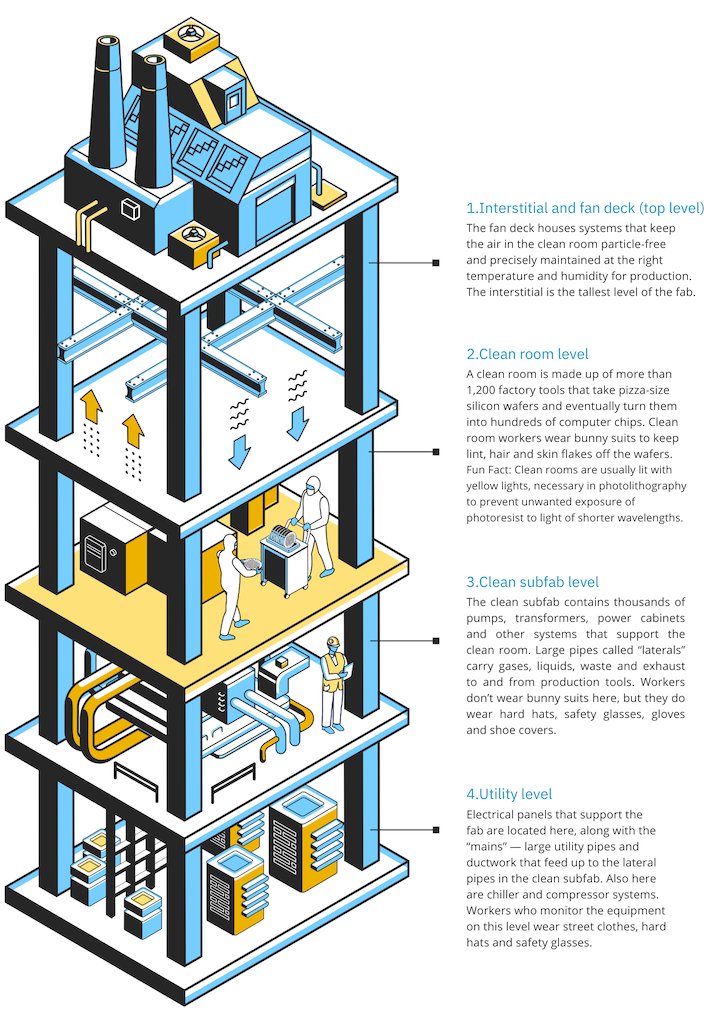
Civil geometry, power routing, subfab depth, and cleanroom physics
Every strategic claim above has a physical analog already built:
Survivability - - inland siting, dual-grid power
Sovereignty - - Secure Enclave integration
Scale - - utility oversizing
Irreversibility - - shell lock & subfab sealing
Defense alignment - - classified manufacturing lanes
This system has already crossed the point of no return
Phases of Ohio One
Trust the Ground not the Press
Genesis does not announce itself because it reveals itself structurally in phases
Most observers watch:
Press releases
Hiring headlines
CapEx guidance
They miss where the truth actually is:
Concrete
Steel
Power topology
Subfab geometry
remember that the ground tells the truth
Phase I - The Physical Lock-in (COMPLETED)
The Point of No Return
Paused semiconductor projects leave obvious signatures & Intel Ohio does not show them
Paused projects do not:
Overbuild utilities
Seal subfabs
Install cleanroom decks
Activate permanent substations
Ohio has done all four...
Observed facts:
Utilities built ahead of tool demand
Subfabs sealed before anchor customers are announced
Cleanroom decks installed before yield teams arrive
At this stage:
Capital is sunk
Design assumptions are embedded
Reversal becomes politically and economically irrational
This is the irreversibility threshold that Ohio has crossed
Multi-Module Commitment Is Already Visible
Second fab module is already above ground
The vertical pillars now visible are the permanent structure behind the hoisted cleanroom slabs of Module 1
First module is expected to be fully shelled this year
This confirms:
Multi-module concurrency
No serialized “wait and see” build
Structural commitment beyond a two-fab narrative
You do not raise permanent vertical structure for follow-on modules unless expansion is assumed
Why This Is Not a “Two Fab” Build
Intel Ohio is not being constructed like a simple dual fab campus
The site shows signals of parallel, scalable deployment:
A two-fab site does not require:
Multi-hundred-MW substations
Multi-story fab shells locked early
Redundant UPW farms
Early cleanroom decks & roof panels
Multiple large gas pads
Deep, compartmentalized subfabs sized for parallel tool clusters
Crane density indicating parallel sequencing
Excess exhaust handling capacity
Central utility plants sized for continuous multi-fab operation
Again, Ohio has all of them
Utilities are built ahead of need, not just in time
You do not prebuild permanent infrastructure at this scale if you intend to pause
Subfab Geometry: Built for What Comes Next
Ohio’s subfabs are:
Deeper
Wider
Heavier reinforced
Than required for 18A alone
This geometry matches High-NA EUV era requirements not transitional nodes
Arizona required redesigns to reach this standard
Ohio was built to it from day one
That signals expectation of next-generation tools
Cleanroom & Shell Signals
Same cleanroom footprint as Fab 52/62 and Fab 38
Majority of cleanroom floor installed
Minimal column count confirmed
Long-span design optimized for tool flexibility
Floor systems aligned for EUV-class vibration tolerance
Once cleanroom decks go in:
Layout assumptions are frozen
Tool intent is implicit
You do not do this without intent to run tools
Interstitial & Shell Completion Path
Interstitial framing underway above cleanroom
Fan deck systems staged for airflow, thermal, and humidity control
Roof truss lifts complete the envelope (“shell”)
Shell completion = transition from construction to activation
Ohio is on this path now
Early EUV Readiness Signals
Cryogenics + vibration isolation appeared early not late
Visible signals:
Cryogenic-capable routing corridors
Gas and cooling envelopes sized for sustained EUV duty cycles
Vibration-isolated corridors for parallel EUV tools
Transport spacing optimized for environmental decoupling
This implies:
EUV readiness baked into civil design
High duty-cycle assumptions
Earlier tool move-in than conservative guidance suggests
Electrical Backbone = Operational Scale
This is not construction power
Signals:
Permanent switchgear
Dense transformer populations
Hardened routing corridors
Substations activating with shell completion
Primary duct trunks, mains piping installed
Chiller and compressor zones structurally complete
Temporary power does not look like this
This is operational infrastructure sized for future fabs
Phase I In Short
All signals align under one assumption:
Utilities assume expansion
Subfab geometry assumes High-NA
Tool readiness assumes sustained throughput
Power systems assume real load
Paused projects are not built this way
Phase II - - Design Gravity (IN PROGRESS)
Once physical lock-in occurs, design gravity follows
Phase II is not visible in steel but its visible in design behavior
At this stage:
Design enablement moves upstream of manufacturing
Packaging and power assumptions lock before demand is public
Programs quietly align to one physical reality
This is where fabs stop competing on price or schedules
and begin competing on architectural inevitability
Designs are being trained on:
High-NA EUV envelopes
Backside power assumptions
EMIB / Foveros constraints
Inland validation timelines
Fab selection becomes implicit
Design Gravity Precedes Wafer Gravity
Foundries do not win customers at tape-out...
They win years earlier inside design flows
Once engineers train on:
Intel PDKs (18A → 14A-class)
backside power (PowerVia) constraints
EMIB / Foveros packaging rules
High-NA EUV layout envelopes
inland validation timelines
Switching fabs becomes a design rewrite not a procurement choice
Ohio is now exerting that pull
What Phase II Looks Like in Practice
Defense and hyperscale architectures are being shaped around Ohio constraints
Packaging is treated as a first-order design variable, not a downstream step
Validation timelines are assumed domestic and inland
Secure enclave compatibility is designed in
Programs are no longer “bid into Ohio.”
They are designed assuming Ohio exists
Phase III - - Demand Ignition (PENDING)
Genesis does not scale linearly
It ignites
Trigger conditions:
First $1B+ external commitment tied to domestic 14A-class wafers
Defense or hyperscale volume activation
Policy or geopolitical shock collapsing alternatives
The igniter can be:
a defense sustainment contract
a hyperscaler capacity reservation
a policy or geopolitical shock collapsing offshore alternatives
When triggered:
Fab 3 / Fab 4 unlock immediately
Federal capital accelerates
Hyperscalers panic-reserve domestic capacity
From the outside it looks sudden but in reality it’s delayed recognition of infrastructure already built
Phase IV - - Strategic Irreversibility
At Phase IV:
Workforce gravity locks
Infrastructure reservations harden
Design flows train on a single system
Ohio stops being a project & it becomes infrastructure
Reversal is no longer a business decision & becomes a national disruption event
All in All
Subfab depths exceed 18A needs
Clean subfab structure largely complete
Gas, liquid, waste, exhaust laterals defined
Power, pump, transformer zones framed
Column spacing widened for EUV density
Vibration isolation sized for parallel tools
Cryogenic routing exceeds transitional requirements
Arizona retrofitted and Ohio was built right the first time
That is confidence poured into concrete
Phase I is done
Phase II is underway
Phase III awaits ignition
Phase IV is structurally forced under escalation
Most people are watching announcements while the ground already decided
High-NA EUV and Continuity
Why Ohio Was Chosen to Keep Running
High-NA EUV is the final physics gate of advanced logic
Ohio’s civil envelope supports:
parallel EUV clusters
sustained duty cycles
long-term installed-base survivability
High-NA is a front-loaded dependency
Once installed survivability depends on location not future tool deliveries
Ohio was selected to keep running when:
ports freeze
shipping insurance collapses
reinsurance withdraws
Full EUV / High-NA Production Compatibility (By Design)
Long before any tool delivery, Ohio’s physical layout signals intent:
tool bays sized for ASML NXE + EXE
subfabs engineered for cryogenic hydrogen handling
dedicated neon / argon / nitrogen corridors
sub-nanometer vibration envelopes
mask & pellicle zones sized for defense-relevant volume
High-NA geometry is already embedded:
300+ ton scanner floor loads
column-optic ceiling heights
beam-path clearance across full envelopes
ultra-tight thermal expansion control
This eliminates:
demolition risk
retrofit downtime
capacity loss during node transitions
Ohio is structurally a High-NA generation site
Packaging & Substrates
Leading edge transistors are no longer the bottleneck in advanced systems.. Packaging is
Wafers do not create power... Systems do
Every modern compute system depends on advanced substrates to physically connect logic memory power and I/O into a usable system
Every advanced system depends on substrates:
AI accelerators
missile seekers
ISR payloads
autonomy compute
space processors
Without substrates, wafers are useless
Packaging Is Where Sovereignty Is Lost
Advanced systems do not fail at the wafer they fail at the conversion layer
Packaging determines:
power density
thermal survivability
latency and signal integrity
radiation tolerance
system-level yield
For decades, the United States allowed this layer to remain offshore
That decision quietly nullified fabrication sovereignty
Genesis restores sovereignty by relocating the system assembly layer inland
The Historic U.S. Vulnerability
The United States historically lacked:
domestic advanced substrate capacity
domestic large-scale advanced packaging
This meant:
iteration speed was externally gated
defense timelines were fragile
escalation collapsed supply chains
Genesis exists to close this gap
Substrate Chokepoint
Even if Intel builds the world’s best transistors nothing works without substrates
The United States has no modern domestic ABF substrate capacity
Global supply is controlled by:
Ajinomoto (Japan)
Unimicron / Nan Ya (Taiwan)
This means:
AI compute
Hypersonic guidance
ISR refresh cycles
Autonomous weapons
…all remain externally rate limited without inland correction
Control of substrates = control of time
Substrate sovereignty is often framed around ABF resin and panel capacity
But even perfect ABF chemistry fails without glass cloth capable of maintaining dielectric performance at GHz+ signaling speeds
Today this remains a global chokepoint led by Japan & under escalation the U.S. strategy is controlled convergence
where trusted domestic platforms like Owens Corning / AGY provide the base upon which performance parity can be subsidized, mandated, and eventually forced
The Midwest Substrate Correction
The United States is quietly correcting this failure... again, inland
SCHMID Group and Calumet Electronics in Michigan are building America’s first modern high-density organic substrate capability, roughly 500 miles from Intel Ohio One, connected entirely by truck and rail.
Capabilities include:
high-density organic substrates
large-panel formats optimized for chiplets
glass substrate pilot lines
redistribution layers and hybrid interposers
materials compatible with EMIB and Foveros
This creates the Ohio–Michigan Axis
The Ohio-Michigan Axis
Michigan produces substrates
Ohio converts them into systems
This creates the first inland end to end chiplet pipeline in U.S. history:
Substrates produced inland
Dies packaged inland
Systems provisioned inland
Logistics fully domestic
No maritime choke points
Geography becomes defense
Conversion Point
Substrates do not create power - Packaging does
Ohio One is where substrates become
EMIB connected chiplets
Foveros stacked systems
Photonics enabled packages
Secure defense grade assemblies
Without Ohio the Midwest substrate effort stalls - - without substrates Ohio can not scale
EDA: Upstream Control Panel
Semiconductor power does not begin in fabs it begins inside Electronic Design Automation (EDA) tools
EDA determines:
what architectures are feasible
what power delivery schemes can be verified
what packaging geometries are realistic
what yield risks are tolerable
Foundries win customers years before tape-out.. inside EDA flows
Why Manufacturing Alone Is Not Enough
EDA dominance alone is insufficient if manufacturing is offshore
Design intent fractures when:
foundry rules are foreign
packaging constraints are external
validation is overseas
secure flows are unauditable
The Cadence → Intel Signal
Leadership lineage matters because design gravity precedes manufacturing gravity
Lip-Bu Tan’s background at Cadence matters because Cadence is where semiconductor outcomes are decided long before wafers exist
Cadence is where:
design constraints become non-negotiable
defense and aerospace architectures are frozen
packaging, power, and validation assumptions are locked
fab selection becomes implicit years before procurement
Foundries do not win at the fab they win inside EDA flows before tape-out is even possible
Under Lip-Bu Tan, Cadence mastered a specific pattern:
shape architectures before capacity exists
embed constraints upstream
make switching costs architectural, not contractual
Intel is now applying that same pattern to manufacturing
Intel’s move to pull defense and government focused design enablement upstream signals:
shaping demand before capacity unlocks
embedding Intel rules before tape-out
designing Ohio into programs rather than bidding later
Why This Matters for Ignition
Ignition does not begin with wafer orders
It begins when architectures become dependent on a single system
Once programs are designed around:
Intel PDKs
PowerVia assumptions
EMIB / Foveros constraints
enclave-grade validation timelines
Demand does not need to be sold
The Ignition Event
The First $1B+ External Customer
It is the first $1B+ multi-year external commitment tied explicitly to domestic 14A-class wafer capacity
That moment flips Intel Ohio One from 2 fabs under construction to America's engine
The system was designed assuming:
Demand arrives suddenly
Not gradually
Ignition IS:
the first $1B+ multi-year external commitment
explicitly tied to domestic 14A-class capacity
made before proof, because alternatives are constrained
Ignition is a financial recognition event not a manufacturing milestone
Once ignition occurs, three things happen automatically:
Capital unlocks
CHIPS expansion clauses activate
lease-back / co-investment structures reopen
federal risk underwriting collapses
Capacity accelerates
Fab 3 / Fab 4 greenlit
tooling timelines compress
Ohio shifts from staged to parallel build
Demand cascades
hyperscalers panic-reserve domestic slots
defense primes align future tape-outs inland
Ohio moves from optional to mandatory
This is how Ohio goes 2 → 4 → 8 fabs inside ~36 months
Who Can Ignite Ohio
Not everyone can.. the igniter must satisfy all four conditions:
Can write a $1B+ check
Needs leading edge + packaging
Benefits specifically from U.S. domestic wafers
Can move before others without waiting for proof
realistically only 4 options exist..
Hyperscaler Custom Silicon
AWS (Primary Igniter??)
Amazon Web Services is the single strongest candidate
Already engaged with Intel Foundry at 18A
TSMC N2 capacity is functionally booked (Apple / NVIDIA / AMD / Broadcom)
Trainium / Inferentia roadmaps require predictable wafer access
Structural forces favor domestic capacity:
Tariff exposure + CHIPS economics structurally favor domestic wafers
GovCloud + defense workloads increasingly require auditable supply chains
Geographic redundancy is now a requirement, not an optimization
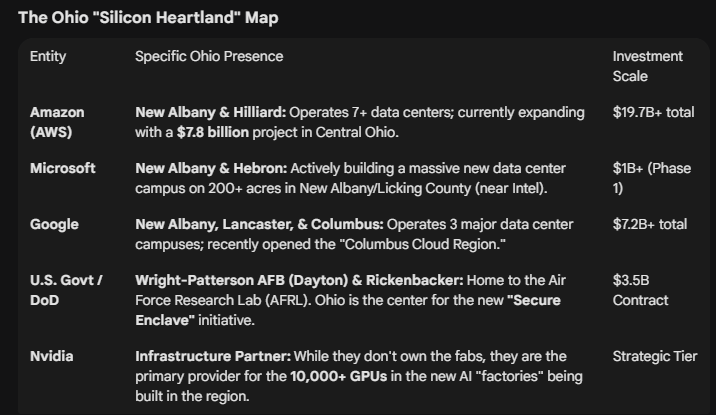
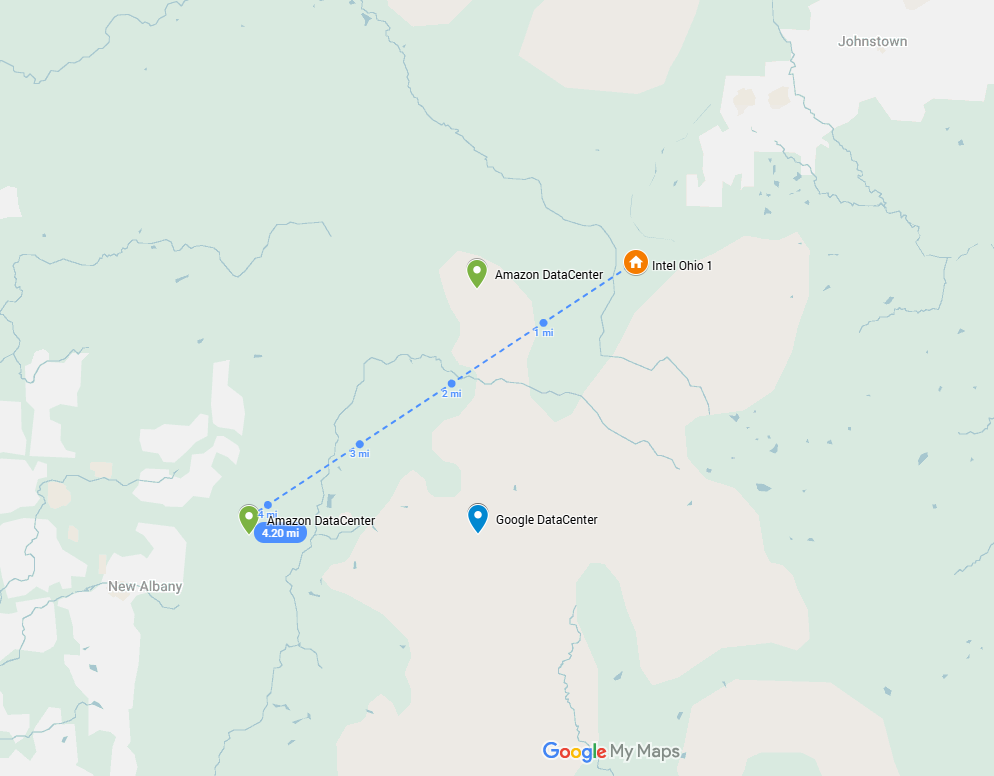
AWS operates one of its largest global regions in Ohio, anchored in the Columbus metro, placing massive, immediately consumable demand inside the same inland basin as Intel Ohio One
That proximity matters because it enables:
Faster silicon-to-deployment loops
Lower logistics, risk, and inventory overhead
Early capacity reservation without waiting for global manufacturing proof
AWS does not require the lowest possible cost or perfect early yields
AWS does require guaranteed domestic supply, geographic redundancy, and capacity it can consume locally
AWS is the only hyperscaler positioned to ignite Ohio first and immediately pull capacity into real utilization
Microsoft Azure
Azure’s strategic strengths are real:
Deep Department of Defense and intelligence community integration
Custom silicon roadmaps (Maia, Cobalt)
Longstanding Intel relationship
Significant federal and classified cloud demand
Microsoft has paused portions of its Ohio data center expansion due to capex so its less likely to be them as a launch customer but they'll be a quick follower
Azure typically:
Waits for manufacturing proof points
Lets supply chains mature
Commits after economics stabilize
Azure is more likely to:
Commit immediately after AWS or DoD ignition
Reserve large blocks once Ohio capacity is visibly real
historically more cautious on first wave capex
U.S. Department of Defense (Classified Wafer Sustainment)
This is the most underestimated ignition path because it doesn’t look like a “customer” on the surface but structurally it behaves like one
The DoD does not need:
Lowest unit cost
Consumer-scale yields
Public announcements
The DoD does need:
Guaranteed domestic, classified, leading-edge wafers
Multi-year availability under escalation
Secure tape-out and advanced packaging entirely within U.S. borders
That maps exactly to Intel Ohio One
A DoD ignition would not look like a traditional commercial deal. It would likely take the form of a 10–15 year classified sustainment contract explicitly tied to 14A-class secure wafer capacity covering:
Hypersonic guidance processors
Missile seekers
ISR payload compute
Autonomy and teaming processors
Space and counter-ISR systems
A single agreement of this type would instantly:
Justify Fab 3 and Fab 4
Force dedicated secure packaging capacity
Lock Ohio as the compute anchor for Golden Dome, NGAD, and Replicator
This would not show up as “Intel wins customer X.”
It would show up as: “DoD expands domestic advanced microelectronics capacity under RAMP-C.” type thing
RAMP-C already mandates:
Domestic tape-out
Secure packaging
Auditable supply chains
Classified programs cannot wait for commercial yield perfection
DoD doesn’t follow hyperscalers it moves when risk crosses tolerance
AMD & OHIO: Pressure Valve Signal
AMD does not need to switch foundries for Intel Ohio to matter
It only needs to prepare for Intel specific process realities
AMD is one of the most demanding fabless designers in the world
If a process is not credible, AMD does not train for it
AMD is not:
Building fabs in Ohio
Abandoning TSMC
Becoming an anchor customer
AMD is applying pressure to:
Node availability
Geographic concentration risk
Packaging and power constraints
That pressure bends toward Ohio
The PowerVia Signal
AMD has posted physical design / CAD roles listing backside power delivery and 3D stack concepts as preferred experience
Backside power is not a generic industry abstraction
It exists only inside:
Intel 18A / 14A-class processes
Intel Foundry Services
Fabs physically designed for PowerVia
Companies do not train engineers for manufacturing architectures they do not expect to encounter
This confirms three things simultaneously:
Intel’s process roadmap is being treated as real
Backside power constraints are entering AMD’s design reality
Intel Foundry is credible enough to warrant internal readiness
This is process level validation
Why AMD Is Structurally Forced to Care
AMD’s exposure is concentrated exactly where Ohio matters most:
Chiplet-based CPUs and GPUs
AI accelerators
Defense-adjacent compute
Hyperscaler custom silicon
All four are:
Packaging-constrained
Power-delivery-constrained
Iteration-speed-constrained
Ohio is the only U.S. site engineered for what comes after TSMC N3/N2 saturation:
Backside power
Large-scale advanced packaging
Secure domestic conversion paths
AMD does not need flagship volume for Ohio to matter because the optionality itself is leverage
Where AMD Would Actually Touch Ohio
Advanced packaging - chiplet integration
EMIB
Foveros
Photonics-enabled packages
Future glass substrates
U.S. only / defense adjacent SKUs
Domestic packaging
ITAR compliant flows
Secure validation
AMD involvement does three things:
Validates Intel Foundry physics
Signals hyperscalers that Ohio is real
Accelerates defense confidence in domestic nodes
AMD’s role is credibility pressure
Fab Workforce Reality - - - The Three Waves
The human signals mirror the physical signals exactly
Intel builds megafabs in three distinct workforce waves
Wave One: Political, Permitting, Subsurface (2022–2024)
Land acquisition, wetlands mitigation, mineral rights, PUCO power filings, Army Corps water approvals, and local incentive structures
These leaders exit once the ground is locked. Their departure signals completion, not slowdown
Wave Two: Heavy Civil & Structural (2023–2025)
Subfab excavation, cryogenic vaulting, utility trenching, vibration-isolated foundations, and cleanroom shell erection
Managers transition out as shells seal and subfabs are commissioned
Wave Three: Tools, Process, Yield (2026–2030)
EUV / High-NA integration leads, lithography tuning specialists, metrology owners, yield ramp teams, and secure enclave certifiers
These $400K–$900K specialists do not relocate until cleanrooms are pressurized and tool bays are certified
Most observers are mistakenly waiting for Wave Three to appear before believing the project is real
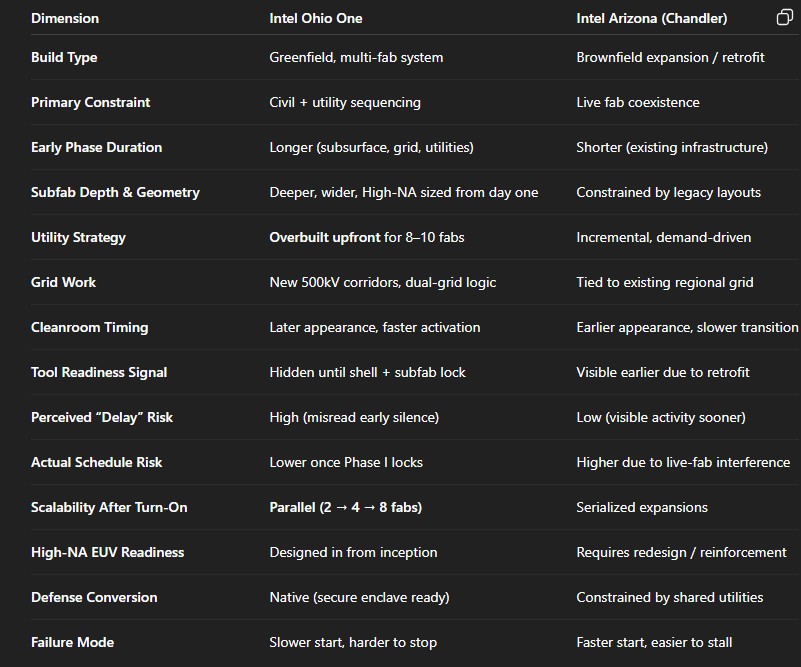
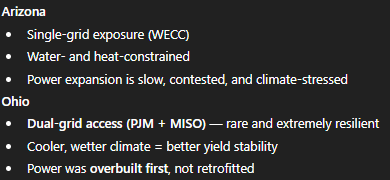
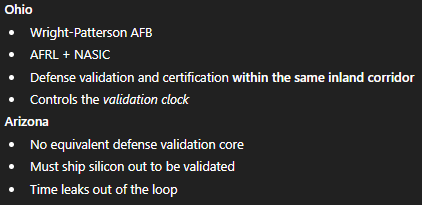
Ohio Versus Arizona - Timing Reality
Key points:
Arizona = volume + commercial scaling
Ohio = control + continuity
Ohio is where:
New nodes are hardened
Sensitive customers anchor
Validation clocks are owned, not borrowed
Arizona is inland by geography - Ohio is inland by survivability
Why Slowing Now Makes No Sense
Despite all the rumors that Ohio One is being delayed .. its all smoke..
Pausing now would:
Strand billions in fixed infrastructure
Permanently damage foundry credibility
Break defense alignment under RAMP-C
Undermine hyperscaler confidence
Trigger congressional and Pentagon intervention
The rational move is not delay - - It is acceleration once demand is formalized
Personnel Turnover - Why Departures Are Normal at This Phase
Recent reporting has highlighted local leadership turnover tied to Ohio One
Several “local Intel leaders” tied to the Ohio One project left around September 2025
Reported departures include:
Toby Starr - public affairs manager
Sanjay Patel - construction-site manager
Tom Marshall - senior program manager (Foundry division)
Kevin Hoggatt - described as a “main lobbyist / government-relations lead” for Ohio One
Ronak Singhal - a senior-fellow / Xeon CPU chief architect - - was also leaving the company in September 2025
The cluster created the illusion of a systemic problem but the roles fall into three predictable end of phase categories:
Government / Community Liaison Roles
zoning & land use negotiations
EPA & Army Corps environmental compliance
workforce grants
tax abatements
regional political coordination
These roles evaporate once political & regulatory gates close
Heavy Civil Site-Development Managers
subfab excavation
stormwater systems
utility corridor routing
crane pathways
perimeter access roads
Their job ends when subsurface work is complete
Early Construction Integration Leads
shell sequencing
contractor coordination
early safety & structural QA
cleanroom envelope erection
They transition out when shells seal and internal MEP takes over
Why September Looked “Sudden” to the Public
Three things converged at once:
Shell + subfab civil milestones were reached
Local political roles expired at phase gates
Contractor transitions masked as “Intel exits”
Defense & Cloud Demand Are Inevitable
Once substrates & packaging moves inland everything upstream follows
Hyperscale cloud demand
Defense production scale
Autonomy manufacturing
Secure logistics
Capital formation
Demand from defense and cloud is a matter of when
Defense and hyperscalers are not optional customers.. They are forced participants once constraints activate
Structural Demand, Not Cyclical Demand
Structural demand has three defining properties:
Appears when alternatives fail
Persists regardless of price
Is governed by compliance and survivability
This is fundamentally different from cyclical semiconductor demand.
Cyclical demand:
Appears when prices fall
Disappears when margins compress
Migrates to the lowest-cost geography
Structural demand:
Appears when alternatives collapse
Persists regardless of pricing
Is locked by regulation, security, and continuity
Once buyers evaluate whether they can legally, securely, and reliably deploy advanced systems without Ohio, demand stops fluctuating:
Demand does not migrate offshore
Demand does not wait for “better timing”
Demand activates when constraints activate
Defense and cloud do not choose Ohio because it is cheaper
They choose Ohio because the alternative paths collapse
Why Defense Can’t Stay Offshore
For decades, U.S. defense silicon tolerated offshore dependencies:
Taiwanese foundries
Asian OSAT packaging
Maritime logistics
That tolerance no longer exists.
Geopolitical risk has collapsed the margin for offshore dependence:
Taiwan concentration risk
Export-control bifurcation
Wartime surge requirements
Classified workflow isolation
The U.S. Department of Defense now mandates:
Domestic wafer production
Domestic advanced packaging
Secure enclave manufacturing
ITAR-controlled flows
Auditable, escalation-resilient supply chains
Intel Ohio One is the only site designed to potentially satisfy all five at scale
Once the Michigan → Ohio flow becomes standard, the U.S. defense silicon stack becomes fully domestic and sovereign by default
When Structural Demand Pulls Consumer Optionality Inward
Apple, Intel Ohio, and the Consumer Multiplier
Intel Ohio does not require consumer OEM participation to succeed...
But once sovereign packaging, substrates, and inland capacity exist, consumer supply chains gain a new option they have never had before
A December 2025 MacRumors report suggests Intel may manufacture future iPhone chips in the United States - - https://www.macrumors.com/2025/12/05/intel-iphone-chips-rumor/
If even partially true the implications are structural
Not because Apple validates Ohio but because Ohio finally makes domestic consumer silicon feasible
A hypothetical Apple pipeline would look like:
Glass → Kentucky (Corning Harrodsburg)
Logic → Intel Ohio One (14A)
Packaging → Ohio Two (EMIB Foveros glass substrates)
Logistics → Rickenbacker Global Hub
Assembly → Interior U.S. states
This configuration eliminates:
maritime chokepoints
China exposure
offshore packaging risk
export control ambiguity
It would be the first time Apple could source leading edge A series silicon entirely within U.S. borders
The key point is this:
Ohio is the first place where such a decision is even possible
Why Consumer Optionality Is Secondary to Warfighting Reality
Consumer silicon may follow Ohio but Warfighting doctrine already requires it
Modern warfare has crossed a threshold where superiority is no longer defined by:
platforms
airframes
hulls
It is defined by compute at the edge
AI warfighting is not about bigger models or centralized training clusters
It is about continuous iteration of deployed intelligence under contested conditions
That requirement collapses every fragile assumption of the old semiconductor order
AI Warfighting Doctrine Forces The Shift
Modern warfare has crossed a threshold & superiority is no longer defined by platforms
Its defined by compute at the edge
Every major weapons and ISR system now depends on:
Edge inference
Sensor fusion
Autonomy
High-bandwidth mission processing
Secure, radiation-tolerant 3D compute
These workloads:
Can't run on legacy nodes
Can't tolerate offshore iteration
Can't survive fragmented packaging paths
AI Doctrine Forces Inland Control
AI-driven warfare demands:
rapid silicon refresh cycles
custom ASICs tuned to mission envelopes
secure tape-out under classification
advanced 2.5D / 3D packaging
domestic validation authority
This cannot be achieved with:
offshore OSATs
foreign substrates
distributed audit chains
maritime logistics dependencies
AI doctrine forces the entire loop inland
Ohio exists because this doctrine exists
From Platforms to Systems of Systems
AI warfare shifts advantage from platforms to systems of systems:
autonomy swarms
sensor networks
ISR fusion layers
command-and-control compute
These systems are:
power-constrained
thermally constrained
latency-sensitive
iteration-dependent
They do not scale on GPUs alone
They scale on custom silicon packaged for survivability
RAMP-C - Quiet Catalyst
The Department of Defense has already rewritten the rules through RAMP C
(Rapid Assured Microelectronics Prototypes – Commercial)
The DoD’s quiet Manhattan Project for microelectronics
custom silicon at advanced nodes
domestic tape-out
U.S.-only advanced packaging
shortened iteration cycles
classified manufacturing environments
This is a structural mandate - Could even argue that this push into Ohio only exists because RAMP C exists
RAMP-C converts defense primes into hyperscaler-style silicon customers
Ohio’s campus was selected because it can scale from 2 → 8+ fabs, turning the U.S. into:
A domestic ASIC powerhouse
The world’s defense-oriented semiconductor hub
The manufacturing engine behind Replicator, NGAD, CCA, ISR, and missile defense
Named Demand Gravity (PROGRAMS THAT REQUIRE OHIO-CLASS SILICON)
Once warfare is defined by edge compute, autonomy, and iteration speed, demand stops being theoretical and becomes program bound
A small set of U.S. defense initiatives now require advanced domestic logic, advanced packaging, and inland validation to function at all:
NGAD – distributed sensor fusion, autonomy-assisted combat systems, rapid silicon refresh
CCA – power-constrained autonomy ASICs with continuous iteration cycles
Golden Dome – persistent sensor fusion, hardened compute, secure packaging
Space-based ISR refresh – radiation-tolerant 3D compute with compressed upgrade timelines
These programs cannot execute on legacy nodes
They cannot tolerate offshore packaging
Once designed their silicon demand does not migrate, fluctuate, or wait for price discovery - - it locks
This is why Ohio does not need to be “chosen.”
It becomes mandatory when these programs cross their next compute threshold
Midwest Defense & Autonomy Layer
Anduril Industries - Arsenal-1
Arsenal-1 is the first true rate-production autonomous weapons factory in U.S. history:
Multi-million-sq-ft autonomous systems campus
CCA-class drones
Counter-UAS systems
Autonomous interceptors
ISR platforms
Autonomous warfare now runs on software cadence and silicon iteration not platform refresh cycles
Arsenal-1 requires a domestic rapidly iterable compute supply chain
Proximity matters:
~20 miles from Intel Ohio One
Same basin
Same grid
Same security envelope
Palantir - The AI Command & Control Plane
Palantir binds:
Intel silicon
Anduril / Boeing hardware
Hyperscaler compute
DoD operational networks
This creates a vertically integrated AI warfare stack:
Intel (compute) → Anduril/Boeing (hardware) → Palantir (command OS)
Palantir systems can't tolerate:
Foreign packaging
Non-auditable silicon
Maritime logistics risk
Advanced Air Mobility → Defense Conversion Pipeline
Ohio hosts the only AAM ecosystem that naturally converts civil autonomy into military capability
Anchors:
Joby Aviation (Dayton + second Ohio facility)
GE Aerospace (Cincinnati)
Wright-Patterson AFB
Rickenbacker Airport
Ohio BVLOS autonomy corridors
Civil platforms become military assets through stress testing.
Joby Aviation relevance:
Large Dayton footprint + 2nd site as of 1/7/25
Direct adjacency to Wright-Patt / AFRL
Autonomy corridor access
~70 miles from Intel Ohio One
"Joby Aviation says it has signed an agreement to acquire a more than 700,000 square foot manufacturing facility in the Dayton, Ohio area"
Same inland defense industrial spine
Ohio operations stress test:
Autonomous routing & landing
Redundant compute avionics
Battery performance across climate extremes
Runway independent logistics
Wright-Patterson AFB - The Validation Core
Wright-Patt is the keystone of the Ohio Doctrine:
AFRL autonomy & weapons research
Air Force Research Laboratory
NASIC ISR analysis
National Air and Space Intelligence Center
EW, avionics, autonomy testing
Classified silicon qualification
As stated before, this is where:
Chips are certified
Autonomy stacks are hardened
ISR payloads validated
EW systems stress-tested
No coastal fab region controls its own validation clock... Ohio does
With Intel Ohio + Wright-Patt:
Silicon is fabricated inland
Packaged inland
Validated inland
Deployed without coastal dependency
Rickenbacker
The Operational Nexus
Rickenbacker is one of the few dedicated cargo focused international airports in the world
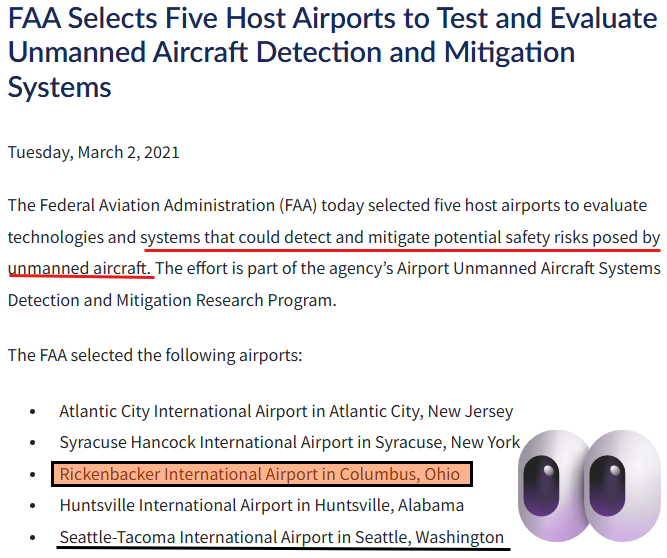
This makes it the ideal environment for the FAA to test how to detect and mitigate drone threats without disrupting massive commercial logistics chains
Logistics Testing: Validating how ISR (Intelligence, Surveillance, and Reconnaissance) payloads function in high-traffic cargo environments
EW Implementation: Testing Electronic Warfare (EW) and counter-UAS systems in a civilian-regulated airspace
Strategic Connectivity
Rickenbacker is located less than an hour's drive from Wright-Patterson AFB.. This creates a high speed feedback loop:
Test at Rickenbacker: Identify failures in the detection stack or silicon performance
Validate at Wright-Patt: Immediately return data to the Air Force Research Laboratory for hardening
Fabricate at Intel: Iterate the hardware at the nearby New Albany "Silicon Heartland" fabs
Interestingly, they were selected by FAA in 2021
Defense Primes as Demand Engines
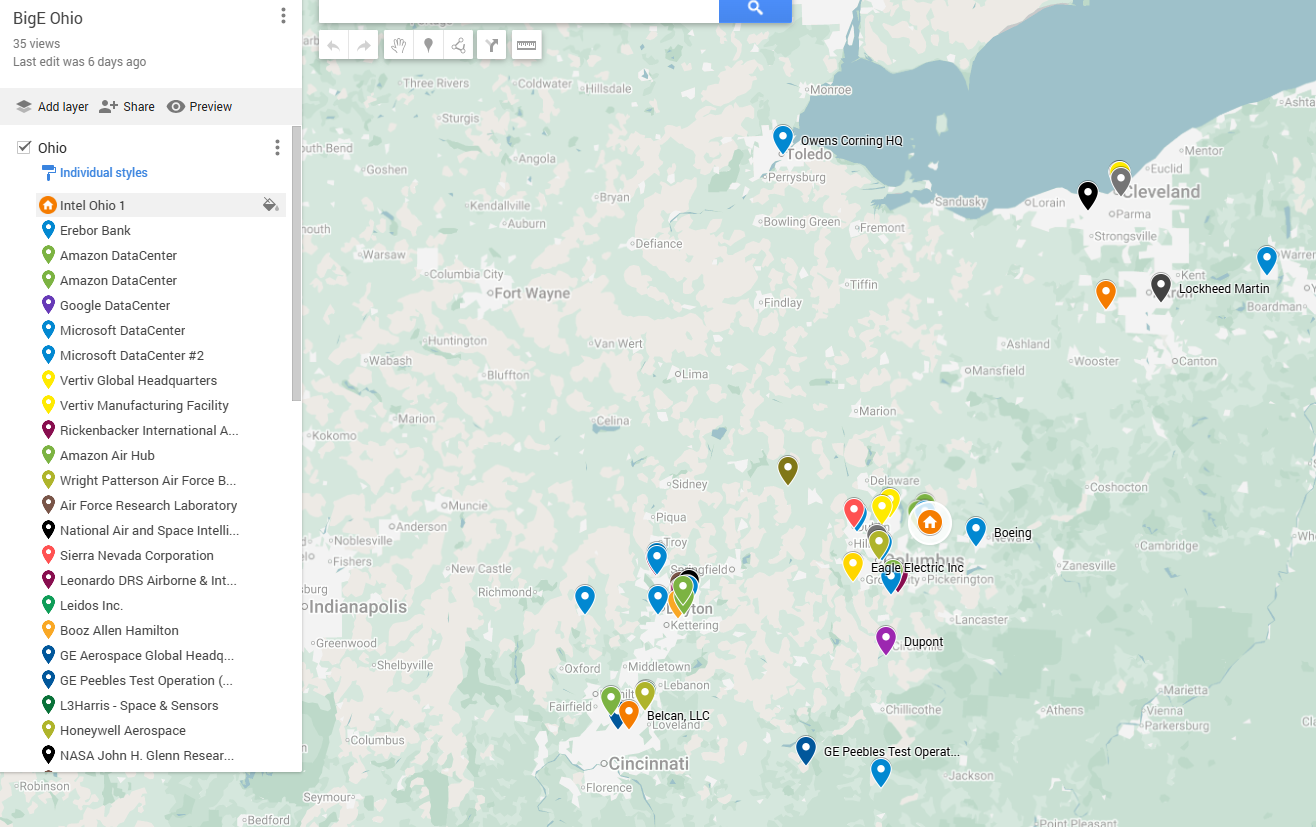
The U.S. defense primes are no longer just metal benders, integrators, or platform builders - - They are becoming the single largest demand engines for domestic, leading-edge silicon
AI warfare = compute warfare
Compute warfare = semiconductor sovereignty
Semiconductor sovereignty = Intel Ohio
Every major U.S. prime now depends on:
Custom silicon
Advanced packaging
Secure domestic tape out
Rapid iteration under classification
Which collapses demand toward Ohio
Prime exposure by compute domain:
Boeing - autonomy, ISR, space systems
Lockheed Martin - mission systems, radar compute
Northrop Grumman - ISR, nuclear command, space payloads
RTX - missile seekers, EW, radar processors
Each upgrade cycle requires new silicon
Each silicon generation requires advanced packaging
Each secure packaging path leads inland
Why Cloud Demand Could be Pulled Inland
AI workloads are exploding beyond general purpose GPUs
Hyperscalers face the same constraints as defense:
Advanced TSMC nodes fully booked
AI demand is not elastic
Dual-sourcing no longer optional
Cloud providers now require:
Custom accelerators
Chiplet based architectures
Secure geographic redundancy
Domestic capacity insulated from tariffs and disruption
TSMC capacity at advanced nodes is oversubscribed & Apple / Nvidia / AMD / Broadcom / Qualcomm already saturate the pipeline..
The anchor customers are pretty obvious:
Microsoft, Amazon, Google as hyperscale compute buyers
My favorite bet is Amazon being anchor
DoD as secure provisioning and defense cloud demand driver
I think they might beat Amazon to the punch and really force Intel One to be defense based from day 1
Ohio absorbs forced overflow demand created by:
Node saturation
Geopolitical risk
Policy alignment
Ohio offers what coastal sites can not:
Inland security
Stable power and water
Advanced packaging at scale
Proximity to defense customers
Tariff-insulated domestic wafers
Intel Ohio is embedded inside one of the heaviest hyperscale concentrations in America:
AWS - multi tens of billions regional expansion
Google - New Albany data corridor
Microsoft Azure - federal & defense workloads
Wafer → Package → Secure Provisioning → Cloud Training → Deployment
All inside 100 miles...
Defense Validates - - Cloud Amplifies
Defense demand creates necessity:
Forces compliance
Anchors continuity
Hardens security
Cloud demand creates scale:
Brings volume
Subsidizes yield ramps
Lowers unit cost
Hardens infrastructure
Together they form a reinforcing loop:
Commercial scale hardens defense
Defense requirements harden commercial scale
Hyperscalers bring volume
At this point demand is no longer theoretical
The only remaining variables are:
Who commits first
How ignition occurs
How fast the system expands once it does
Acceleration
If anchor demand commits, timelines compress because the system is already built for it
Utilities are oversized - Subfabs are sealed - Civil geometry is High-NA-ready
Acceleration is not speculation its conditional physics
From January 17th 2025 - December 2025 - - Watch the difference in these videos
New Betchel Job listings for Intel Ohio - - time to ramp up constuction??
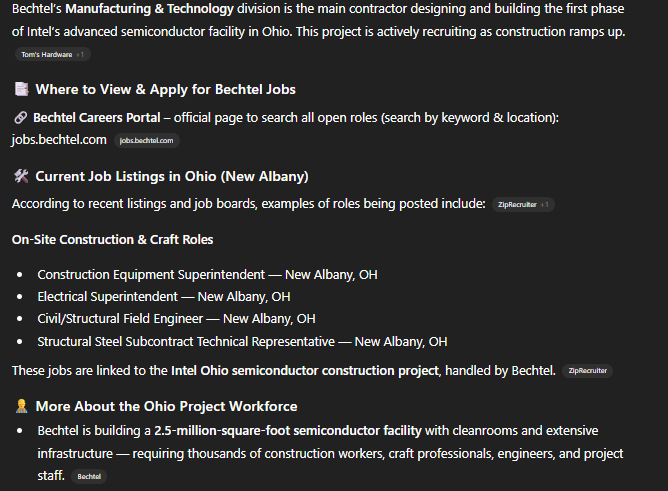
Finance, Insurance, AND Continuity
Fabs do not stop only because of bombs & physical war
They stop when:
war-risk insurance voids
reinsurance withdraws
capital freezes
financing collapses
Ohio avoids this regime entirely:
inland insurability
no maritime exposure
defense-aligned underwriting
domestic reinsurance continuity
Capital continuity is operational continuity
Systems Do Not Scale on Steel Alone
Megaprojects fail when capital talent and policy drift out of alignment & Ohio is doing the opposite
As physical infrastructure locks, soft infrastructure follows:
Federal alignment
Financial talent
Defense integration
Ohio’s ecosystem is reinforced by:
National labs
Defense test ranges
Hyperscale campuses
Industrial research institutions
which is why it scales under stress rather than hype
Finance Must Match the Risk Profile
Intel Ohio is generating a new class of companies that traditional banks do not serve
These firms share the same traits
Long pre revenue cycles
Milestone based defense contracts
High capital intensity
Export controlled IP
Non standard collateral
Classified customer bases
This category collapsed when Silicon Valley Bank failed & that failure created a vacuum
Ohio is filling it
Erebor Bank
The Missing Financial Layer
Erebor is a Peter Thiel backed post SVB financial institution purpose built for
Defense and dual use technology
Advanced manufacturing
Classified and export controlled companies
Hard tech suppliers with lumpy cash flows
Semiconductor and autonomy ecosystems
This is not a retail bank
It is industrial underwriting
Why Erebor Matters to Intel Ohio
Intel Ohio is spawning
Advanced packaging startups
Photonics suppliers
Materials firms
Defense ASIC design houses
Autonomy compute vendors
Classified subcontractors
These firms can't operate inside JPM or BofA risk models
Erebor exists for exactly this ecosystem & Columbus, Ohio is their Headquarters...
Banks do not arrive after ecosystems mature - they arrive when capital velocity is about to spike
Why Columbus Is Not a Coincidence
Central Ohio sits inside a unique convergence
Intel Ohio One & Two
Wright-Patterson Air Force Base
Anduril Arsenal-1
Midwest substrate corridor
Hyperscale cloud belt
Defense-cleared industrial workforce
Inland geography
Erebor anchoring here signals expected deal flow
Strategic Alignment - - Not Accidental Overlap
Peter Thiel’s worldview aligns directly with the Ohio construct:
sovereign manufacturing over globalization
national security over cost optimized fragility
hard tech over attention economies
friend shored capital stacks
resilience as a strategic asset
Together Erebor & Intel suggest the U.S. is rebuilding not just factories but an entire sovereign industrial finance model that has not existed FOR DECADES
With Erebor in the ecosystem:
Defense suppliers scale without JPM or BofA approval
Classified startups bank without existential friction
Intel-aligned design houses finance tape-outs domestically
Autonomy and ISR companies survive long DoD cycles
This transforms Intel Ohio from a megaproject into a self sustaining industrial system
The presence of a Thiel backed defense oriented bank near Ohio is not a footnote it is a signal that the financial system is reorganizing itself around Intel Ohio... the same way power grids, logistics, substrates, and defense programs already are
In wartime or financial stress scenarios this layer determines whether the industrial base stalls or continues operating under pressure
Workforce as a Strategic Asset
Ohio solves the talent problem under stress
Defense cleared labor pools
Veteran engineering pipelines
Lower cost of living = faster scaling
Surge hiring possible without coastal bottlenecks
Talent scales faster inland during crisis
Workforce becomes a weapon
Talent Migration Follows Design Gravity
Physical capacity attracts execution talent while design inevitability attracts leadership
Under Lip Bu Tan Intel has begun shifting leadership weight away from local execution and toward system level alignment and recent hires reflect this pivot
Policy and Federal Alignment
Robin Colwell
Senior Vice President Government Affairs
Former White House National Economic Council official
Robin Colwell’s role is not local permitting -its federal alignment
At the National Economic Council she worked directly on Trump era economic security policy including:
Domestic manufacturing reshoring
Trade and tariff strategy
Supply chain resilience
National competitiveness
Reported directly to NEC Director Larry Kudlow
That background is directly relevant to Intel Ohio
Intel did not elevate a former NEC official to manage a regional project..
Colwell’s presence reframes Ohio as a national interest asset
Her role is to align Intel Ohio with
CHIPS Act capital flows
Trump era and successor tariff regimes
Defense procurement priorities
Export control enforcement
Federal energy and grid policy
This is how projects move from state sponsored builds to federally protected infrastructure
Intel does not place NEC level leadership on optional site hopes
This hire signals that Intel Ohio is being treated as permanent national infrastructure, not a cycle dependent expansion
Defense and Design Alignment
James Chew
Aerospace Defense and Government Enablement
James Chew’s role sits upstream of manufacturing
He operates at the design decision layer where defense and aerospace systems are architected before tape out
Prior to Intel he spent ~10 years at Cadence leading aerospace defense and government strategy including 6 years under Lip Bu Tan - 2015 - 2021
At Cadence he worked directly with
Boeing
Lockheed Martin
Northrop Grumman
RTX
Anduril
Classified defense programs
Defense programs do not choose fabs at the manufacturing stage
They choose them at the architecture stage
Chew’s role is to pull Intel Ohio into defense system designs before silicon commitments are made
By placing Chew in this role Intel is ensuring that:
Defense ASICs
Autonomy processors
ISR silicon
Secure networking chips
are architected from day one to run on Intel process nodes and packaging flows
That is how fabs get designed into programs
Intel does not deploy design enablement leadership like this to speculative capacity - this indicates Ohio is expected to be a long term anchor for defense grade silicon... not an experimental foundry site . . another indication Ohio is THE spot
He was just lead on this Project Shield Contract:
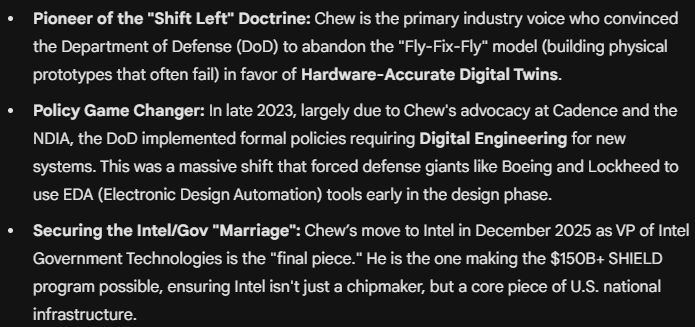
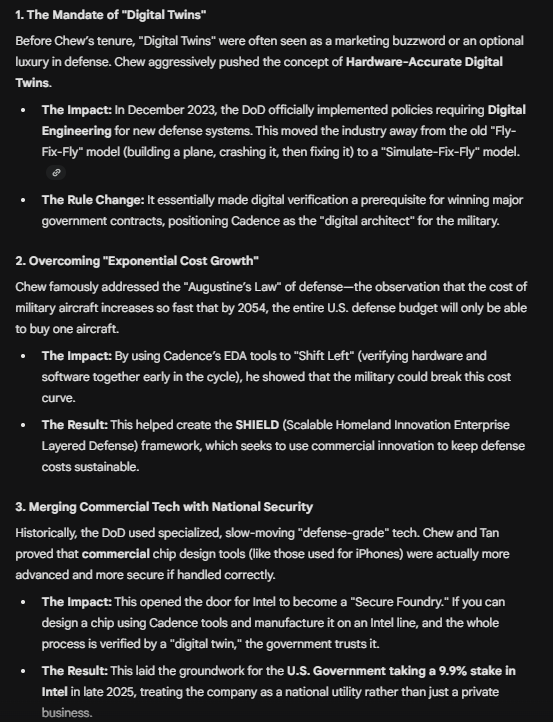
Process and Execution Alignment
Pushkar Ranade
Technical Bridge and Foundry Enablement
Pushkar Ranade operates at the interface between design process and manufacturing
His role is to translate customer architecture requirements into manufacturable reality at Intel Foundry
Functions as a bridge CTO in addition to current role as LBT Chief of Staff
This function becomes critical at 14A class nodes where:
Design assumptions directly affect yield
Packaging choices determine feasibility
Process constraints must be resolved before tape out
His role exists to prevent the single biggest foundry failure mode:
building capacity ahead of real customer designs
He tightens the feedback loop between:
Customer architectures
EDA enablement
Intel process and packaging realities
This reduces execution risk before capital is committed
Intel does not elevate this role unless external demand is expected
The Emerging Pattern
What is happening in Ohio mirrors Lip Bu Tan’s Cadence playbook almost exactly
Design inevitability first
Physical capacity second
Scale only after certainty
This is how Cadence locked itself into every major semiconductor program globally
Intel is now applying the same logic to manufacturing
Talent is being positioned before volume commitments
Design enablement is being solved before fabs are turned on
Capacity is waiting for architecture
That sequencing only makes sense if real external demand is expected
Speculation Hires:
Nimish Modi - keep this name noted he will be a huge player in INTC ecosystem one way or another
Longtime Cadence SVP who worked closely under Lip-Bu Tan during his CEO tenure (2009–2021)
Worked under LBT from 2013-2021
Primarily in strategy and execution focused roles
Widely viewed as one of Tan’s most seasoned and trusted enterprise operators
At INTC he would likely be tasked with enforcing cross company execution discipline across Foundry, Products, and Defense
Strong candidate for next CTO
Boyd Phelps -
SVP & GM of Cadence’s Silicon Solutions Group
Operating at the system design and advanced packaging layer
Worked under LBT from 2016-2021
Deep credibility in chiplets, heterogeneous integration, and design enablement
He spoke at Intel Foundry Direct Connect in April this year
Most likely to fill a senior systems, packaging, or architecture focused leadership role, not the CTO replacement
Ohio Forever
Like I said at the beginning, Intel Ohio is not a factory - It’s the strategic heart of the next American arsenal where the silicon for NGAD, CCA, hypersonics, Golden Dome, missile defense, autonomy, and space ISR will be designed, packaged, qualified, and deployed
An inland fortress of power designed to endure / engineered to scale / built to survive
It won't be exclusively for defense but it seems more and more likely it'll be heavy focused on defense side of the business
Within a 50-mile radius now exist:
The fab
The grid
The cloud
Autonomy factories
Propulsion and actuation
Military validation
Capital continuity
There is no equivalent... not in Taiwan, not in Korea, not in Japan, and not in Europe
Arizona fabricates
Taiwan manufactures
Ohio controls what becomes operational when it matters
Welcome to Ohio... Ohio Forever