
Introduction
In the rapidly evolving world of cycling technology, few brands have managed to disrupt the established order as effectively as Magene. This Chinese-based technology company has emerged as a formidable challenger to industry giants like Garmin and Wahoo, offering sophisticated cycling equipment at competitive price points. Since its inception in 2015, Magene has transformed from a startup focused on indoor cycling solutions into a comprehensive cycling technology ecosystem that spans power meters, bike computers, sensors, and safety equipment.
What sets Magene apart isn't just their aggressive pricing strategy, but their commitment to innovation and their understanding of what modern cyclists actually need. The company's name itself—a combination of "magnetic" and "gene"—reflects their position as a technology company built on attraction and innovation, drawing cyclists away from traditional brands with compelling value propositions.
Brand History and Evolution
Foundation and Early Years (2015-2018)
Founded in December 2015, Qingdao Magene Intelligence Technology Co.,Ltd. has always been committed to the development of intelligent, interesting and information-based cycling sports. The company emerged during a pivotal moment in cycling technology, when indoor training was gaining momentum but remained dominated by expensive European brands.
Magene is a Chinese-based technology company that has been making waves in the sports electronics industry since its inception in 2015. The founders recognized a significant gap in the market: while premium cycling technology existed, it was often prohibitively expensive for the average cyclist. Their mission from the start was clear—to democratize access to professional-grade cycling technology.
Strategic Focus and Market Entry
The company's initial strategy focused heavily on indoor cycling solutions, recognizing the growing trend of smart trainers and indoor training platforms. For the indoor part, Magene actively promotes indoor cycling culture and provides a comprehensive solution for smart indoor cycling scenes, which combines smart indoor trainer and Onelap software. Magene has become a leading enterprise in the field of indoor cycling in Chinese market.
However, Magene's ambitions extended far beyond the Chinese market. They understood that to compete globally, they needed to offer products that could match the quality and features of established brands while maintaining significant price advantages.
Expansion and Product Diversification (2019-2023)
By 2019, Magene had begun expanding their product portfolio beyond trainers to include power meters, bike computers, and sensors. This strategic diversification allowed them to create an integrated ecosystem of cycling technology, similar to what Garmin and Wahoo offered, but at more accessible price points.
One of Magene's flagship products is its cycling power meter, which has been praised for its accuracy and ease of use. The power meter uses advanced sensors to measure power output and provides real-time data to help cyclists improve their performance. This marked a significant milestone for the brand, as power meters were traditionally the domain of premium brands.
Recent Developments and Market Position (2024-2025)
The period from 2024 to 2025 has been particularly significant for Magene, marked by both expansion and strategic refocusing. Magene was at Eurobike this year as usual, except with not one booth - but two different booths in two different locations, indicating their growing presence in the European market.
However, recent reports suggest a strategic pivot. However, I use Western within the article as well, because in some cases Magene themselves isn't super clear or consistent. For example, the power meter pedals show as orderable in US currently (whether on purpose or on accident), while they don't show in most as Europe as actually orderable (listed as out of stock perpetually, and have been for months). Point being, they're consolidating to China, except in certain products where they aren't, suggesting the company is reassessing its global market strategy.
Product Portfolio Analysis
Power Meters: The Technical Foundation
Magene's power meter lineup represents the company's technical prowess and their ability to compete with established players on accuracy and reliability.
PES Series - The Performance Line
The PES series represents Magene's premium power meter offerings. The P515 spider-based power meter employs high-precision strain gauges and acceleration sensors. Combined with built-in intelligent temperature compensation algorithms, it can provide precise and reliable power data anytime and anywhere, even when the environment changes constantly. Extensively tested in harsh environments with highly demanded standards, and with each strain gauge undergoing stress release, the product guarantees a ±1% power accuracy.
This level of accuracy puts Magene in direct competition with premium brands like SRM and Quarq. The PES P515, for instance, offers several key advantages:
Enhanced Accuracy: Upgraded from ±1.5% to ±1.0% accuracy
Improved Compatibility: Resolved issues with BB386 and T47 bottom brackets
Weight Optimization: Approximately 14 grams lighter than its predecessor
Extended Battery Life: Up to 330 hours of operation
QED Series - Value-Performance Balance
The QED series targets cyclists who want power meter technology without the premium price tag. PES P505 Base power meter employs high-precision strain gauges and acceleration sensors. Combined with built-in intelligent temperature compensation algorithms, it can provide you with precise and reliable power data at anytime and anywhere.
User feedback has been overwhelmingly positive for this price segment. So far, one of the best affordable power meters for Shimano users in terms of price/performance. Switched directly from my 105 crankset, no extra spacers, no mess, no fuss. Installed in less than 5 minutes. It's not the lightest crankset, but for $300 you really can't find better.
P715 Pedal-Based System
P715 pedal-based power meter can support you for up to 120 hours of cycling, yet with an easy way to charge - magnetic charging. Compared with clip charging and replacing button cell, we apply a rechargeable lithium battery. This pedal-based system represents Magene's most sophisticated power measurement solution, incorporating advanced features like gyroscope-based power calculation and temperature compensation.
Bike Computers: Smart Navigation and Training
Magene's bike computer lineup demonstrates their understanding of modern cycling needs, combining GPS navigation, training features, and smartphone integration.
C606 Smart GPS - The Feature-Rich Option
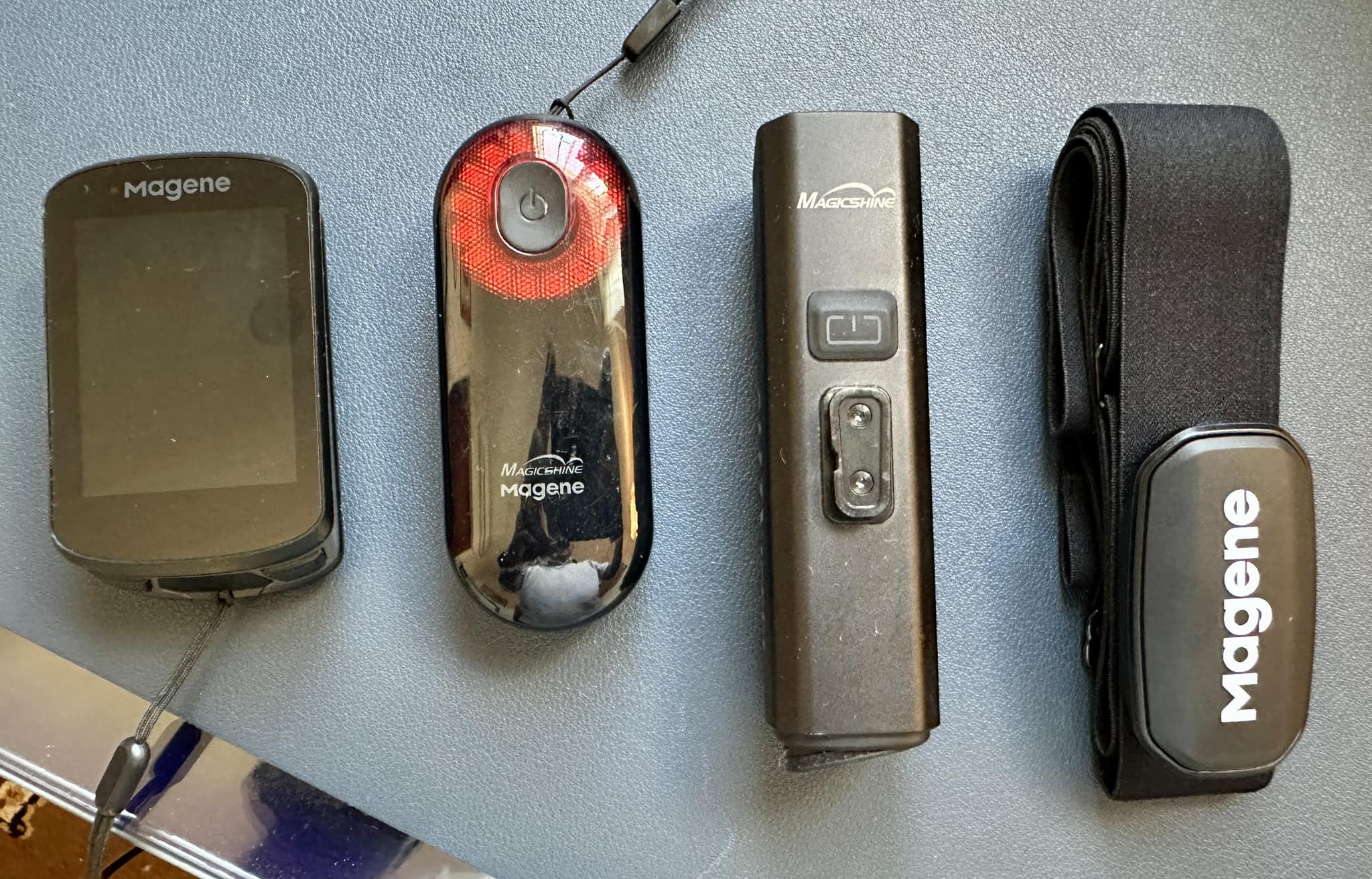
The C606 represents Magene's flagship bike computer, designed to compete directly with Garmin's Edge series and Wahoo's Elemnt lineup. The C606 inherits Magene years of innovation in bike computer technology, data integration and significantly. Improves performance in terms of screen display, wifi connectivity and navigation.
Key features include:
2.8" Full-Lamination Touchscreen: Waterproof with nano anti-fingerprint coating
Dual Connectivity: Both Bluetooth and WiFi support
Advanced Navigation: GPX file support up to 300 kilometers
Smart Integration: Compatible with Magene's OnelapFit app ecosystem
User experiences have been generally positive, though with some reservations. The Magene C606 Smart GPS Bike Computer includes a touchscreen, maps, and the ability to sync to Strava and TrainingPeaks, as well as the ability to attach into a Garmin mount. But it costs way less than higher-end choices like Garmin and Wahoo.
However, some limitations have been noted: A major miss was for the C606 to treat all TrainingPeaks workouts as indoor. GPS data is not recorded during these workouts, so if you're planning on doing outdoor workouts, you're not going to have a good time.
C506 and C506 SE - Entry-Level Options
These models target budget-conscious cyclists who still want smart features without the premium price tag. They offer essential GPS tracking, basic navigation, and smartphone connectivity.
Sensors and Safety Equipment
Speed and Cadence Sensors
The 3rd generation product of speed/cadence dual mode sensor S314 is coming. The exquisite appearance featured with the anti-loss strap and the reliable waterproof and battery life as well as the easily-switched dual mode, which will bring you a better experience.
The S314 sensor demonstrates Magene's attention to practical cycling needs:
Dual-Mode Operation: Can function as either speed or cadence sensor
Anti-Loss Design: Double-secured mounting system
Long Battery Life: Optimized power consumption
Universal Compatibility: Supports both ANT+ and Bluetooth protocols
L508 Radar Tail Light - Safety Innovation
The L508 radar tail light represents one of Magene's most innovative products, directly challenging Garmin's Varia radar dominance. Magene L508 radar tail light adopts millimeter-wave pulse signals and has 40°beam angle, able to detect rear vehicles within 140m even at bends.
Comparative analysis reveals both strengths and limitations:
Advantages over Garmin Varia:
In terms of battery life, the L508 has a longer battery life in radar mode (up to 19 hours) compared to the Varia (up to 15 hours)
USB-C Charging: Faster charging compared to Garmin's micro-USB
Customizable Light Modes: Seven different modes including peloton mode
Brake Light Function: Automatically activates during deceleration
Limitations:
Magene L508 also does well (no false negatives) and has a few benefits over Varia (light modes customizability). But it gives false positives more often than Varia (several per ride)
The Garmin's rear light is quite a bit brighter and the battery life is also superior to the Magene
Competitive Analysis and Market Position
Primary Competitors
Garmin - The Established Leader
Garmin dominates the cycling computer market with comprehensive product lines and established brand recognition. In the bike computer market, Garmin and Wahoo are the clear leaders, so much so that "Garmin" has become synonymous with bike computers, similar to how Google is for search engines.
Garmin's Advantages:
Market Leadership: Garmin's fitness segment (which includes cycling computers) generated US$1.34 billion in net sales in 2023
Feature Richness: Most comprehensive feature sets across all product categories
Brand Recognition: Synonymous with GPS cycling technology
Ecosystem Integration: Seamless integration across multiple device categories
Magene's Competitive Response:
Price Advantage: Typically 30-50% less expensive than comparable Garmin products
Feature Parity: Matching most essential features while eliminating rarely-used options
Innovation Focus: Introducing features like brake lights and extended radar angles
Wahoo - The User Experience Leader
Wahoo has built its reputation on simplicity and user experience. When searching for the best bike computer, many riders' choice comes down to either a Garmin Edge or a Wahoo Elemnt unit.
Wahoo's Strengths:
Simplicity: Industry-leading ease of setup and use
Button-Only Operation: Reliable in all weather conditions
App Integration: Seamless smartphone configuration
Magene's Positioning Against Wahoo: It feels like Magene is targeting Wahoo's level of sports metrics, capabilities, and post-ride app functionalities rather than the significantly richer set of Garmin features. But it's not yet on par with Wahoo's capabilities even though the app's abilities appear similar to Wahoo.
Emerging Competitors
The cycling technology market is seeing increased competition from brands like Hammerhead (Karoo series) and various Chinese manufacturers like iGPSPORT and Bryton.
Market Positioning Strategy
Magene has positioned itself as the "intelligent value" choice in cycling technology. Their strategy focuses on:
Technology Accessibility: Making professional-grade cycling technology available to a broader market
Feature Innovation: Introducing unique features not found in competing products
Ecosystem Integration: Creating comprehensive solutions rather than standalone products
Price-Performance Leadership: Offering premium features at mid-market prices
Pricing Strategy and Value Proposition
Competitive Pricing Analysis
Magene's pricing strategy represents one of their strongest competitive advantages. Comparing key product categories:
Power Meters:
Magene PES P505: ~$300-350
Garmin Vector 3S: ~$600-700
Wahoo Powrlink Zero: ~$650-750
Bike Computers:
Magene C606: ~$160-180
Garmin Edge 540: ~$350-400
Wahoo Elemnt Bolt v2: ~$280-320
Radar Lights:
Magene L508: ~$125-140
Garmin Varia RTL515: ~$170-200
This pricing strategy positions Magene products at approximately 40-60% of premium brand pricing while maintaining feature competitiveness.
Value Proposition Elements
Cost Accessibility: Professional-grade cycling technology without premium pricing
Feature Innovation: Unique capabilities like brake lights and extended radar coverage
Ecosystem Integration: Comprehensive solutions through the OnelapFit app
Build Quality: Matching or exceeding industry standards for durability and reliability
Future-Proofing: Regular firmware updates and feature additions
Advantages and Strengths
Technical Innovation
Magene has demonstrated genuine innovation rather than simple cost reduction:
Advanced Power Meter Technology: ±1% accuracy matching premium competitors
Radar Innovation: 40-degree coverage angle exceeding Garmin's 15-degree standard
Smart Integration: Comprehensive app ecosystem for device management
Battery Technology: Extended operational periods across product lines
Manufacturing Excellence
After 1 million pedals, product still works normally. Testing data comes from Magene lab. This level of durability testing demonstrates serious commitment to product quality.
Market Understanding
Magene demonstrates sophisticated understanding of cyclist needs:
Practical Features: Focus on features cyclists actually use
Price Sensitivity: Recognition that cost barriers limit technology adoption
Global Compatibility: Products work with existing cycling ecosystems
Ecosystem Development
The OnelapFit app and integrated product approach creates user lock-in similar to premium brands while maintaining cost advantages.
Disadvantages and Limitations
Market Presence and Support
Limited Physical Presence: Unlike Garmin and Wahoo, Magene lacks extensive dealer networks and physical retail presence in Western markets.
Support Infrastructure: Sad to see Magene leave. It probably more or less kills support on existing products, reflecting concerns about long-term support availability.
Software and Firmware Issues
Several users have reported software-related limitations:
The companion app used OneLapFit is about what you'd expect from a Chinese language company without much of an English market presence. There's some translation oddness around the app
Feature Gaps: Some advanced features available in competing products remain missing
Update Consistency: Irregular firmware update schedules compared to premium brands
Quality Control Variability
While generally good, some products show consistency issues:
But it gives false positives more often than Varia (several per ride) for the L508 radar
Manufacturing Tolerances: Occasional reports of unit-to-unit variations in performance
Brand Recognition and Trust
Market Penetration: Despite the dominance of a few brands, however, new ones are also entering this highly competitive space, aiming to carve out their own niches. Magene remains relatively unknown among casual cyclists.
Professional Adoption: Limited use among professional cycling teams compared to established brands.
Future Outlook and Market Trends
Strategic Positioning for 2025 and Beyond
Recent market analysis suggests that Magene has been oscillating between European & US markets and OEM cash business, resulting in a lot of missed good times. This strategic uncertainty could impact their market position.
However, several trends favor Magene's approach:
Cost Consciousness: Economic pressures making premium cycling technology less accessible
Feature Maturation: Core cycling computer features becoming commoditized
Innovation Focus: Unique features becoming more important than brand legacy
Technology Development Directions
Based on recent product releases, Magene appears focused on:
Smart Trainer Integration: Enhanced indoor/outdoor training integration
Safety Technology: Advanced radar and lighting solutions
Data Analytics: Improved training and performance analysis tools
Ecosystem Expansion: Broader product compatibility and integration
Market Challenges
Competition Intensification: Garmin usually launches new products every two to three years, with Wahoo following a similar route, and to keep that going, in the first nine months of 2024, Garmin spent US$735 million alone on research and development.
This level of R&D investment from established competitors creates pressure on Magene to maintain innovation pace while preserving cost advantages.
Conclusion
Magene represents a significant force in the cycling technology market, successfully challenging established brands through a combination of technical competence, strategic pricing, and genuine innovation. Their ability to offer professional-grade features at accessible prices has democratized access to sophisticated cycling technology.
The brand's strengths lie in their understanding of practical cycling needs, their commitment to technical excellence, and their willingness to innovate beyond simple cost reduction. Products like the L508 radar tail light and PES power meter series demonstrate that Magene can compete on features and quality, not just price.
However, significant challenges remain. Market presence limitations, support infrastructure concerns, and the need to maintain innovation pace against well-funded competitors create ongoing strategic pressures. The company's apparent strategic refocusing toward Asian markets may limit global growth potential but could strengthen their position in their core market.
For cyclists evaluating Magene products, the value proposition remains compelling: professional-grade cycling technology at substantially lower prices than premium alternatives. While some compromises exist in software polish and market support, the core technical performance generally matches or exceeds expectations for the price point.
Looking forward, Magene's success will likely depend on their ability to maintain their innovation edge while building the market presence and support infrastructure necessary to compete with established brands. Their focus on practical features and cost accessibility positions them well for continued growth, particularly as cycling technology features mature and price competition intensifies.
The cycling technology market benefits significantly from Magene's presence, as their competitive pressure forces established brands to justify premium pricing while pushing overall innovation forward. Whether shopping for a first power meter, upgrading a bike computer, or seeking advanced safety technology, Magene merits serious consideration as a viable alternative to traditional premium brands.
In the rapidly evolving landscape of cycling technology, Magene has established itself not as a budget alternative, but as a legitimate competitor offering genuine value and innovation. Their continued development and market presence will be crucial factors in determining whether cycling technology remains the domain of premium brands or becomes truly accessible to the broader cycling community.