

Today is a day of deep historical significance for Armenia and Armenians—one that resonates with all of us dedicated to preserving and sharing our remarkable past and enduring legacy.
On this occasion, I’m happy to share the summary of an essay written by Alexander Khatisian in 1935, commemorating the 17th anniversary of the declaration of the Republic of Armenia on May 28, 1918. This powerful piece is both a reflection and a defense of Armenian statehood, based on Khatisian’s personal experience, political insight, and deep understanding of national identity.
His central message is seventeen years — from 1918 to 1935 — are more than enough to judge the legitimacy and vitality of Armenian independence. Drawing comparisons with the evolution of other nations, he argues that statehood is essential for the political, cultural, and national development of any people.
“No amount of theoretical speculation, even based on other nations’ histories, can be more convincing than direct personal experience.”
Khatisian stresses that only those who lived through the events following 1918 can truly grasp the necessity of Armenian independence. He turns his attention to a new generation—those who were children in 1918 and, by 1935, had reached adulthood. This generation, shaped by war, famine, revolution, and exile, still holds fast to the idea of an independent homeland.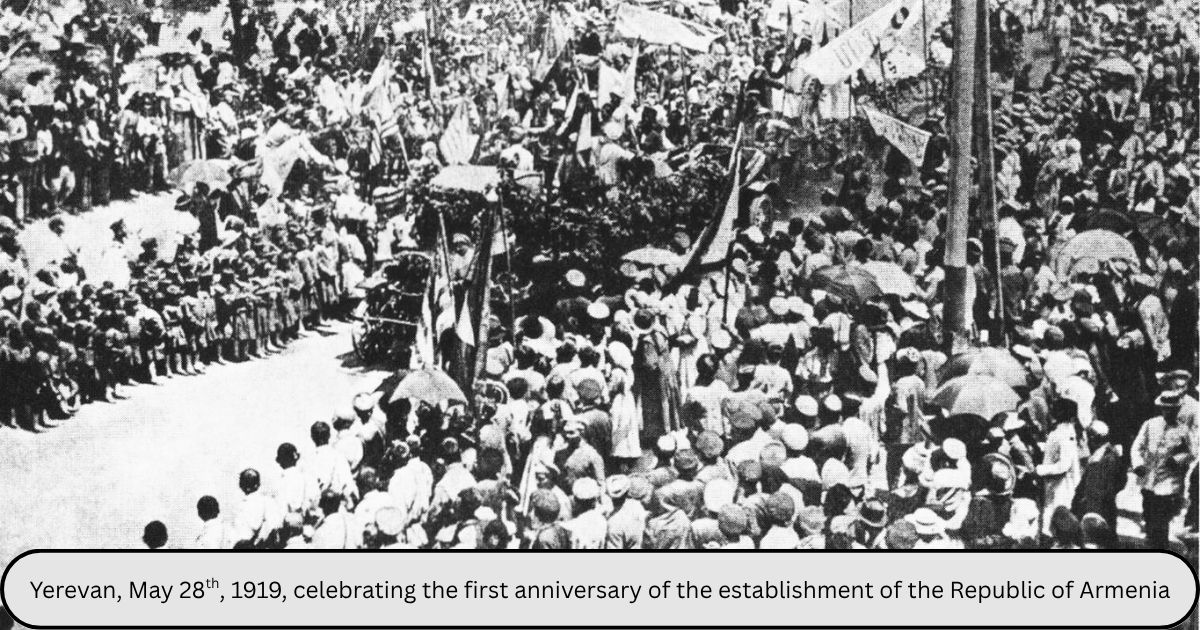
Citing examples from France, England, Finland, Latvia, and Switzerland, he makes the case that statehood is not merely a right — it is a requirement for national survival and expression. He challenges the notion that a shared language alone is enough to sustain a people; territory matters.
Khatisian also speaks to the historical and geographical shift in the Armenian national ideal—from dreams of reform in Western (“Turkish”, or "Tachkahayastan") Armenia before 1914 to the focus on Eastern Armenia after the Genocide and World War I. The Ararat Valley and its surroundings became the new anchor for Armenian hopes.
“We now have a territory… a corner that is called the Republic of Armenia.”
It may be small, landlocked, and underdeveloped—but it is ours.
In a call for national unity, he urges Armenians to rise above party divisions—Dashnaks, Hunchaks, Ramgavars, Bolsheviks, independents—and recognize the shared national treasure that is the homeland.
While he acknowledges that global events like WWI, the Russian Revolution, and international diplomacy played a role in Armenia’s independence, he is adamant that Armenians acted consciously and decisively:
“Yes, circumstances helped, but the decision was ours. And seventeen years of experience confirms that it was justified.”
He draws parallels with other nations—Finland, Poland, Latvia, Lithuania—whose independence also emerged through geopolitical shifts rather than solely internal uprisings. Armenia, too, seized its moment when history opened a door.
This essay is deeply philosophical and resonates with the ideals of Khatisian’s comrades who fought for an independent Armenia. It explores political legitimacy, national territory, the bond between geography and identity, and the power of memory and continuity.
Even if the vision of a United and Independent Armenia remains unfulfilled, Khatisian insists that the mere existence of the Republic gives structure, meaning, and hope to the Armenian struggle.