

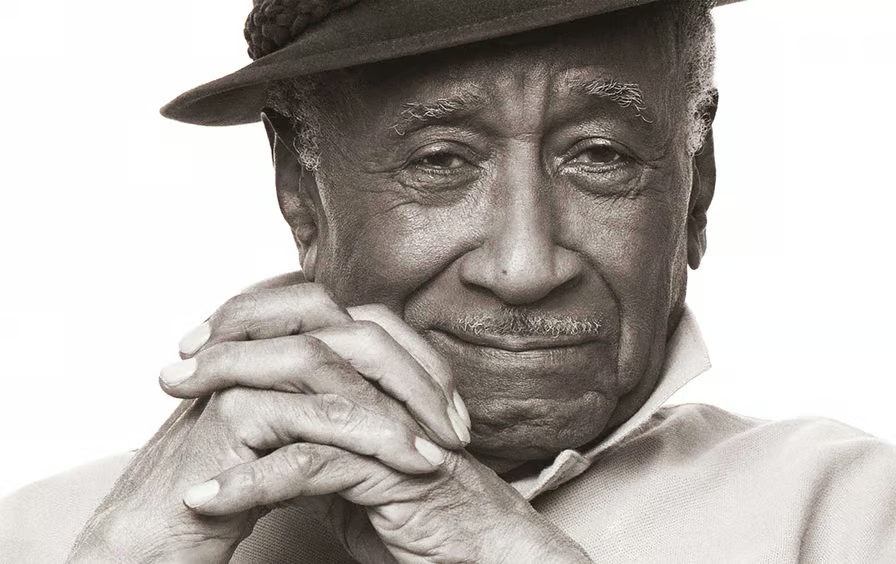
 A few years ago I published an essay about the great Albert Murray (1916-2013) or rather, about why white American Christians ought to pay attention to him. There's so much more that could be said about Murray, and I think about him all the time.
Murray was in the military for two decades, and during that period was constantly working on stories and essays, but his responsibilities were many and his opportunities for publication few. It was only after his retirement from the Air Force in 1962 that he began his writing career in earnest. Indeed, his first book, The Omni-Americans, appeared in 1970, when he was fifty-four. Imani Perry once wrote about this long preparation,
One of my favorite cultural critics, Albert Murray, began publishing his writing at age 46. I imagine him during his 19-year career in the Air Force, mulling over the ideas that one day would dazzle me and many others. I imagine him practicing thought riffs and idea phrases so that when he decided to set words to the page, they sparkled with their elegant composition and elucidation. It strikes me as beside the point to call him a late bloomer. I'd rather call him a man who wrote on his own time — the right time. If we are open, we can see that possibility in us all.
What Murray had been working on for all those years was not a book or a thesis but rather what he came to call, half-seriously and half-ironically, Cosmos Murray — a way of using the thought-structures of European modernism to organize and make sense of the Black experience in America. When he joined the military in 1943 he said that his goal was to live long enough to see Thomas Mann complete the final volume of Joseph and His Brothers, and Cosmos Murray could be succinctly defined as the place where Thomas Mann meets Duke Ellington.
After retirement, Murray and his wife Mozelle moved into an apartment building in Harlem — at Lenox Avenue and 132nd Street — in a flat that looked south to midtown. From there, for the next fifty years, he would expand on his views to visitors: friends, acquaintances, disciples. (He had many disciples, the most famous of them being Wynton Marsalis.) He wrote books, several wonderful books, but I get the sense that Cosmos Murray was best encountered in that apartment.
 I'm fascinated by Cosmos Murray, but it is not quite my cosmos — it is incomplete, I fear, because Murray, though he saw that art is "the secular counterpart to religious devotion," and understood that the dancehall on Saturday night counterbalances the church service on Sunday morning, does not explore that Christian Other. In Cosmos Jacobs those forces have to be understood in relation to one another.
As I explained in last month's missive, I've finished my biography of Dorothy L. Sayers — though the Lord alone knows when it will be published — and have stepped back from the Big Blog. I have a few essays I am committed to writing, and of course my classes occupy most of my time, but I am less obligated to writing than usual, and I am taking this time to think extensively about Cosmos Jacobs.
After all, I am retiring from the military — I mean, from the university, at the end of this year, and while I don't plan to move to Harlem, I will have a room with a view, as it were, and want to be ready to entertain visitors — largely digital visitors, to be sure, but I want to be a hospitable host all the same. I want to have Albert Murray's ease and humor, his lively mind, his constant interest in the world. (Even when he was a very old man his younger friends would drive him to bookstores and record stores where he would scan the rooms, assess the new productions, and buy a few items to take home and experience.) But, as Murray often said, the new is best when it embraces, assesses, and then transcends the old. In a conversation with the great Dizzy Gillespie, Murray commented that the bebop movement Dizzy and Charlie Parker pioneered was powerful because it drew on the energies of its predecessors; and Murray worried about the younger musicians who knew Diz and Bird but did not know what Diz and Bird knew.
Similarly, when Ethan Iverson attended the memorial service for Murray in 2013, he commented: "I scanned the room carefully. Apologies if I missed someone, but as far as I tell, there were absolutely no 'younger white experimental jazzers' present for this free afternoon event. Too bad for them! Their music would only get better if they explored a wider perspective."
I want to provide a "wider perspective" on the contemporary scene for my readers. I want to connect the old and the new, the elite and the demotic, the dancehall on Saturday night and the worship service on Sunday morning. (And I also want to explain what happens when people don't dance any more but just sit motionlessly as they stare at screens.) I don't want to build a system — I am the enemy of System — but I would love to open up, for all my readers, a Cosmos.
Please stay tuned to see what I come up with. And thanks again for your support.