

Every day, we are exposed to nearly 2,900 marketing messages. Behind this invisible flood, web giants have built an economy where our attention is the true currency. Discover how these strategies shape our behavior and why it’s time to rethink our relationship with digital technology.
Without even realizing it, we receive an average of 2,900 marketing messages per day — a notification when we wake up, a billboard in the street, a banner online, an ad between two videos. A fine, invisible rain that seeps into our daily lives without asking permission.
We believe we live in a free world where our choices come from our own desires. Yet behind every click, every search, every hesitation, digital giants are watching, analyzing, and learning.
These companies have perfected the art of turning curiosity into loyalty, a simple glance into attachment. They know how to capture our attention, hold it, and sometimes even shape it.
 It all starts with a simple truth: attention has become the most valuable resource of the modern world. Every second we spend in front of a screen is a coin added to the attention economy. Brands no longer just sell products; they sell emotions, promises, and reflections of who we are.
Take Amazon, for example. The online retail giant now offers over 600 million products. Every click, every pause, every hesitation becomes a data point. These fragments of behavior are transformed into a digital portrait: “He likes this.” “She’s interested in that.” “They probably have two children.”
And we give this information willingly, almost gratefully — in exchange for convenience, fast delivery, a free video, or the illusion of closeness. This is the silent contract of digital marketing: we give our attention, and they sell us the feeling of being understood.
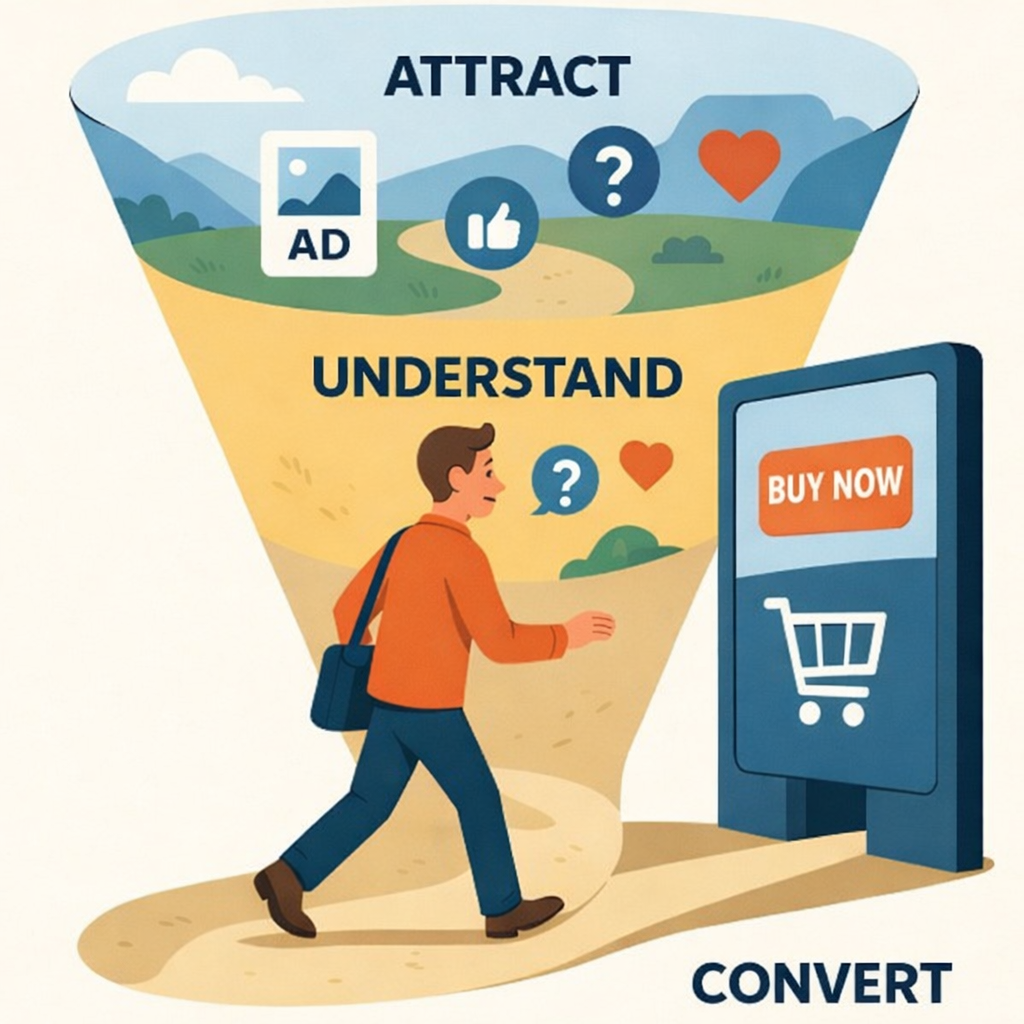
The process is extremely efficient. Web giants use what’s called a funnel. First, they attract. Then they observe. Finally, they convert. Everything begins with an invitation — an article, an ad, a welcome email. Then comes the observation phase: our reactions, our tastes, our hesitations. Finally, the targeted message arrives, precise and perfectly timed, when our guard is down.
At that point, nothing is random anymore. We believe we are receiving useful information, but in reality, we’ve entered a story written for us. And without noticing, we become loyal customers — not because we chose to be, but because someone learned how to reach us at exactly the right moment.
Faced with this reality, it would be easy to blame technology. But the problem isn’t the tool — it’s how we use it. Web giants have used human insight to sell more. We could use that same understanding to love better, connect more fairly, and communicate more deeply.
What if we also learned to truly understand our communities? Not to manipulate them, but to listen. Not to hold onto them, but to help them grow. Not to create dependency, but to rebuild genuine connection.
— Hagop Talatinian
Founder of the Armenopole platform
References
1. The 2018 Dilemma: Digital VS Direct Mail Marketing. DirectMail2.com
2. How Many Products Does Amazon Carry. Red Stag Fulfillment, 2024