

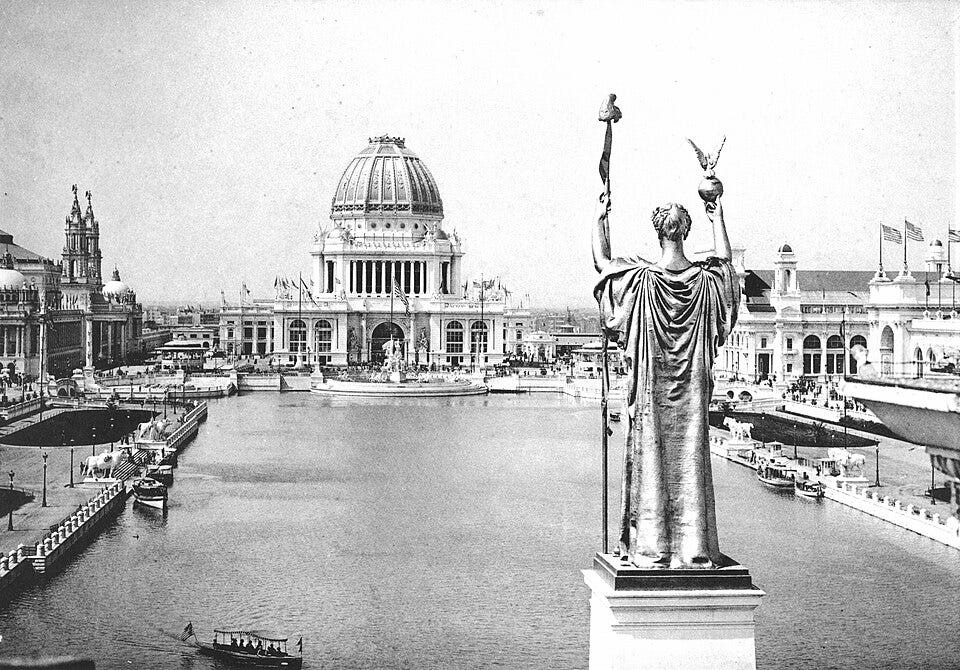
In the aftermath of the devastating Great Chicago Fire of 1871, the city grappled with mass unemployment, economic turmoil, and deep social challenges. Chicago needed more than recovery—it needed a bold plan to reimagine itself. The opportunity arrived with the World’s Columbian Exposition of 1893, a grand world’s fair held in Jackson Park to celebrate the 400th anniversary of Christopher Columbus’s voyage.
After fierce competition, Chicago won the bid over cities like New York and St. Louis. Led by architect Daniel H. Burnham as director of works, alongside landscape architect Frederick Law Olmsted and others, the fair transformed marshy lakefront land into a dazzling vision of urban possibility.
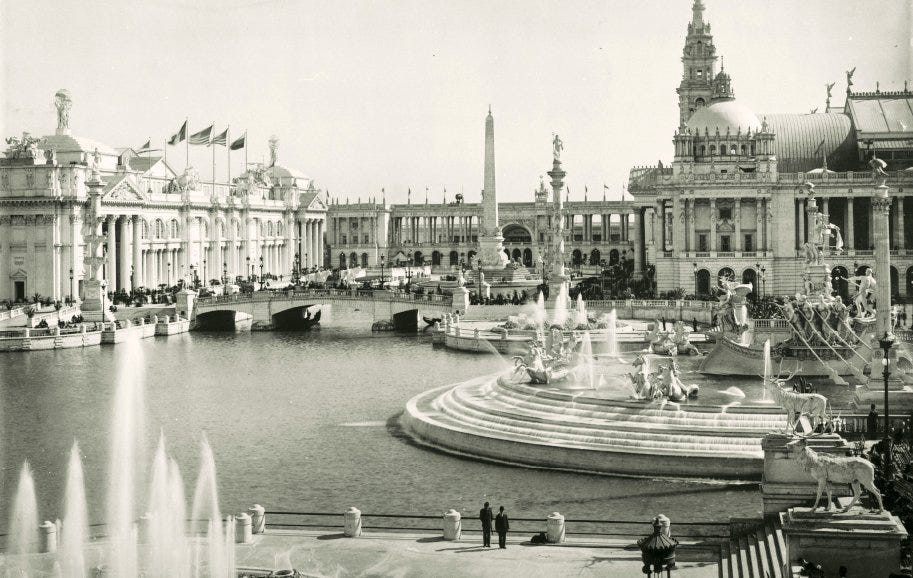
The fairgrounds, nicknamed the White City for their gleaming façades made of “staff” (a temporary plaster-like material), featured harmonious neoclassical buildings, vast lagoons symbolizing Columbus’s journey, the debut of the Ferris Wheel, early moving pictures, and a showcase of alternating current electricity. Drawing over 27 million visitors, it wasn’t just a celebration—it was a beta-test in urban design, proving that thoughtful planning could create beauty, order, and civic pride on a massive scale.
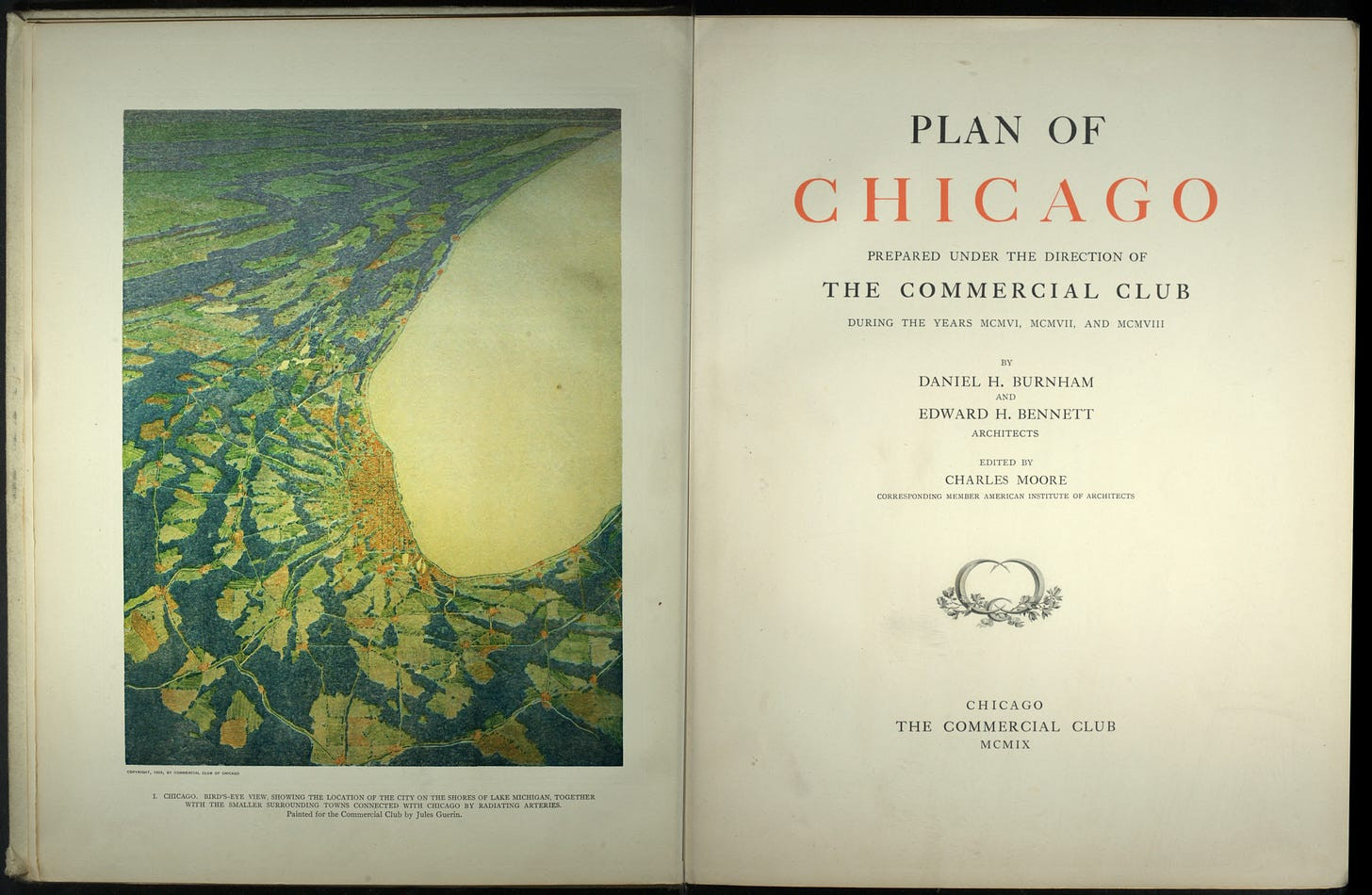
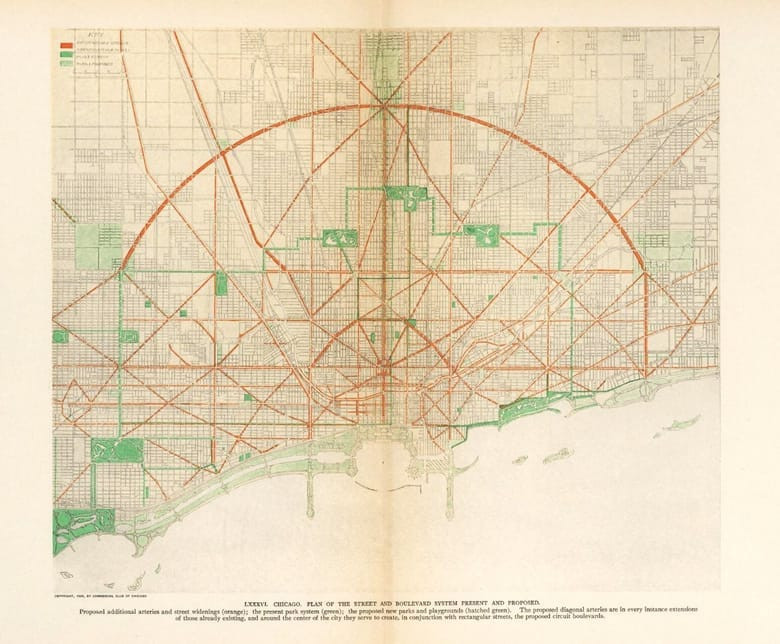
This success inspired the City Beautiful movement and directly led to the 1909 Plan of Chicago, co-authored by Burnham and Edward H. Bennett. This groundbreaking comprehensive plan proposed widened streets, expanded parks, improved harbors and railroads, and iconic civic buildings—reshaping Chicago’s core and pioneering modern city planning worldwide.
Evolving Toward Sustainable, Equitable Cities
Over a century later, the spirit of visionary urban planning endures, but adapted to today’s global challenges: rapid urbanization, inequality, and the need for sustainability. The legacy of Burnham’s grand designs has evolved into frameworks like the New Urban Agenda (NUA), adopted in 2016 at Habitat III in Quito, Ecuador.
This action-oriented global roadmap represents a paradigm shift, viewing urbanization as a tool for sustainable development, job creation, and improved quality of life. Aligned with the UN’s Agenda 2030 and Sustainable Development Goals, it guides planners, governments, and communities in building inclusive, resilient cities.
Key action areas for today’s planners include:
Sustainable Mobility: Prioritizing walking, cycling, and public transport over private cars.
Housing: Ensuring affordable, safe, and adequate homes for all.
Urban Finance: Enabling local funding for sustainable initiatives.
Climate Action: Embedding decarbonization, resilience, and cooling strategies in design.
Local Economy: Boosting neighborhood businesses and circular economies.
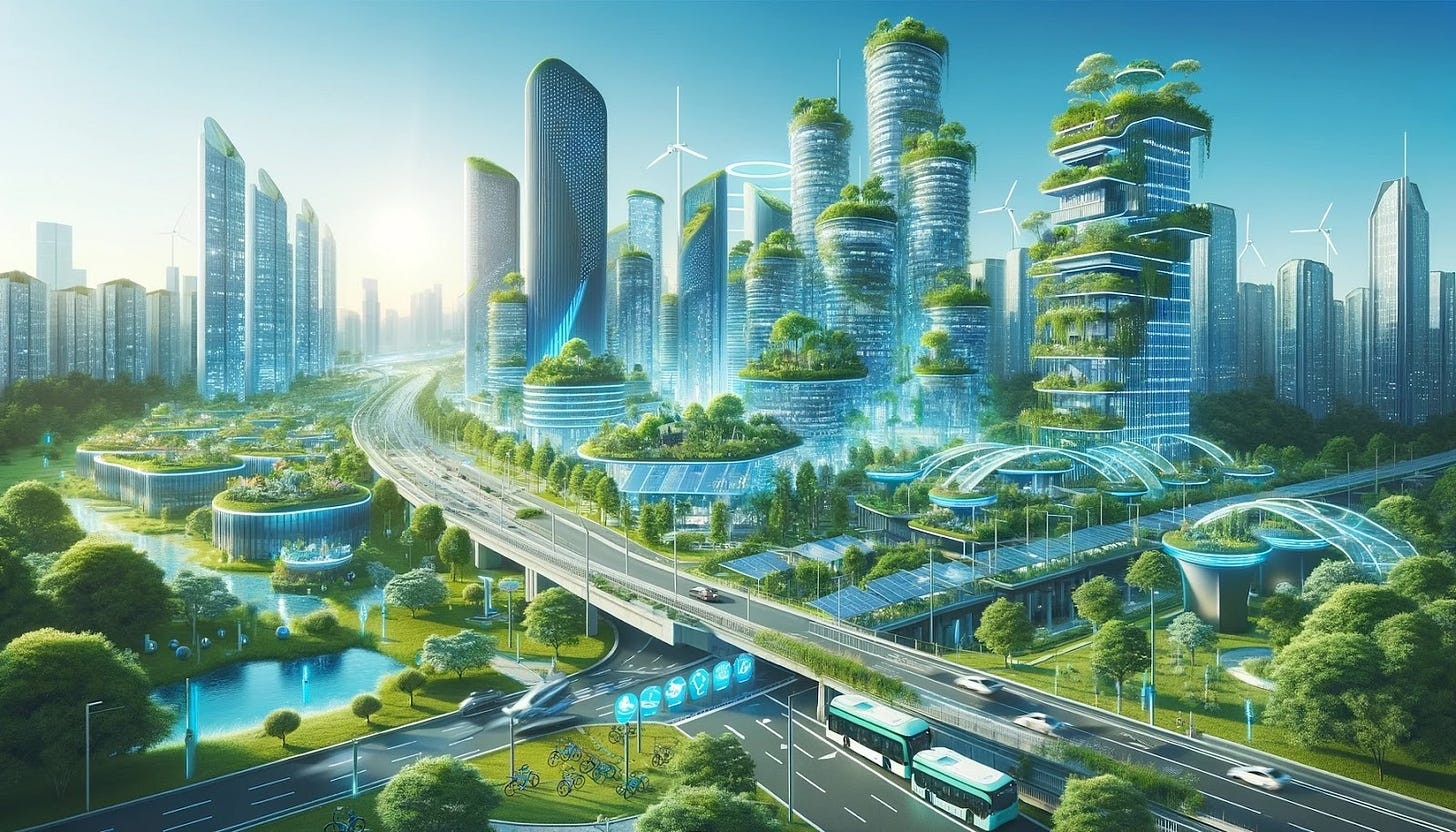
From World’s Fairs to the Fourth Industrial Revolution
The grand, collaborative spectacles like the Chicago World’s Fair weren’t just about celebration; they were early prototypes of public-private partnerships (PPPs) harnessing collective resources for societal transformation. Fast-forward to today, and Klaus Schwab’s framework at the World Economic Forum (WEF) echoes this through the “Fourth Industrial Revolution” (4IR), which he popularized in his 2016 book and WEF agendas. The blending of government oversight with private innovation to tackle urban sustainability, much like Burnham’s plan evolved into modern agendas.
Public-private collaborations have roots stretching back centuries, but they gained modern traction in the 19th and 20th centuries amid industrialization and urbanization crises—much like Chicago’s post-fire rebirth. Early examples include:
Infrastructure Booms in the 19th Century: In the U.S. and Europe, railways and canals were often funded through PPPs, where governments provided land grants or subsidies, and private firms handled construction and operations. The Transcontinental Railroad (1860s) succeeded in connecting a nation, spurring economic growth and urban expansion, but at the cost of exploitative labor practices and Native American displacement. Similarly, London’s early sewer systems in the 1850s involved private engineers partnering with public boards, averting cholera epidemics and enabling city growth— a clear “public good” win, though initial failures from poor planning led to overflows and public outcry.
Post-WWII Urban Renewal: The U.S. Housing Act of 1949 kickstarted massive PPPs under the Department of Housing and Urban Development (HUD), where federal funds met private developers to clear “blighted” areas and build highways, housing, and civic centers. Successes? Projects like New York’s Lincoln Center (1960s) revitalized neighborhoods, creating cultural hubs that boosted economies. Failures? Many initiatives displaced low-income communities (often minority groups) without adequate relocation, exacerbating inequality—think Boston’s West End demolition, which critics labeled “urban removal” rather than renewal. In Europe, post-war reconstructions like Rotterdam’s harbor redevelopment via PPPs accelerated recovery but sometimes prioritized commercial interests over livable spaces.
1980s-2000s Globalization Wave: As neoliberal policies took hold, PPPs exploded for infrastructure. The UK’s Private Finance Initiative (PFI) funded hospitals and schools, delivering projects faster than public-only models in some cases. Yet, audits revealed long-term costs ballooned due to private profits—hospitals paid inflated rates for decades, straining budgets. In developing nations, water privatization PPPs (e.g., in Bolivia’s Cochabamba, 2000) promised efficiency but sparked riots over price hikes, leading to reversals.
Yin-Yang—balance between light and shadow
The Yin - Transformative progress, like turning rubble into thriving cities.
The Yang - Power imbalances where private gains eclipse public welfare, echoing critiques of elite-driven agendas.