
 I first learned about Tibetan culture while helping my younger son with his middle school geography homework. Together, we learned about the Chinese occupation of Tibet in 1951, about the exile of its leadership, and the continued destruction of its once pristine environment. I felt strongly about preserving Tibet’s cultural heritage, and took the opportunity when it arose to learn the art of thangka painting.
Rather than close themselves off in an attempt to preserve their culture, Tibetan religious leaders have allowed their tradition to extend into Europe and the Americas. My Danish teacher, Carmen Mensink, was taught by artist Andy Weber, one of the first westerners to learn the thangka tradition. He, in turn, learned from a seventh generation thangka artist, Tharge-La, who fled Tibet in 1959 to Nepal, along with approximately 250 sacred religious scrolls.
At its heart, a thangka is a teaching (it means “recorded message” in Tibet). It is a spiritual guide in the form of a scroll that could be hung on the wall or taken along from village to village. Creating a thangka requires concentration and meditation upon the teaching being depicted, and each painting has its own proportions that must be faithfully reproduced. Though certain elements and colors in the painting can be restricted due to the subject matter, artists generally have quite a bit of liberty in the depictions of the background.
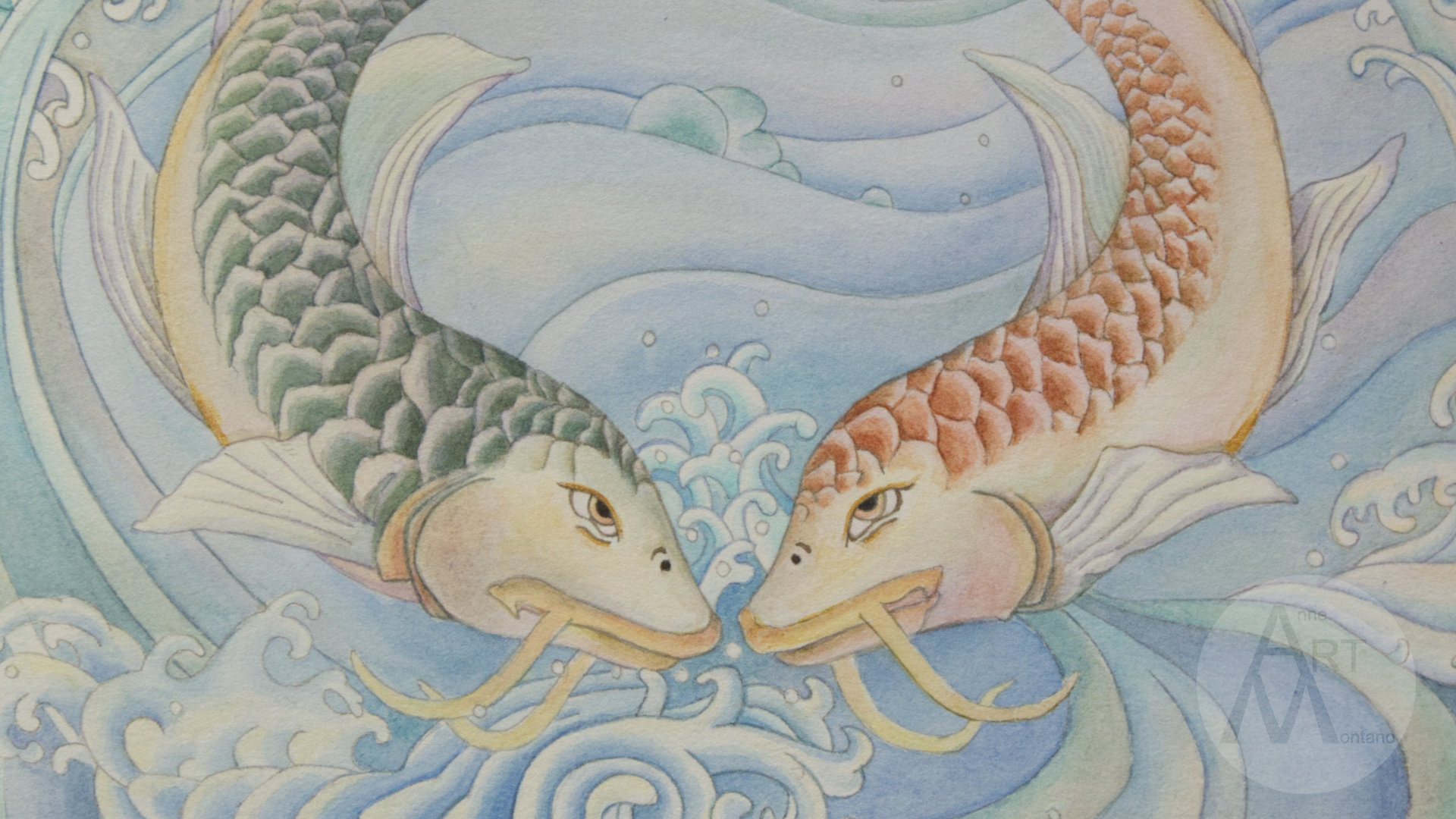
The Eight Auspicious Symbols (Ashtamangala in Sanskrit) are not thangkas in and of themselves, but are often depicted in a mandala, presented during religious ceremonies, or are painted along a roadside for the safety of the traveler. Each symbol contains a meaning which is relevant beyond Tibetan culture. The pair of fish for example, originated in India, and once represented the Ganges and Yamuna rivers. They are a kind of Yin and Yang. The first avatar of Lord Vishnu (Hinduism), in the form of a fish, protected the sage Manu from a great flood, and so the pair of fish also became a symbol of protection and of new beginnings. In Bhutan they are the great golden mahseer. In Japan and China, they are the koi swimming against the current, a symbol of perseverance and transformation.
In Tibetan Buddhism they represent the combination of wisdom with compassion. The fish are thus able to swim happily in a sea of suffering. For me, they are a reminder to cultivate happiness, without causing suffering, for both myself and for others. Practicing Tibetan art is a way for me to turn towards the good in a world that seems to increasingly value violence and greed.