

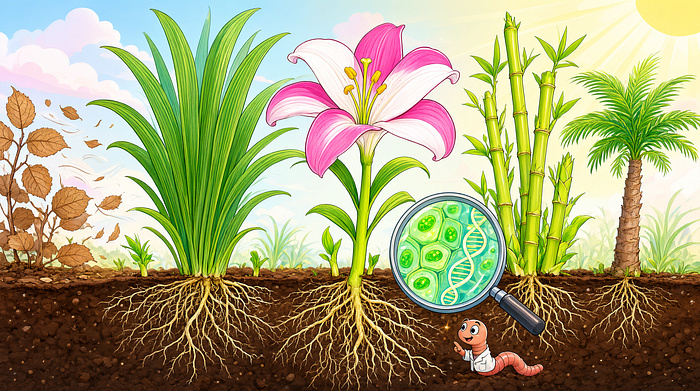
Have you ever seen a coconut tree that’s decades old and thought, “Wow, are monocotyledonous plants really destined to live longer from the moment they’re born?” It seems plausible, but it turns out to be just a common biological misconception!
Let’s take a casual look at the secrets behind these plants’ lifespans!
The Difference Between Monocot and Dicot Seeds
The main difference lies in the cotyledons. Monocots have one cotyledon (like corn), while dicots/eudicots have two cotyledons (like mung beans). Monocot seeds store food reserves in the endosperm, while dicots store them in the cotyledons.
It’s Not Just the Seeds, Differences Extend from Roots to Flowers
Beyond the seeds, the differences are evident in other organs. Monocots have fibrous roots, parallel leaf veins, and scattered vascular bundles. In contrast, dicots have taproots and pinnate leaves. However, these structural differences do not automatically result in a longer plant lifespan.
Plant Lifespan Is Determined by Life Cycle
The length of a plant’s lifespan is not determined by the number of cotyledons, but rather by its life cycle: annual, biennial, or perennial. Coconut palms can live a long time because they are perennial plants, not simply because they are monocots.
Nevertheless, There Are Short-Lived Monocots
As evidence, rice and corn which are classified as monocots actually have short lifespans and die after harvest. Therefore, the assumption that all monocots are necessarily more durable than dicots is an inaccurate perception when viewed through the lens of modern science.
In conclusion, monocot seeds do indeed have a single cotyledon, but that does not automatically make them long-lived. The secret to a plant’s lifespan actually lies in the type of life cycle it has.
Hopefully, this discussion will expand our scientific knowledge in an engaging way. Let’s continue to learn and take a critical look at the fascinating natural phenomena around us!