
On 31st July 1423, eleven months after the death of King Henry V, an English and Burgundian army defeated the French and Scottish armies at the Battle of Cravant at Cravant, Yonne.
There are a number of sources that describe the battle with Jean de Waurin's and Monstrelet's being the most detailed:
𝗖𝗵𝗿𝗼𝗻𝗶𝗰𝗹𝗲 𝗼𝗳 𝗘𝗻𝗴𝗹𝗮𝗻𝗱 𝗯𝘆 𝗝𝗲𝗮𝗻 𝗱𝗲 𝗪𝗮𝘂𝗿𝗶𝗻 𝗕𝗼𝗼𝗸 𝟯: "And the next day [31st July 1423], which was Saturday, at about ten o'clock in the morning, they departed, and went in fair array to meet their enemies, whom they found without difficulty all prepared to receive them in a fair and large company, and they had taken their position upon a hill before the said town of Crevant, where they had already remained a day and night waiting for their enemies, and nevertheless had left their siege furnished with men. The English and Burgundians, seeing the preparation of their enemies, went on to cross to the other side of the river Yonne towards Coulange la Vineuse, and then the French descended from their hill against their enemies, making a great show of boldness. So they set themselves in battle array one against the other, and there remained full three hours without doing anything else; and the river was between the two armies. When they had so remained, as you have heard, the English and Burgundians, who much hated the French, seeing that they made no show of attacking them, advanced suddenly with the ardour of rash courage, and archers began to shoot all together, and men-at-arms to go with alacrity into the water to rush upon their enemies, some of whom had it up to their knees, and others above the girdle. Then the earl of Salisbury, admonishing his men to do well, with the cry of "Saint George!" and with his banner before him, crossed the water and went to attack his enemies. And on the other side, upon the bank of the river towards the bridge, lord Willoughby made so much progress that with his banner he gained the bridge, which he crossed by force of arms, piercing through the Scotch and French with blows of lances, axes, and swords, so that those who guarded the passage of the river could not prevent the English and Burgundians, their enemies, from driving them from the said place, but before this was achieved there were many fair passages of arms, both on one side and on the other. Then those in the city of Crevant, that is to say, the lord of Chastelus and the others of the garrison of which he was the head, seeing their succours acting so skilfully, sallied out, very joyful and with great courage, and fell upon their enemies in the rear, although they were so enfeebled and broken down with famine that they had great difficulty to keep upon their feet, yet the great joy that they felt at seeing themselves so succoured, and the desire to be delivered from the present danger gave them courage, wherefore strength and hardihood were manifested in them in such a manner that at their first onset, crying their war cries, they killed and cut down their enemies so impetuously that it was terrible to behold; on which the said enemies, seeing themselves so violently assailed on all sides, were much dismayed, for the English and Burgundians with all diligence endeavoured to conquer, each in his place. Then on all sides they began to fight one against the other, but in conclusion, by the vigour, strength, and valour of the English and Burgundians, thus fraternally associated together, they obtained the victory, and the French and Scotch were at that time turned to flight, in which many were killed and wounded, which was a pitiable thing to see. In this battle the greater part of the Scotch were slain, for they were in the vanguard, that is to say, about four thousand, and the constable of Scotland was taken prisoner by a gentleman of the lord of Chastelus, and the said constable had an eye put out there; the other Scots escaped as well as they were able. Likewise of the company of the French there were taken prisoners the count of Yentadour, the lord of Gamaches, who also lost an eye there, Stephen de Famieres, and many other noble men, to the number of from three to four hundred; and of those dead upon the field [were] sir Thomas Siccon, Andrew Hambon, sir William Hambon, John Fillet, a Scotch captain, a bastard of the king, with many others; there were also found dead on one of the wings, to the number of twelve hundred, or thereabouts."
𝗖𝗵𝗿𝗼𝗻𝗶𝗰𝗹𝗲 𝗼𝗳 𝗘𝗻𝗴𝘂𝗲𝗿𝗿𝗮𝗻𝗱 𝗱𝗲 𝗠𝗼𝗻𝘀𝘁𝗿𝗲𝗹𝗲𝘁: "[31st July 1423] Upon the English and Burgundians crossing to the other side of the river Yonne, near to Coulogne les Vimeus or Vigneuses, the French descended the mountain, and marched toward the enemy with great appearance of courage; and each party formed their order of battle, in which they remained without doing any thing more for three hours, as the river Yonne was between them. The English and Burgundians, however, made an advance, and gained possession of a bridge, whence they annoyed the French greatly, those in Crevant, at the same time, making a sally, and attacking them briskly in their rear. The battle now began in earnest on both sides, and, finally, the English and Burgundians won the day and the field; the greater part of the Scots, amounting to three thousand, who were in the front ranks, were either killed or taken. The constable of Scotland surrendered himself prisoner to the lord de Châtellux, but with the loss of an eye. In like manner, the lord de Ventadour surrendered to the lord de Gamaches,—and he also had lost an eye. Stephen and John de Farimeres[1], scots, knights, with several gentlemen of note, to the number of four hundred were made prisoners. The nephew of the earl of Buchan was slain, as were sir Thomas Secron[2], sir William Hambon[3] and his son, all three knights of Scotland, John Pillot[4], a scots captain and bastard to the king, with many others, to the amount of twelve hundred or thereabout. The english and burgundian captains assembled together in great harmony and joy after the victory, and entered the town of Crevant rendering thanks to the Creator for their success. They were received with every demonstration of joy, and their men lodged within and near to it. Perrinet, however, and some others followed the runaways, and took and slew several in the pursuit. On the Monday following, when all their men were returned, the army separated: the Burgundians went home, and the earls of Salisbury and Suffolk returned to the siege of Mont-Aquilon, whence they had come, having left a sufficient force to blockade the place. Soon after the battle of Crevant, the earl of Suffolk laid siege to the town of Coussy, which was yielded up to him within a few days. He thence marched into the Maconnois, where he subdued many castles held by the French. He ordered one of his captains, called Claidas, to besiege the strong castle of la Roche, which in the end surrendered to him."
Note 1. To clear up, if possible, these misnomers, I consulted my friend, Dr Robert Anderson, at Edinburgh. 'He thinks, that Stephen and John de Farimeres may perhaps mean Ferrier, or Ferrieres, which are scottish names. It may be Farmer, or Farnihurst, or Fernihurst, the ancient title of the family of Lothian. Stephen, however, is a Christian name of but rare occurrence. The nephew of the earl of Buchan is doubtful. Robert Stewart was active in raising the levies, but whether he attended his uncle to France, and was killed at Crevant, is uncertain.
Note 2. Sir Thomas Secron is probably sir Thomas Swinton, who is mentioned by our historians among the gentlemen of reputation and honour who fell at this battle. This is almost certain.
Note 3. Sir William Hambon is evidently sir William Hamilton. Hume mentions him among those who were left on the field of battle.
Note 4. John Pillot does not apply to any Scottish name, except perhaps Pollock, which seems probable. Of the bastard of the king, I find no name.'
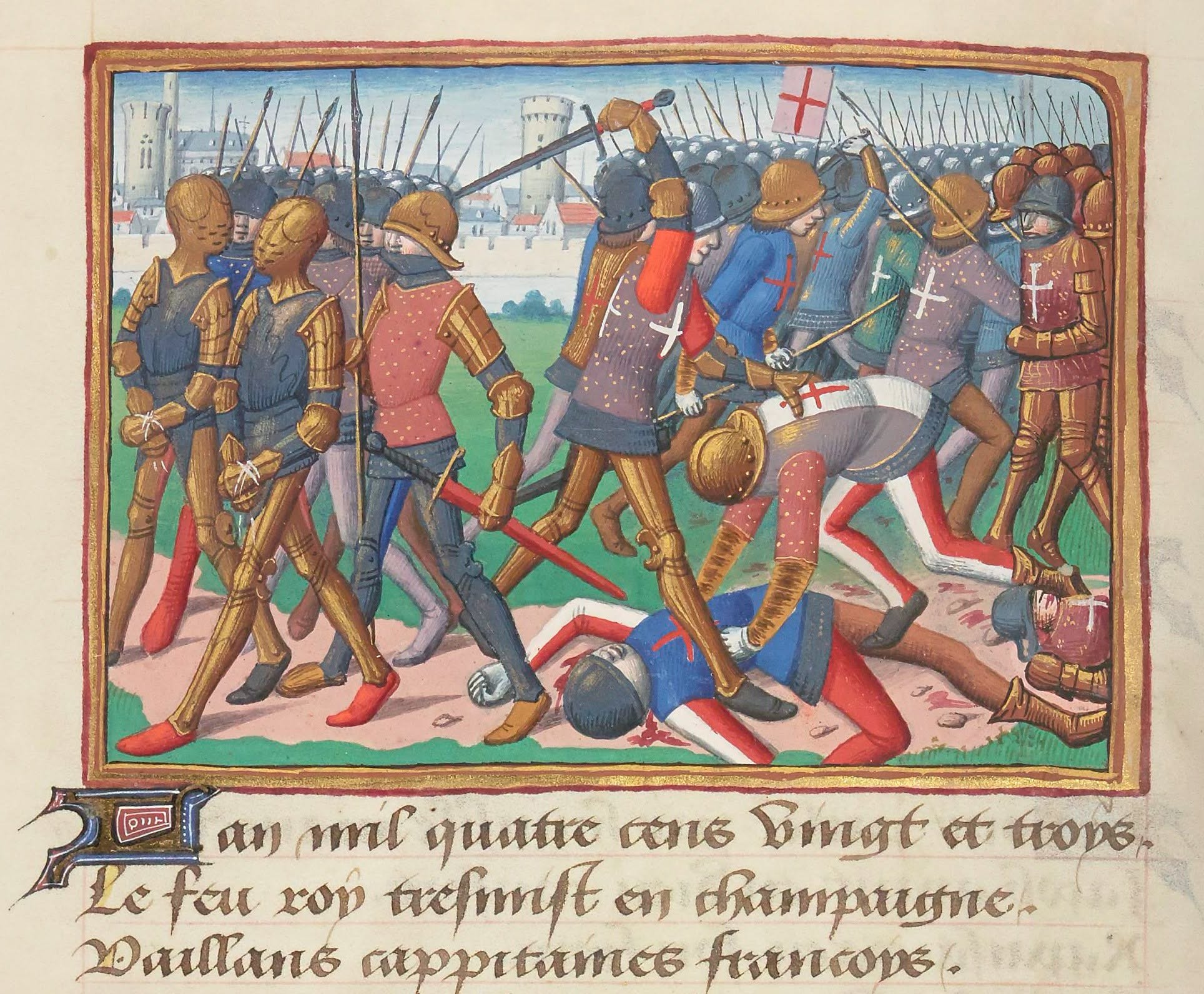
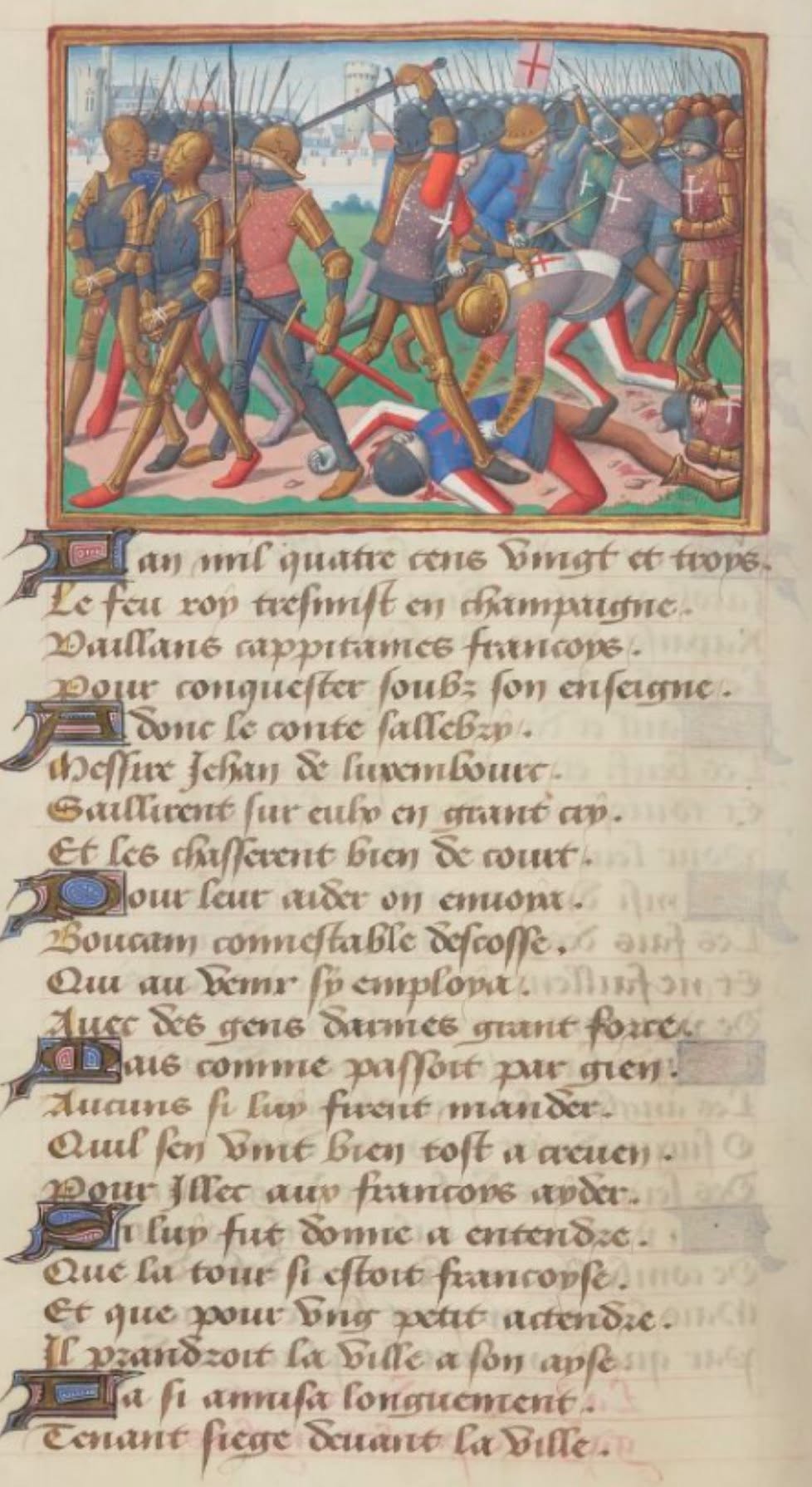
The image from 'Les Vigiles de Charles VII' by Martial d'Auvergne, written around sixty years after the battle, with the text being:
In the year fourteen hundred and twenty-three,
The late king reigning in Champagne,
Valiant French captains
To conquer beneath his banner.
Then the Earl of Salisbury,
Sir John of Luxembourg,
Fell upon them boldly in great force
And drove them swiftly from the field.
To give them aid there was sent
Buchan, Constable of Scotland.
Who later devoted himself to it,
With a great force of men-at-arms.
Then, as he was passing by Cravant,
Some sent word to him
That he should come swiftly to Cravant
To aid the French there.
He was given to understand
That the tower was held by the French,
And that, by waiting a little,
He would take the town at his ease.
There he assaulted it for a long time,
Maintaining the siege before the town.
And then the English, hotly,
Came there on foot, in haste.
The late king, wishing to strengthen
His men, holding firm nearby,
Caused to go and be transported there
Four hundred Spanish men-at-arms,
Whom the Count of Ventadour,
The lords of Bellin and Fontaines,
Found thereabouts,
Together with other captains.
The Burgundians and the English,
Against this supporting force,
Boldly crossed the ford
And charged them fiercely.
There were blows and heavy strokes
In the assault that was made.
But the English and Burgundians
Won that day.
There was a defeat
Of the French, of whom there died
About a thousand in the battle,
Besides the prisoners who were taken.
The aforesaid Constable of Scotland,
Ventadour, Gravaches and Bellin,
Surrendered, and were compelled
To submit themselves to ransom without delay.