

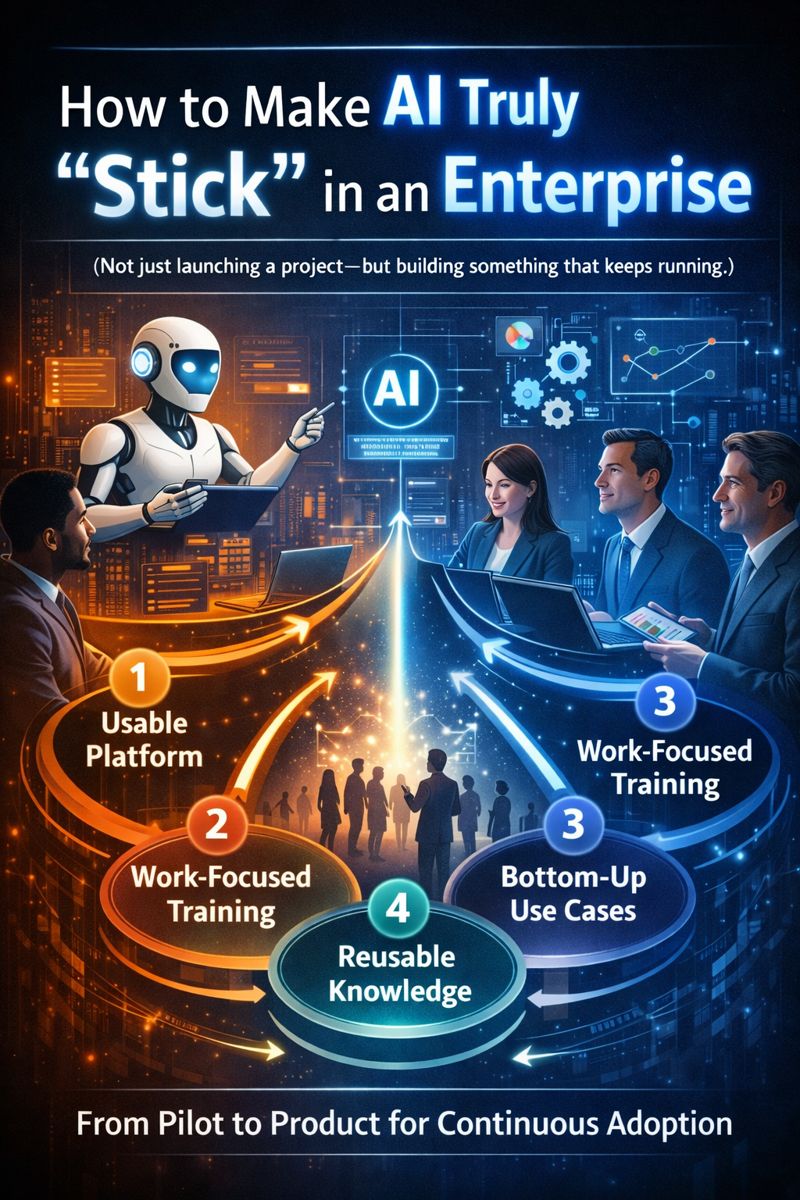
(Not just launching a project, but building something that keeps running.)
Many organizations are rolling out AI with real enthusiasm—and still end up with the same outcomes:
You have a platform, but no one uses it
You have pilots, but they don’t scale
You have technology, but it doesn’t move the needle
In most cases, the problem isn’t the model. It’s the adoption approach.
The essence of enterprise AI adoption isn’t debating model capabilities—it’s designing a sustainable operating mechanism that creates ongoing usage, measurable impact, and continuous improvement.
Based on my experience implementing AI in enterprises, successful adoption usually comes down to five keys. The 5 Keys to Enterprise AI Adoption
1) Start with a “usable platform” before talking about tech
Most AI programs begin with model selection. The better starting point is friction reduction.
A platform that “sticks” looks and feels like any other core enterprise tool:
A single entry point (avoid multiple portals and fragmented tools)
Practical prompt templates and scenario-based entry points
Day-one value: users can solve real work problems immediately
Low friction + high usability is the prerequisite for adoption.
If it isn’t easy, it won’t spread—no matter how strong the model is.
2) Training should solve work problems—not teach AI theory
AI training fails when it resembles a lecture about how models work.
Training succeeds when it’s built like a productivity workshop:
Maps directly to real departmental tasks
“Learn today, use today” via use-case demos and hands-on practice
Emphasizes time saved and outputs delivered, not concepts
Users want efficiency, not more knowledge.
If training doesn’t help them do tomorrow’s work faster, adoption drops quickly.
3) Let each department grow its own use cases (bottom-up)
Generic “one-size-fits-all” AI features rarely create sustained value.
What scales is department-led use case development, where:
Teams define their own pain points and scenarios
Use cases start small and specific (one task, one workflow, one measurable output)
Adoption is driven by demand, not centrally mandated rollouts
AI adoption can’t rely on top-down messaging alone.
Real traction happens when teams feel: “This solves my daily problem.”
4) Turn wins into reusable organizational knowledge
A common failure pattern: one team finds a great workflow—and everyone else starts from zero.
AI becomes scalable only when success is made copyable:
Capture what worked: prompt templates, shared assistants, knowledge base entries, “how-to” playbooks
Make reuse effortless: one-click duplication, simple tagging, and searchable libraries
Prevent reinvention: stop every team from repeating the same trial-and-error cycle
This step determines whether AI remains a “pilot” or becomes a true organizational capability.
5) Shift the AI team from “system ops” to “product management”
Go-live is the beginning—not the end.
If AI is treated like infrastructure, it becomes stagnant.
If AI is treated like a product, it improves and spreads.
A product-minded AI team continuously:
Improves UX based on usage data and user feedback
Expands features and integrates workflows into daily tools
Amplifies frontline creativity and productivity by removing friction
AI systems aren’t one-time launches. They are products that require iteration.
Conclusion: AI adoption is a cultural flywheel
Enterprise AI adoption is not a single implementation—it’s a positive feedback loop:
Usable platform → real work value → department use cases → reusable knowledge → product iteration → broader adoption
Once this flywheel spins, AI stops being a “project” and becomes part of daily operations—ultimately enabling every employee to be AI-empowered (the real goal).
#EnterpriseAI #AIAdoption #DigitalTransformation #AIPlatform #OrganizationalCapability #LLM #AITransformation