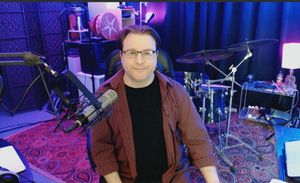

Chapter 1: The Instrument of Language
Learning a language is not a short-term goal. It’s a lifelong practice.
It’s not like buying a product. It’s not a trophy you win.
It’s like learning a musical instrument—something that grows with you, opens your soul, and brings beauty into your life.
You don’t “finish” learning the piano or the guitar.
You keep playing.
You keep improving.
You keep discovering.
Language is the same.
At first, it’s awkward. You make noise, not music.
Your words feel clumsy, your pronunciation feels strange.
But over time, with patience and practice, that noise becomes rhythm.
That rhythm becomes melody.
That melody becomes expression.
And just like music, language gives you a way to share your deepest thoughts, emotions, and ideas with others.
🎵 Perform It Anyway
I remember my first performance. I was fifteen. A teacher paid me fifty bucks to play snare drum at a church fundraising event. My only job? A short drumroll and a cymbal crash every time someone received an award.
It should’ve been simple.
But I was terrified.
I sat there on stage, drumsticks in hand, shaking. Afraid to mess it up.
Afraid of being embarrassed.
But I did it. I performed. And it wasn’t perfect—but it didn’t have to be.
The next time, it was easier. Then easier again. That’s how it works:
you don’t wait for confidence to arrive—you build it by doing the thing you fear.
There is a cost to the ticket of greatness… and that cost is embarrassment.
If you want to be great, you must be willing to be embarrassed.
The greatest performers—the best musicians, artists, athletes, and speakers—aren’t fearless.
They’ve just learned to walk through fear and keep going anyway.
🎤 Speaking Is a Performance
It’s easy to forget that language learning isn’t just academic.
It’s performance.
You perform with your voice, your face, your mouth, your timing, your rhythm.
You are on stage every time you speak. That’s what makes it both exhilarating and terrifying.
When a musician practices, they’re not just memorizing notes.
They’re learning to express themselves through sound.
Through movement.
Through breath.
The same is true for you as a speaker of language.
Be musical with your language, just like a musician is musical with their music.
You’re not just aiming for grammatical accuracy.
You’re aiming for connection, clarity, and expression.
🎧 You’re Not Alone
Did you know that around 40% of native English speakers are afraid of public speaking?
So if you’re nervous about speaking a second language—you are absolutely not alone.
But here’s the surprising part: what holds you back isn’t usually your grammar or vocabulary.
It’s fear.
And fear can be trained—just like a difficult scale or a hard rhythm.
The more you face it, the more fluent you become in working through it.
I think about learning how to swim when I was a child. Standing at the edge of the water, afraid to jump in.
Until someone—parent, sibling, uncle—gives you that push.
And suddenly you’re swimming.
Maybe this chapter is that push for you.
Most of your fears about speaking are inflated in your mind.
And most people don’t care about your mistakes—they care about your effort.
In fact, many people will admire your courage more than your correctness.
🎻 The Yo-Yo Ma Mindset
Yo-Yo Ma, widely regarded as the greatest cellist on Earth, still practices every day.
And every day, he tries not to be perfect… but to be more musical.
This is the way of language, too.
Every day you wake up and try to make it better.
You will never “complete” English or any language.
But you will always have the chance to play it more beautifully.
🎙️ The Real Goal
Don’t aim to be flawless.
Don’t aim to “finish” the language.
Aim to play. Aim to perform. Aim to express.
Speak with rhythm. Speak with feeling. Speak with purpose.
Let your words have tone. Let your sentences have soul.
Let your language become your music.
Language is not something you conquer.
It’s something you cultivate.
It’s not a test to pass.
It’s not a finish line to cross.
It is, quite simply, an instrument you learn to play.