

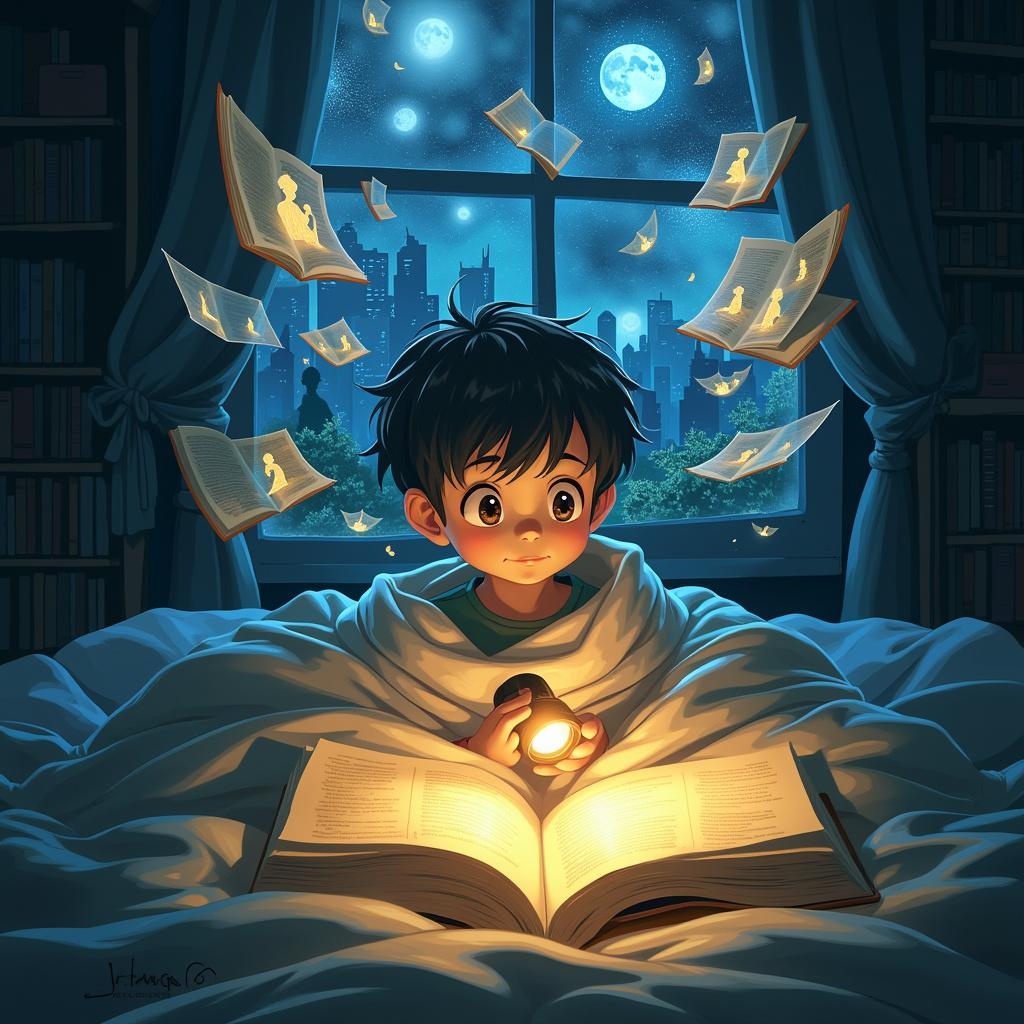
The virtual world—that shimmering realm of imagination—became my second home long before I understood what virtual reality truly meant. Born in 1982, I grew up straddling two worlds: the concrete reality of suburban life and the infinite landscapes that unfolded between book covers. If I were to calculate the hours, I'm certain I've lived equally in both realms, my consciousness split between the tangible and the imagined.
I wish I could pinpoint the exact moment reading claimed me, but memory blurs those early years into a warm haze of discovery. What I do remember is the transformation—how words on a page suddenly became doorways, how black letters on white paper dissolved into living, breathing worlds. Once I crossed that threshold, there was no turning back.
Reading became my obsession, my addiction, my escape hatch from ordinary existence. I carried books like other kids carried security blankets, clutching them against my chest as I navigated hallways, sidewalks, and dinner tables. The weight of a paperback in my hands felt more real than the ground beneath my feet.
"Boy, you need to put that book down while you're walking—you can't see where you're going if you're looking at the book!" The refrain echoed through my childhood, spoken by teachers whose voices seemed to come from another dimension, by parents whose concern couldn't penetrate the spell I was under. At school, I perfected the art of stealth reading—books hidden under desks, pages turned with the subtlety of a practiced magician. My teachers would catch the telltale signs: my eyes tracking left to right beneath the desk's edge, my distracted responses to questions that pulled me unwillingly back to math problems and history lessons.
Home offered no sanctuary from this beautiful curse. "Do your homework," my parents would plead. "Do your chores." "Pay attention to what we're saying." "Come to the dinner table." But even at meals, stories swirled in my mind like background music, characters continuing their adventures in the spaces between bites.
Nighttime brought the most desperate measures. I remember the weight of covers pulled over my head, creating a small tent of warm breath and stolen light. First, I tried keeping the bedroom lights on, but the golden glow seeping under the door was a dead giveaway. My parents' footsteps would approach like thunder, followed by the decisive click of the switch and firm voices: "Turn that light off. Go to sleep."
So I graduated to flashlight smuggling—the classic childhood crime. Under the covers, I'd create my own private reading chamber, the beam creating a small pool of possibility in the darkness. The flashlight grew warm in my grip, its circle of light illuminating not just pages but entire universes. The muffled sound of my breathing mixed with the whisper of turning pages, creating a rhythm that lulled me deeper into whatever world I was inhabiting.
Inevitably, they'd catch me. The telltale lump under the blankets, the faint glow leaking through cotton weave, the suspicious stillness when they opened the door. "Go to sleep," they'd say, confiscating my contraband light, leaving me in darkness to dream of unfinished chapters.
The books themselves live in my memory like old friends: Charlotte's Web with its tender tragedy, tales of knights in gleaming armor, stories of toy horses that came to life in a little boy's imagination. I devoured everything within reach, my appetite insatiable. As I grew older, my literary hunger led me toward forbidden territories—books about vampires and witches that made my strictly Christian parents uncomfortable. Being naturally curious, I sought out these shadow stories anyway, reading them in secret moments, stealing glimpses of worlds my parents deemed too dark for young eyes.
When I couldn't access the forbidden fruit, I gorged myself on everything else available, reading voraciously through every approved book I could find. The hunger never diminished; it only grew more sophisticated.
What captivated me wasn't just the stories themselves but the complete transportation they offered. Reading wasn't a passive activity—it was shape-shifting, soul-traveling, time-bending magic. I would dissolve into the narrative, becoming one with protagonists, feeling their fears pulse through my chest, their victories surge through my veins. The boundary between self and story evaporated until I existed fully in both worlds simultaneously.
Stopping felt like death. Even knowing I could pick up where I left off, the interruption created a terrible anxiety—as if pausing mid-sentence might cause the entire universe to collapse, leaving me forever locked out of paradise. So I read with desperate intensity, racing against time, against interruption, against the inevitable return to ordinary reality.
This beautiful obsession consumed years of my life. I was completely, helplessly enraptured, an addict whose drug was imagination itself. It interfered with everything—school, family, social connections—but I couldn't stop. The virtual worlds between pages felt more real than the physical world around me.
Eventually, the internet arrived, and with it, a new form of reading. People called it the death of literature, the end of deep reading, but I saw it differently. The internet meant more words, more stories, more worlds to explore. Yes, the format changed—shorter bursts, different rhythms—but the essential magic remained. Now I could read novel-length fiction online, listen to audiobooks, watch stories unfold in videos. The medium evolved, but the transportation remained the same.
These days, anime has become my primary vehicle for escape. I prefer subtitled versions, which means I'm still reading, still processing language and story simultaneously. Each episode becomes a small meditation, a brief vacation from the weight of current reality. For those precious minutes, I don't have to think about stress, about people's judgment, about uncertainty and fear. I can lose myself in the adventures unfolding on screen, in the rhythm of reading subtitles, in the familiar comfort of narrative structure.
Recently, I've been watching "Terraformars" on Amazon Prime—a story about humans enhanced with insect DNA, sent to Mars to battle evolved cockroaches. It's absurd and violent and completely absorbing. For the duration of each episode, I'm transported away from my current struggles, back to that childhood feeling of complete immersion in another world.
But today, walking back from a McDonald's with locked doors, exhaustion settles into my bones like lead. The endless walking, the heat, the constant uncertainty—it all crashes back. I'm tired in ways that sleep can't fix, worn down by the relentless demands of survival. The virtual worlds that once offered perfect escape now feel like brief respites in an otherwise overwhelming reality.
I find myself thinking about that child who read by flashlight under the covers, who got in trouble for reading while walking, who couldn't put books down long enough to eat dinner. That boy lived in infinite possibility, believing in the power of stories to transform everything. He had no idea that someday, escape would become not just desire but necessity, that the virtual worlds would become not just entertainment but lifeline.
The magic is still there, dimmed but not extinguished. In the glow of a screen showing subtitled anime, in the familiar rhythm of reading, in the blessed temporary amnesia of a well-told story, I can still find echoes of that original wonder. The boy who read by flashlight still lives somewhere inside me, still believing in the power of words to create worlds, still hungry for that next story, that next escape, that next moment of perfect transportation away from the weight of the world.
The virtual realm—whether found between book pages or on glowing screens—remains my sanctuary, my second home, my proof that there are always other worlds waiting, always other stories to live, always other ways to be. In a life where so much feels uncertain, this remains constant: the doorway is always open, the invitation always extended, the escape always possible.
All I have to do is read.
If this one stayed with you, you might also like:
From Country Roads to Swordmaster Glory: Finding Hope in Beryl's Journey
Rick and Morty: Irreverent and Gross Comedy, Thought-Provoking Conversation