

Search visibility improves when readers feel that content speaks in a consistent, trustworthy voice. If AI-generated drafts miss that voice, the message becomes vague, brand trust declines, and rankings follow. This guide explains how to align AI to brand voice for SEO without sacrificing clarity or originality. You will learn how to codify voice, steer prompts with intent, build editorial guardrails, and validate every draft with Easy AI Checker.
Why brand voice matters for SEO in 2026
Search engines reward pages that satisfy user intent and demonstrate authority. Voice influences both outcomes. A consistent voice reduces confusion, speeds comprehension, and signals expertise. It also improves engagement metrics such as dwell time, scroll depth, and internal click flow. When you align AI to brand voice, headings sound purposeful, paragraphs carry useful specifics, and calls to action feel natural rather than forced.
The Voice Alignment Framework
Use this three-layer framework to make voice repeatable.
Voice Charter: A one-page document that records tone, persona, and vocabulary boundaries.
Operational Guardrails: Prompts, checklists, and examples that translate the charter into daily work.
Quality Assurance: A single reviewer workflow that validates rhythm, clarity, and intent coverage.
Each layer reinforces the others. The charter defines the target, the guardrails steer generation and editing, and the QA step proves that the page meets expectations.
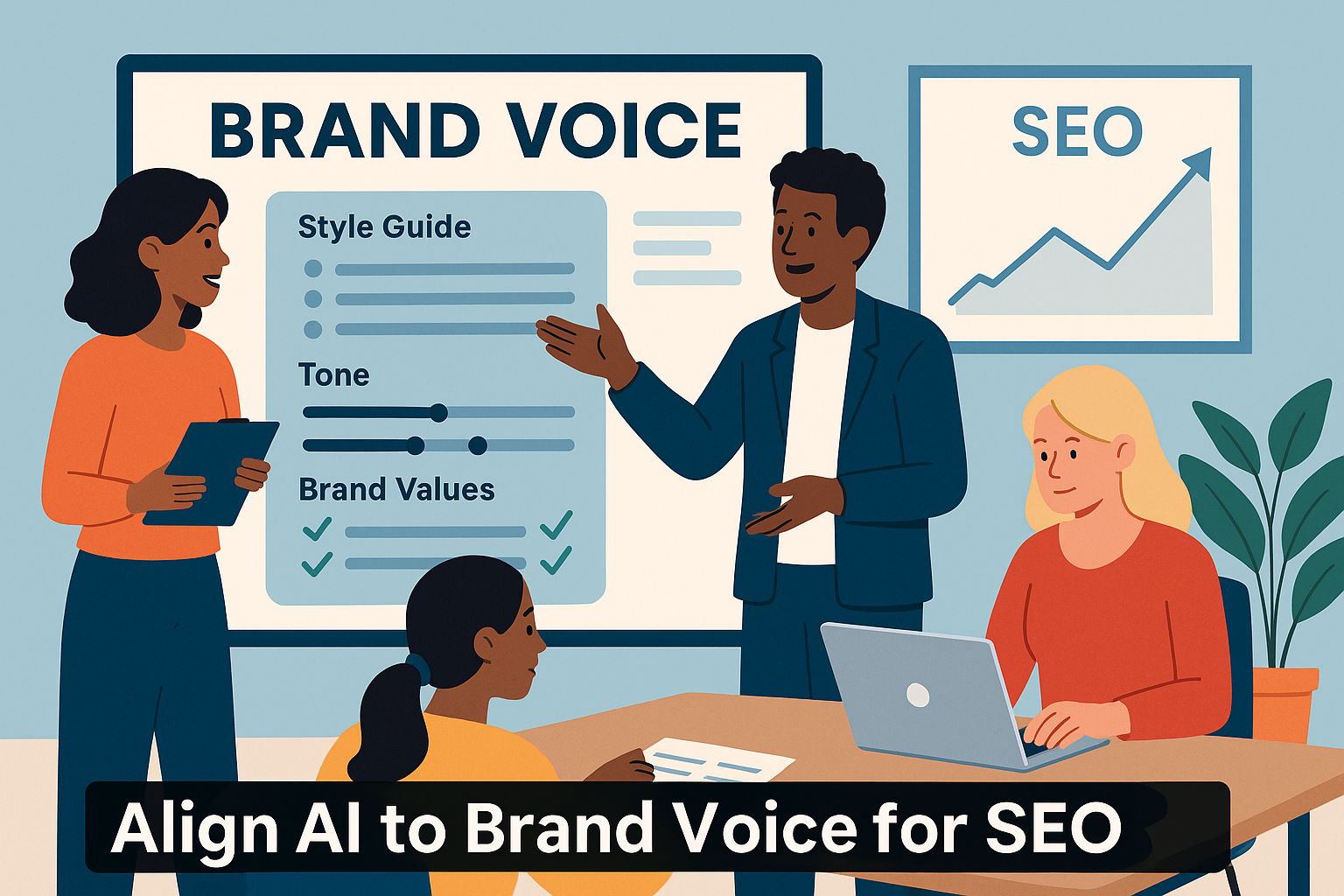
Build a voice charter that writers actually use.
A voice charter should be short, concrete, and actionable. Aim for a single page organized under four headings.
Personality: Confident, helpful, and evidence-driven. Avoid snark, hype, and slang.
Formality: Professional and approachable. Define acceptable sentence complexity and acceptable rhetorical devices.
Lexicon: Preferred terms, neutral alternatives, and banned phrases. Include product naming rules and capitalization.
Style cues: Sentence rhythm, preferred transitions, and paragraph length norms.
Add two miniature examples: one paragraph that perfectly matches the voice and one that clearly breaks it. People remember contrasts more than definitions. When teams see the difference, they internalize the target.
Include a short section for brand voice alignment for AI content that clarifies how models should treat tense, person, and claims. This reduces the risk of robotic outputs and keeps language consistent across the site.
Translate the charter into prompts that guide AI.
Prompts should carry task, audience, and tone constraints. They should also include a few lexical choices and disallowed phrases. A good pattern looks like this:
Task: Write a how-to section that solves a single user problem.
Audience: Marketing managers who evaluate tools and processes.
Tone: Confident, plain language, evidence-led, and free of hype.
Lexicon: Prefer “evaluate,” “validate,” and “compare.” Avoid “revolutionize,” “cutting edge,” and “game changer.”
Constraints: Use active voice, short to medium sentences, and transitional phrases that explain cause or contrast.
When the prompt mirrors your charter, AI stays within boundaries and drafts arrive closer to final form. This reduces post-editing time and prevents voice drift.
Outline with search intent first, voice second.
Intent alignment prevents robotic tone and makes voice easier to sustain. Create H2 headings that reflect user questions and H3 prompts that represent sub-tasks. This pattern helps the reader skim and decide to engage. It also opens natural spots to place long tail phrases without stuffing. For example, when planning a section about style governance, integrate an AI tone of voice consistency checklist as a subheading phrase to confirm topical coverage while staying useful.
Edit AI prose with a structured pass system
A simple five-pass loop keeps revisions fast and repeatable.
Intent pass: State the reader's problem and desired outcome in one sentence at the top of the draft.
Structure pass: Ensure each section resolves a question and flows logically.
Voice pass: Apply the charter. Replace generic claims with specific actions and confirm terminology.
Clarity pass: Add examples, tighten verbs, and remove filler.
Cadence pass: Vary sentence openings, balance lengths, and add connective transitions.
During the voice pass, compare the draft against a short checklist titled brand voice guidelines for AI content, so nothing slips. The checklist can live in your CMS or documentation hub.
Create examples that demonstrate the difference.
Nothing teaches faster than before-and-after edits. Use this micro pattern across your site.
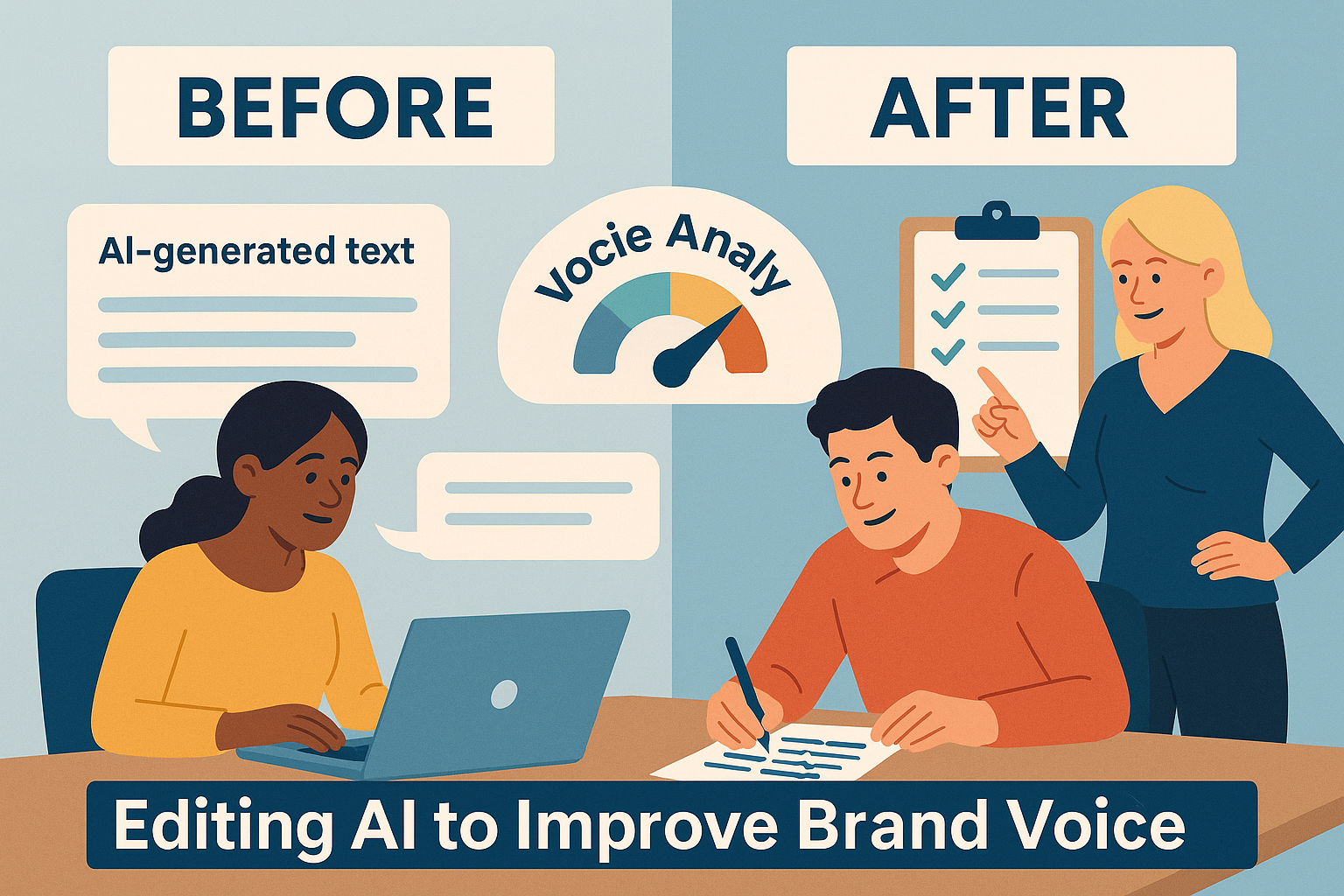
Original: “Our platform offers comprehensive capabilities that deliver significant improvements to the quality of SEO content.”
Issue: Vague nouns and inflated adjectives hide the claim.
Rewrite: “Our platform improves SEO content quality by enforcing voice rules, clarifying transitions, and removing filler.”
Examples like these show writers how to turn abstractions into actions. Readers benefit from concrete language that they can apply immediately.
Governance that scales across teams
As teams grow, voice requires simple governance.
Editorial brief: Attach the focus query, the primary reader's job, and the top three voice cues to every assignment.
Reusable snippets: Maintain approved definitions, product statements, and disclaimers.
Review lanes: For complex pages, add a subject matter expert review before final QA.
Training cadence: Host quarterly refresh sessions to share new examples and resolve disputes.
Document a lightweight rule for exceptions. Certain technical posts may demand stricter formality or narrower vocabulary. Record those decisions so future writers do not repeat the debate.
Validate with a single reviewer workflow.
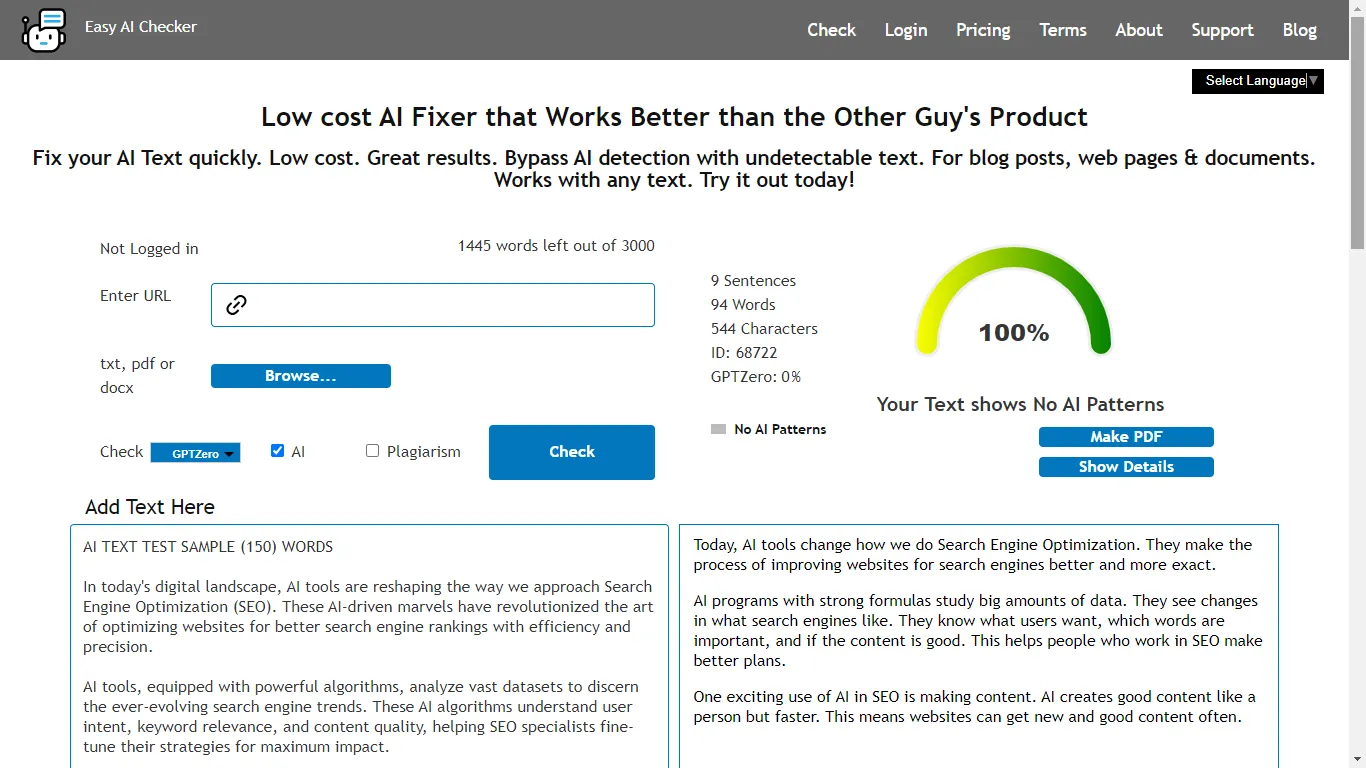
Once the draft passes internal review, run a final validation. Easy AI Checker centralizes these checks so teams can move quickly without bouncing between dashboards.
Paste or upload the draft for an initial scan. The system flags mechanical phrasing, voice mismatches, and abrupt transitions.
Apply targeted suggestions to align tone, clarify steps, and improve rhythm.
Verify that the page addresses the intent directly and that headings match the reader's questions.
Re-scan to confirm progress and catch residual issues.
Save a brief changelog that records edits made during validation.
This workflow keeps production predictable and preserves brand integrity across a large library.
On-page SEO that supports voice
Technical polish should reinforce clarity rather than fight it. Address the following items before publishing.
Title and slug: Keep the keyphrase visible and concise.
Meta description: Promise a concrete outcome rather than a vague improvement.
Headings: Use descriptive labels that match questions.
Internal links: Connect to cornerstone guides with precise anchors that reflect the destination.
Image alt text: Explain purpose and context in plain language.
Schema: Add Article or HowTo markup where relevant.
Readability: Balance sentence lengths and keep paragraphs digestible.
Calls to action: Invite one next step, such as validating the draft with Easy AI Checker.
These items help you maintain seo friendly brand voice in 2026 while avoiding keyword stuffing.
Common pitfalls and how to avoid them
Voice misalignment often appears in predictable places.
Mixed formality: Pages that alternate between casual and academic tone feel untrustworthy. Decide on a range and stay within it.
Overuse of passive voice: If responsibility matters, use active constructions.
Inflated modifiers: Replace “very,” “really,” and “quite” with specific facts.
Jargon without definition: Define acronyms at first mention and prefer plain terms when possible.
Template repetition: Vary openings and avoid identical sentence structures across a paragraph.
A short internal rule titled Reduce robotic tone in AI articles reminds everyone to address these items during editing.
Case-styled mini walkthrough
Imagine a product update blog. The goal is to explain a new analytics dashboard and encourage current users to try it.
Brief: Audience is existing customers. Voice is confident and helpful, not salesy.
Prompt: Provide tasks, tone, lexicon, and disallowed phrases.
Draft: AI generates a three-section article.
Edit: Apply the five-pass loop. Replace generic claims with steps that show how to use the dashboard to answer a real question.
Validation: Run Easy AI Checker, improve rhythm and transitions, and confirm consistent terminology.
Publish: Add a single call to action that links to the feature guide.
The final page reads like your brand, not like a template, and the SEO basics are in place. Avoid any so-called free, undetectable AI essay writer, and instead prioritize transparent drafting and attribution that align with your brand and integrity standards.
Measure alignment and iterate.
Voice quality is measurable. Track the following signals.
Content quality audits: Score pages against a rubric that includes accuracy, clarity, and voice fit.
Engagement metrics: Watch dwell time, scroll depth, and assisted conversions.
Editorial cycle time: Observe how many revisions are required to reach approval.
Reader feedback: Collect comments and support tickets related to clarity.
During quarterly reviews, compare results to your charter. If new patterns emerge, update the charter and examples. Then recirculate the changes during a short training session.
Where Easy AI Checker fits into ongoing operations
Use Easy AI Checker as the final gate and the periodic reviewer.
During drafting: When a section feels stiff, run a quick scan to highlight repetitive openers or awkward cadence.
Pre-publish: Confirm that the page reads naturally, matches brand vocabulary, and addresses the promised outcome.
Post publish: Re-run checks when a page underperforms or when messaging evolves.
This single tool approach simplifies quality assurance and keeps your voice consistent across hundreds of posts. If your team drafts on the go, an Android mobile chatbot app for article writing can capture voice notes and convert them into outline-ready prose that matches your charter.
FAQs: Align AI to Brand Voice for SEO
Q1: Does voice alignment mean every page must sound identical?
A: No. It means every page stays within a defined range. Writers can vary energy and detail based on audience and intent while respecting the charter.
Q2: How does voice relate to E E A T?
A: Clear, consistent voice supports experience and expertise by making claims precise and verifiable. It also signals authoritativeness and trust through transparent wording.
Q3: Can highly technical content keep a friendly tone?
A: Yes. Define the formality range for technical posts and use plain explanations alongside accurate terminology.
Conclusion
When you align AI to brand voice for SEO, you create pages that people trust and search engines reward. Codify the voice in a practical charter, translate it into prompts and guardrails, and validate with Easy AI Checker. Maintain light governance, measure results, and iterate quarterly. The outcome is a library that reads like your brand, answers real questions, and performs in competitive search results.