

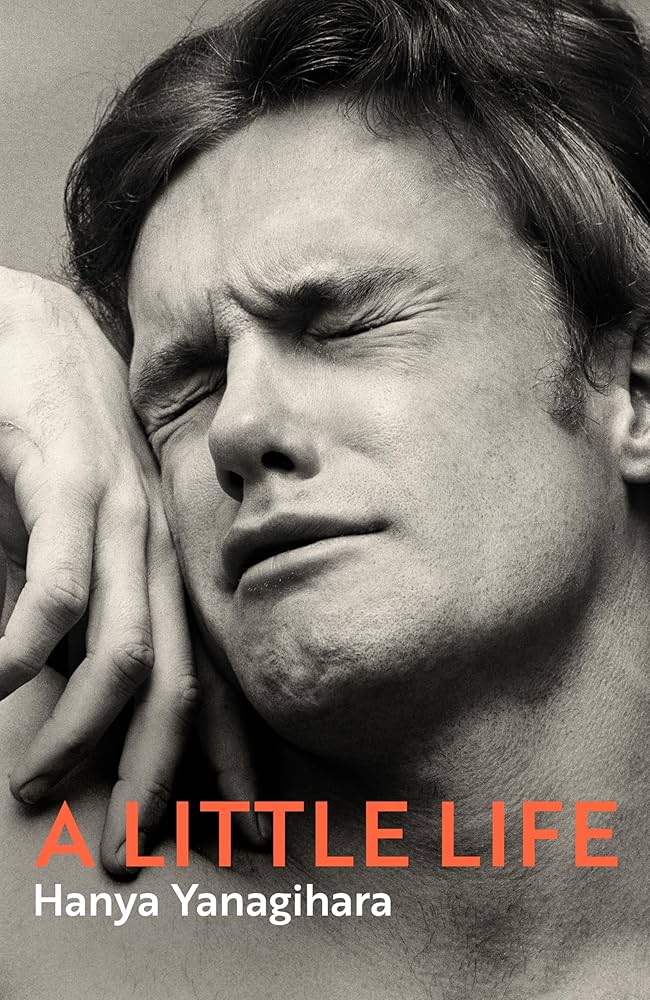
A Little Life by Hanya Yanagihara
The book seems extremely complex, with several layers linearly connected through time, while friendship is something far greater – it is love. It takes place in our century in the city of New York, following the lives of four friends who are each utterly unique individuals, and we follow them from their college days. But the trick is that the deeper and longer we read the book, the more we see that one character is actually the central portrait around which all the other characters crystallize. All possible concentric circles of narration radiate from him and toward him, and that is Jude St. Francis.
This is the story of one life, but also a narrative about one era, one city, one America that has many faces, and at the same time it is a Jungian analysis of the psychological – one might say psychopathological – influence of childhood on a mature adult, on his friends, and on everything he does in life.
In the prologue, Jude is a student sharing an apartment with Willem in one of those cheap New York dumps, and the group is completed by Malcolm and JB. The reader follows them from the beginning until the biological end, and within that circle of friends there is also another portraitist – JB (a painter).
Every youthful friendship is a treasure, and in America it often endures for years, starting from college days, especially friendships formed on campuses that last until biological disappearance. Over the years, we watch the climb up the social ladder, rises and falls in careers, great and small satisfactions, travels and exhibitions, restaurants, the art of cooking, the art of healing, the art of adapting, the art of living.
What is specific is Jude – a corporate lawyer who rises high on the social ladder thanks to his intelligence, thanks to one fact: that he survived the unfortunate circumstances of his birth and upbringing until the age of sixteen. That is the central story, which hits emotionally but raises many questions: how is it even possible that an absolute loser, abandoned as a baby next to a dumpster, who goes through seven circles of hell, manages to achieve so much materially, yet forever remains cocooned in what happened to him in those first sixteen years.
Anyone who grew up and struggled in life, living normally in a protected family as a protected child, cannot imagine the poisonous fruits through which an orphan left at the mercy of the adult world goes – a world that abuses him as a thing, as a nothing, as a rubber toy, as a piece of wood, teaching him only to submit, to adapt to their desires, and in those moments to leave his own body and watch it from the ceiling.
You guessed it – it’s about pedophilia, about all those unfamiliar figures we encounter on the street whom we don’t really know, yet in some basements or orphanages they abuse a boy, teaching him that he is dirty, smelly, without any human value. Rare are the moments of light and hope that something will be better, until that agony is interrupted along the way by breaking his spine – but Jude is freed. Was that tragic accident, which makes him a lifelong invalid, necessary to mark a crescendo in this symphony – a turning point and a completely new beginning? And is it even possible to escape what we are and what we were?
From that moment onward, there is an ascent in one sense, but the psychological cocoon remains; Jude’s being stays trapped in the past, and not only is his spinal injury incurable, but his psychological self-torment continues through self-punishment. In moments of brilliant beauty and inclination toward aesthetic loveliness, despite the friendship and love he gains through the years of existence, he somehow does not respect his own life because that horrific past always exists – a past he is not ready to confess to anyone, not even to the closest person who loves him – Willem. All those people from the past took away something completely normal and natural, and he cannot regain it despite the strongest will and desire.
Life is beautiful, and all the little things, all the successes, every smile or small achievement, or sunny morning, or new suit make Jude happy. He appears as a happy man who enjoys his career, preparing meals for friends, collecting art, his artistically furnished apartment – but the hyenas return mercilessly, without pardon, without compromise, and without warning. Happiness and that little life are obliterated by what has coagulated in the cocoon of Jude’s being – a completely beautiful man, both visually and spiritually, an intelligent and successful lawyer, but the problem is incurable.
The author has managed to write a perfect book, in which a great deal of time is concentrated, yet it is written in a completely simple way, without grand sentences or attempts to sound wise, clever, or to impose her own ethical conclusions. Everything is left to the reader, everything is left to the observer from the side, and everything is left to Jude himself, who does not even try to pursue his tormentors. He only wants his aesthetic and psychological peace, and love – a lot, a lot of love. But the biggest problem is that he does not love himself. In the end, he consistently and systematically destroys himself, and no one and nothing can stop him in that sadomasochistic way of life. The past is stronger, childhood is stronger; what we were at the beginning is what we become in the end, without our will and without any possibility or strength to overcome it within ourselves. Only a few succeed in that.
The book deserves every attention, first because of the central theme – in my subjective judgment – the presence of pedophilia in the world we live in, the danger hidden in the dark corners of this world and the adult world that can be very cruel. It has a multi-layered content, or rather multiple meta-levels, pointing out that life offers us other possibilities we thought did not exist, yet despite everything, they do. Hanya writes to us about the beauty of friendship, love, empathy, and self-sacrifice, and builds a cathedral that pays homage to aesthetic beauty in the environment that surrounds us. It is read with pleasure because each chapter reveals some new page and some unknown leaf in the book of life, branching out in all possible directions.