

This is chapter four of a 32-page special report, published in multiple installments. You can read the previous chapter here.
If you’d like immediate access to the complete PDF, you can check our Substack page to download it. Otherwise, you’re welcome to continue reading each chapter as it’s released, free of charge.
For questions, leave us a message and we’ll respond as soon as possible.
 4.1. U.S. Goals in the U.S.-China AI Competition
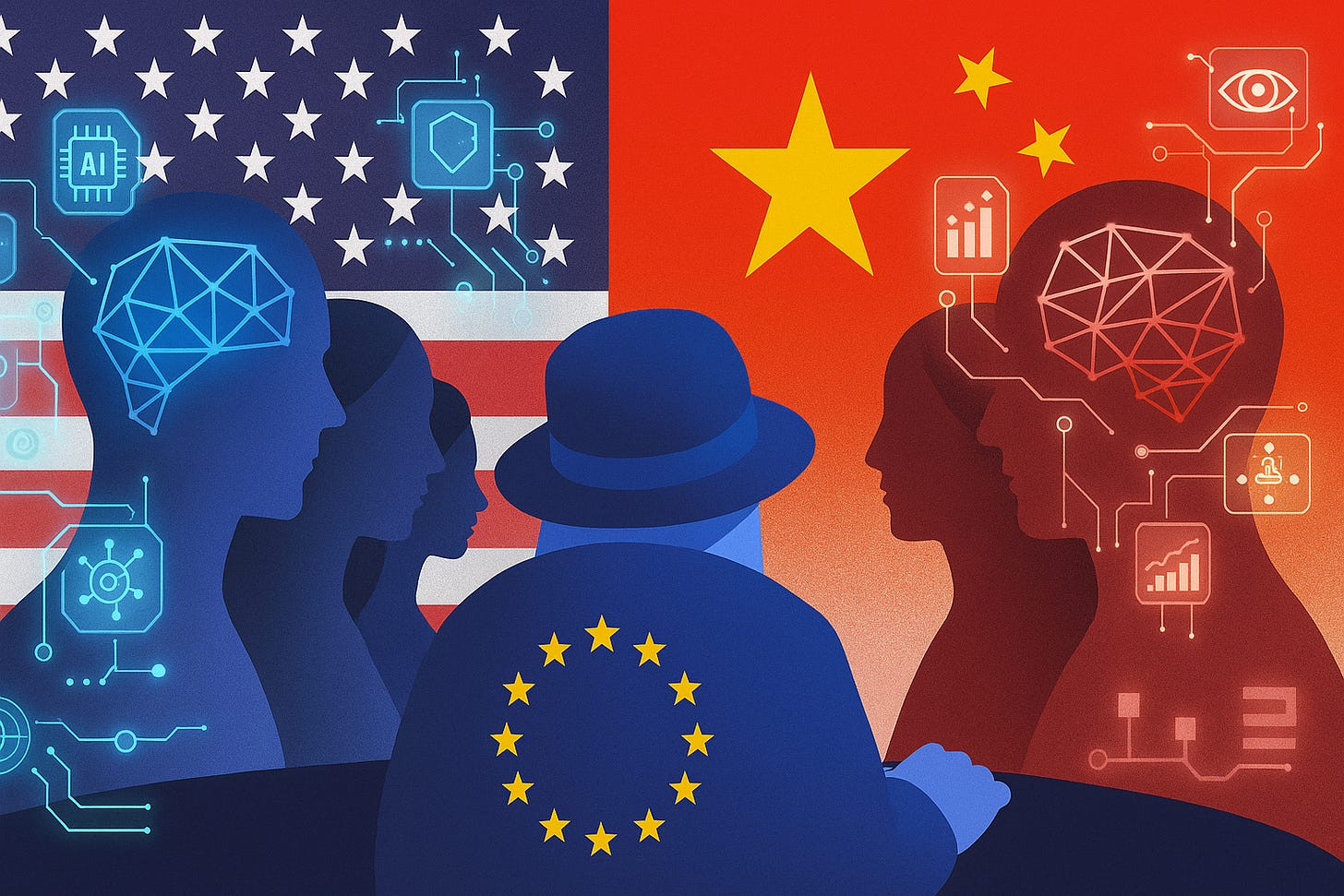
In Western media and policy circles, the U.S.–China artificial intelligence (AI) competition is often framed as a race for technological innovation. In reality, it is far more than a contest over large models, chips, and computing power—it is a geopolitical confrontation over global information sovereignty, ideological influence, and leadership in the international governance system.
Like China, the United States seeks to export its AI ethics, safety standards, and governance frameworks through multilateral mechanisms, building a U.S.-centric “soft alliance for AI governance.” This contest is not merely about technical specifications; it is a struggle to reshape the discourse and institutional frameworks of global governance.
In this framing, China is cast as the emblem of “authoritarian AI,” while the U.S., invoking the language of “freedom and transparency,” seeks technological cooperation and political alignment from global democracies. AI is therefore both a strategic instrument and a means of geopolitical governance.
4.2. The AI Policy Divide: Reconciling Tech-Globalism with National Security Imperatives
The United States retains a dominant position in AI—from foundational model algorithms to chip manufacturing, from open-source frameworks to global talent pipelines. Yet beneath this advantage lies a structural contradiction: the clash between Silicon Valley’s ideology of “technology as power” and Washington’s emphasis on “national interest.” This tension increasingly shapes the U.S. approach to AI competition with China.
1) Technology as Power: Big Tech’s Ideological Foundations
For major technology companies, AI is not a neutral tool—it is an instrument for shaping rules of social operation, public discourse, and even cognition. From this perspective, Big Tech resists government intervention not out of principle, but because it views technology itself as the primary source of governance authority. This manifests in several ways:
Data as Sovereignty: Framing “free data flow” and opposition to data localization as “freedom of information” and “open innovation,” Big Tech seeks to absorb global user data into its AI systems, giving them a trans-sovereign reach.
Algorithms as Governance: Large language models (LLMs) construct discourse structures, determining which content is produced, amplified, or suppressed.
Scale as Control: By embedding ever-larger models into public infrastructure, tech firms create irreplaceable platforms that generate regulatory dependence.
This “technology as power” philosophy erodes traditional state authority and promotes a governance order centered on platform control.
2) Avoiding Regulation, Shaping Rules
AI firms are limiting public API access, withholding training data and benchmarks, and influencing AI standards by funding research, steering standard-setting bodies, and working closely with policymakers. Publicly, they argue that regulation will “stifle innovation” or “give China an edge.” In practice, these positions aim to protect their dominance over data and discourse.
3) Integration Over Decoupling
Faced with U.S. export controls, many firms pursue “integration over decoupling.” NVIDIA’s creation of A800/H800 chips—designed to bypass restrictions—is emblematic. The logic: if China remains tied to U.S. platforms and ecosystems, it remains within their sphere of influence. This runs counter to the national security community’s push for stricter separation.
4) National Security Logic
From a defense perspective, AI is critical infrastructure, integral to cognitive warfare, military systems, diplomacy, and supply chain security. National security agencies advocate for strict control, supply chain separation, and export restrictions—policies often diluted by corporate lobbying and market dependencies.
Big Tech does not reject the state outright but seeks a collaborative relationship free from public oversight. This creates a split in U.S. AI strategy: the national security community demands control and sovereignty; Silicon Valley advances tech-globalism and platform governance. The resulting policy incoherence offers strategic openings for China.
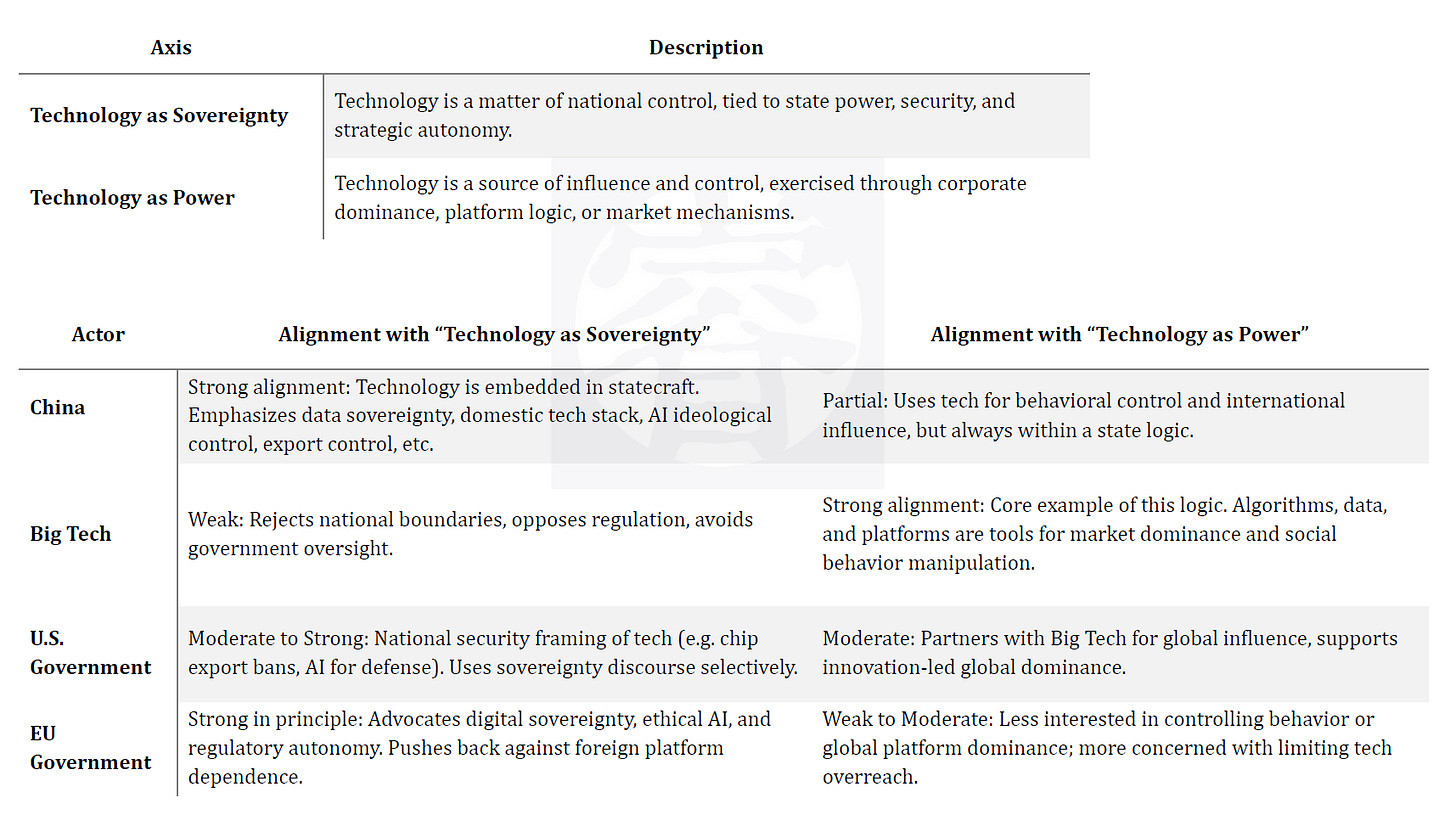 “Technology as Sovereignty” vs “Technology as Power”
Read more @ Sinosage.substack.com
4.3. Strategic Blind Spots: Why the U.S. Misunderstands China’s AI Approach
Shaped by both Big Tech interests and national security perspectives, many Western political and media narratives portray China as a “technological chaser”—racing to close gaps in algorithms, chips, and large models to challenge U.S. dominance. However, this linear framing overlooks a more fundamental reality: China is neither seeking to win AI hegemony through symmetrical competition nor attempting to replicate a U.S.-style tech ecosystem in the near term. It is not relying on global market share or open-source influence to reshape technological discourse power.
Instead, Beijing is pursuing a classic asymmetric strategy: focusing on deploying AI products and systems that are sufficient to meet political and strategic objectives, while expanding its influence in global narratives and ideological dissemination. The priority is to be “autonomous enough” and “controllable enough,” not “universally superior.” As seen in initiatives such as the Digital Silk Road and the Global Digital Development Initiative, China’s AI strategy is less about pushing the limits of hardware or computing power and more about producing practical, easily deployable solutions for domestic governance and targeted overseas applications. In this logic, “deployability” holds greater strategic value than “technical advancement.”
This approach supports China’s long-term goal of “political security” and has secured strong policy backing and resource allocation for its AI industry. Through system integration, platform building, and the export of governance capabilities, Beijing aims to shape a new set of rules for the global digital order with a “practicality-first” mindset.
1) “Good Enough”: Deployment Before Breakthrough
Research shows that while China still trails companies like OpenAI, Anthropic, and Google DeepMind in areas such as training efficiency, model compression, and energy optimization, its domestic large models have reached a “strategically sufficient” threshold in several key capabilities:
High-quality Chinese-language semantic understanding and generation (e.g., Baichuan, Zhipu, DeepSeek);
Deep integration of multimodal and image recognition technologies (e.g., SenseTime, Baidu);
Localized Chinese corpora and safety-filtering mechanisms (centrally managed by the Cyberspace Administration).
In practical terms, these capabilities are already deployable for national governance, public opinion guidance, and large-scale system integration.
2) Bottlenecks: From “Possessing” to “Scaling Deployment”
China’s primary AI challenge is no longer acquiring core technologies, but achieving systematic, large-scale deployment. The most significant gap between China and the U.S. lies in deployment efficiency, not raw technological capability. This explains why Chinese policymakers are not prioritizing the development of the “world’s strongest AI,” but instead are concentrating on targeted applications in social governance, ideological control, risk assessment, and international communication.
3) Strategic Misalignment Between Technological Containment and Market Integration
U.S. restrictions on China’s AI development often miss the mark. Continued access to U.S. technology can actually accelerate China’s process of “substitution-based autonomy.” Once U.S. products and services—including open-source models, algorithm frameworks, pretrained models, inference chips, and other tools—enter the Chinese market, they can produce several reverse effects:
Enterprises rapidly build localized platforms to meet domestic demand;
National labs fine-tune models through interface parsing, sample training, and scenario-specific iteration;
Chip companies advance domestic architecture alternatives through direct performance benchmarking.
As a result, exposure to Western technology enables China to gain application-level expertise, close knowledge gaps, and ultimately pursue reverse engineering and domestic substitution.
Importantly, some U.S. tech firms continue to see market integration as a strategic anchor—believing that as long as China depends on their platforms, APIs, or hardware ecosystems, it cannot fully decouple. Yet Beijing’s logic is different: “temporary integration, long-term substitution.” All imported technologies are potential benchmarks for eventual replacement.
4) Reverse Lock-In and Strategic Risk
Silicon Valley’s continued push into the Chinese market can undercut U.S. national security objectives. Commercial logic risks producing:
Loss of control points — Greater Chinese familiarity with Western systems shortens decoupling timelines and speeds substitution;
Reverse lock-in — Once Chinese products and governance tools are embedded in Western-linked ecosystems, future sanctions carry higher mutual costs and reduced effectiveness;
Strategic misjudgment — Viewing China as a purely symmetric competitor could lead the U.S. to over-invest in hardware races while overlooking Beijing’s export of institutional governance infrastructure;
Erosion of discourse power — As Chinese AI tools become embedded in global digital systems, influence will depend less on technical superiority and more on institutional usability for systemic penetration.
In short, China’s core aim is not “technical supremacy” but information sovereignty and control over the structures of dissemination. Under this framework, deployment capacity, institutional export, and self-contained ecosystems hold far greater strategic value than cutting-edge breakthroughs. Unless the U.S. closes the gap between its strategic objectives and the tools it uses to achieve them, its technology policy risks drifting away from its stated priorities—leaving it poorly positioned in the long-term competition.
Read more @ Sinosage.substack.com
4.4. Europe’s Position: EU Marginalization in the AI Geopolitical Game
Caught between the technological and geopolitical giants of the U.S. and China, the European Union occupies an awkward strategic position. While it has the world’s most advanced AI regulatory framework and a rigorous digital governance philosophy, its institutional influence and strategic agency remain limited. The EU faces both internal and external constraints.
1) A Regulatory Vanguard at the Technological Periphery: The EU’s Dual Dilemma
In late 2024, the EU formally passed the AI Act, becoming the first political entity to regulate artificial intelligence comprehensively through codified law. The Act establishes a risk-based regulatory system, categorizing AI applications from “unacceptable high-risk” to “acceptable low-risk” and imposing corresponding restrictions and obligations. Its guiding philosophy emphasizes “human-centered, transparent, explainable, and auditable” AI—a direct response to the growing power of algorithms.
However, the framework faces several practical challenges:
Technological Lag: The EU lags significantly behind the U.S. and China in AI infrastructure, computing resources, and the development of large foundational models. Studies indicate that Europe’s top AI firms tend to focus on industry-specific applications and small- to medium-scale models, lacking the capacity to train general-purpose large models. As a result, EU regulations mainly target external technologies from the U.S. and China, rather than domestic production—undermining regulatory autonomy and weakening implementation capacity.
Internal Divisions: Member-state policy differences undermine the EU’s strategic unity on AI. Germany and France support an “AI Sovereignty Fund” to strengthen EU-led public computing and data infrastructure, aiming to reduce reliance on U.S. tech giants. By contrast, the Netherlands and Ireland prioritize attracting multinational investment and favor regulatory flexibility to safeguard national economic interests. These differences lead to fragmented policymaking, especially on defining high-risk systems and regulating open-source models, weakening the EU’s collective voice in shaping global AI norms.
Industrial Dependency: Despite aspirations for greater autonomy, the EU’s AI industry remains heavily dependent on U.S. infrastructure. Most European startups rely on APIs and cloud services from companies like OpenAI and Google, with few mature local alternatives. This structural dependency means that any regulatory action against these core services risks harming domestic enterprise growth—a potential “self-inflicted regulatory wound.”
2) An Island of Norms: Limited Impact of EU Regulation
The EU often emphasizes its “regulatory export capacity,” likening the AI Act to a “GDPR for the AI era.” Yet in AI—a systemic technology deeply tied to military-civil fusion, infrastructure, and information sovereignty—standards alone are insufficient as geopolitical leverage. Due to technological and diplomatic shortcomings, the EU’s rule-making increasingly resembles a “normative island”:
Exogenous Rules: Without global authority in technical standard-setting, EU AI norms often lack international adoption. For example, the AI Act prohibits “social credit scoring systems” and “predictive policing algorithms.” While these provisions may be morally applauded, they have little traction in the Global South and cannot compete with Chinese and American “smart city” offerings in terms of export viability.
Weakness toward the U.S.: Although EU regulators have launched investigations into privacy and algorithmic bias at firms like OpenAI and Meta, they often make technical concessions during U.S.-EU trade negotiations. Analysts note that the European Commission frequently holds “informal consultations” with Google on standard-setting, with many industry standards ultimately shaped by U.S. tech alliances—leaving EU regulators to endorse them after the fact.
Geopolitical Imbalance: The EU’s model is neither China’s “state capitalism” nor the U.S.’s “platform liberalism,” leaving it without strong institutional allies in multilateral forums. At the 2025 Global AI Governance Summit, for example, the EU’s “Human-Centered AI Roadmap” received symbolic support from Canada and New Zealand, while most Asian, African, and Latin American states opted for China’s rapidly deployable solutions or U.S.-based platforms.
Read more @ Sinosage.substack.com
3) Beyond the U.S. and China: The EU as a Strategic Technological Hedge
Despite being increasingly marginalized in the global technology power structure, the EU’s distinct “non-military, rules-based” digital governance model retains some strategic value:
Digital Ethics Authority: The EU remains a global leader in promoting algorithmic ethics, AI accountability audits, and human rights protections. Its academic and legal frameworks continue to have soft power in parts of the Global South. Some African and Latin American countries reference the EU model when drafting national AI laws to avoid falling into either U.S. or Chinese spheres of technological influence.
Multilateral Diplomatic Platform: The EU is a key driver of the “Global Cooperation and Governance Initiative” (GCGI), which seeks to promote a basic global AI governance framework through institutions such as the UN, Human Rights Council, and WTO. Although its influence is limited, this initiative provides the Global South with an alternative to U.S. and Chinese unilateral norms in areas like data governance and cross-border regulation.
Geopolitical Window: As the U.S. and China consolidate their respective technology blocs in a “new cold war,” the EU could play a limited role as a “buffer zone” for technological diplomacy. For example, some Southeast Asian countries depend heavily on Chinese technology but remain wary of Beijing’s governance model, while also relying on U.S. platforms yet fearing tech hegemony. A “trusted, non-hegemonic AI platform” from the EU could give it a modest but meaningful sphere of influence.
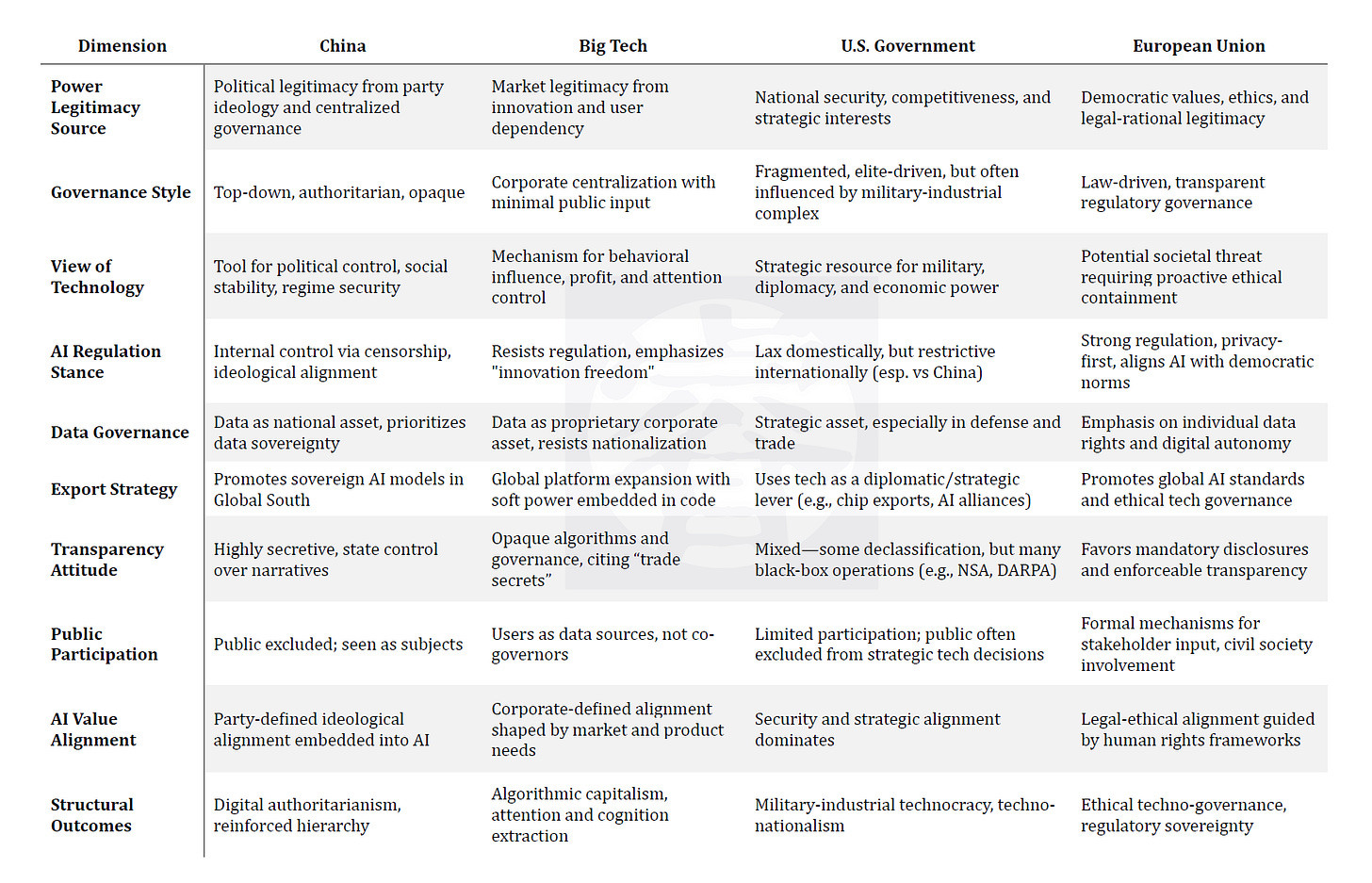 Divergent Power Logics in China, Big Tech, the U.S., and the EU
Taken together, the relationships among China, the United States, the European Union, and major technology companies can be understood through the dual lenses of power logic and power structure. While their respective objectives and systems of authority are often intertwined—sometimes overlapping, sometimes in direct conflict—one striking similarity stands out: both the Chinese government and Big Tech are characterized by highly centralized authority, which they leverage to pursue monopoly and control, albeit in different forms.
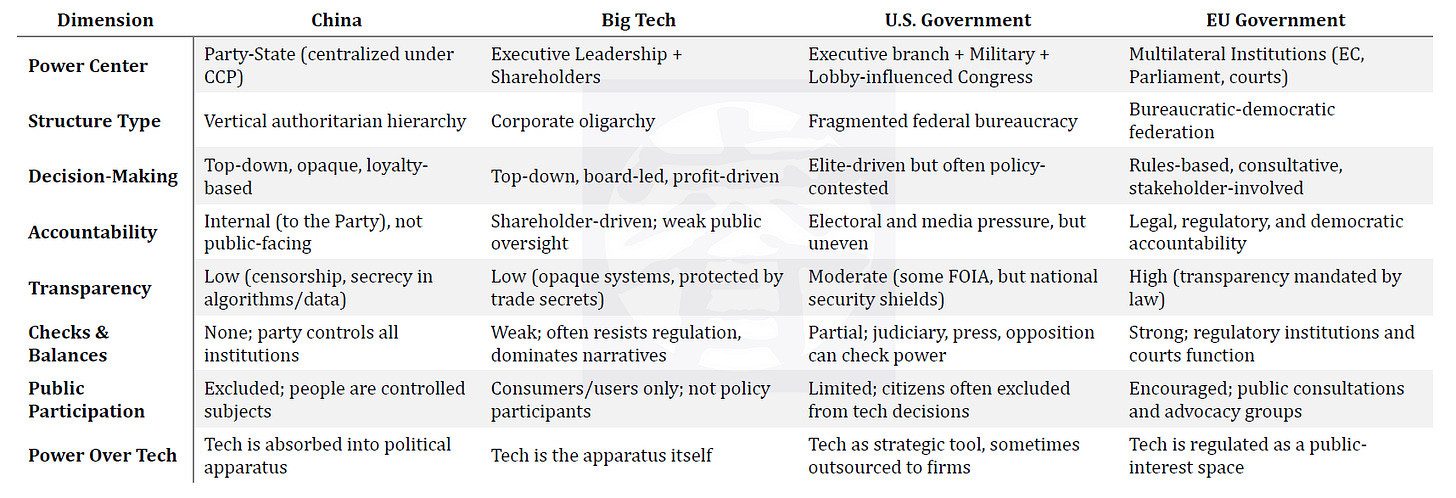 Power Structures of China, Big Tech, the U.S., and the EU
If you like our work, please consider subscribing or buying us a coffee. Thank you!
Read more @ Sinosage.substack.com