
Is learning to code still worth it in an era of advanced AI generation? Industry data and modern engineering workflows reveal a massive shift: the end of the traditional “typist” and the rise of the system architect. Here is why the barrier to entry has changed, and exactly how your learning roadmap needs to adapt for 2026.
Introduction
Every few months, a new headline declares that software engineering is dead. With the rapid evolution of AI agents that can navigate complex, multi-step workflows across entire codebases, it is easy to assume that learning to code is a waste of time.
However, looking closely at how production-grade software is actually built today reveals a different story. Tools like Claude Code, Cursor, and Replit have not eliminated the developer; rather, they have created an explosion of opportunity for those who understand how to handle production-ready architecture and debugging. The profession is not dying — it is undergoing a necessary evolution from manual syntax typing to high-level system orchestration.
The Data: Programmers vs. Software Engineers
To understand the current landscape, it is crucial to separate the hype from the labor data.
Recent analysis of job market trends shows a stark divergence based on job classification. While traditional “computer programmer” roles (historically focused on translating detailed specifications into raw code) have seen significant declines — dropping over 27% in recent years — the broader category of “software developers” remains highly resilient [1].
This data points to a fundamental shift: the market no longer pays a premium for the mere act of typing out syntax. AI has commoditized boilerplate code. However, the market drastically needs engineers who can conceptualize digital systems, design scalable architecture, and ensure security.
The Trap of “Vibe Coding”
A dangerous misconception in 2026 is the idea of “vibe coding” — the belief that anyone can build reliable software simply by chatting with an AI and pasting errors back into the prompt until it works [2].
While this approach might be sufficient for a disposable weekend project, it fundamentally fails in production environments. AI solutions require a human to engineer the structure of the work. If you do not understand the underlying mechanics of the code being generated, you will inevitably hit the “conceptual bottleneck.”
When an AI introduces a subtle memory leak, or when an authentication flow needs to be securely integrated across multiple microservices, vibe coding collapses. There is simply no better way to instruct an AI to code than knowing how the code functions yourself.
The 2026 Learning Roadmap: What Actually Matters
If you are learning to code today, your curriculum should look vastly different than it did five years ago. Memorizing the syntax of a specific language is no longer the primary goal. Instead, the focus must shift toward logic, architecture, and utilizing AI as a 24/7 technical mentor.
Here is what the modern developer must master:
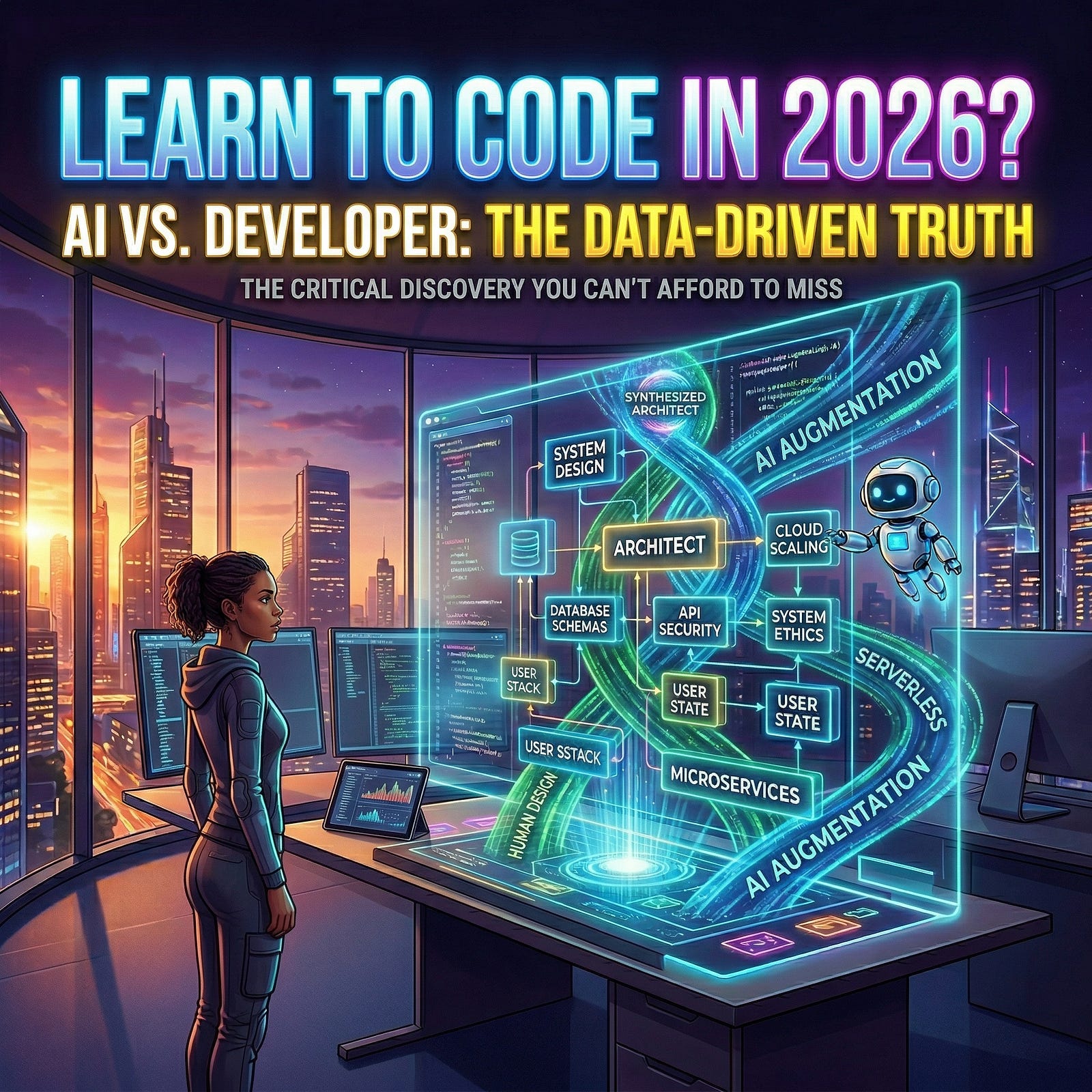
System Design over Syntax: Understanding how the pieces fit together is paramount. For example, when building a modern full-stack application (such as a React frontend paired with a Node.js backend), you no longer need to spend hours writing basic CRUD (Create, Read, Update, Delete) endpoints. AI can scaffold that instantly. Your value lies in designing the database schema, securing the API routes, and managing the application’s global state.
Reading and Auditing Code: You will spend significantly more time reading AI-generated code than writing it from scratch. Learning to quickly spot logical fallacies, security vulnerabilities, and inefficient database queries is a critical skill.
Advanced Prompting and “Plan Mode”: Modern AI coding environments, like Cursor, thrive when given precise technical context. Learning how to write a detailed architecture plan — defining data models, component hierarchies, and strict security rules — before allowing the AI to generate a single line of code is the new standard workflow.
Core Fundamentals: Data structures, algorithms, and core programming logic have not lost their value; they are the vocabulary you must use to communicate effectively with advanced AI agents.
Conclusion
Should you still learn to code in 2026? Absolutely. But you must approach it with a modern mindset. You are not learning to be a human compiler; you are learning the rules of digital logic so you can orchestrate AI tools to build scalable, impactful software. The barrier to generating code has vanished, but the ceiling for what a single, knowledgeable developer can build has never been higher.
References
Bureau of Labor Statistics / Industry Labor Market Predictions for Tech (2024–2034 Data Trends).
Addy Osmani: “Vibe coding is not the same as AI-Assisted engineering.” (Nov 2025).
🚀 Join the Developer Universe
If this post lit a fire in you, don’t stop here. I’m building a community of developers who refuse to be left behind. Connect with me across the digital cosmos for cutting-edge insights, exclusive tutorials, and behind-the-scenes development magic.